

The race to the lunar south pole has entered a decisive phase, shaped by a combination of technical setbacks, commercial ambition, and geopolitical urgency. What was once a distant scientific aspiration has become a contest over scarce, high-value real estate on a body whose surface area rivals that of a continent. The south polar region offers a rare combination of near-permanent sunlight on elevated rims and peaks, which can power solar arrays for months at a time, and permanently shadowed craters nearby that have trapped water ice and other volatiles for billions of years. These resources could sustain long-term human presence, produce oxygen and rocket fuel, and serve as a proving ground for the technologies needed to reach Mars. Yet the geometry that creates these advantages also limits the number of practical landing zones. Only a handful of sites satisfy the strict engineering requirements of gentle slopes, reliable Earth communications, and access to both light and ice. Whoever arrives first and operates successfully can establish a presence that effectively shapes access for everyone who follows.
In late August 2026, China’s Chang’e-7 mission, long positioned as the most sophisticated robotic probe yet aimed at this terrain, suffered an abrupt delay. The spacecraft and its Long March 5 rocket had already been rolled to the pad at Wenchang when officials announced that the mission did not meet launch conditions and could not proceed within the planned window. Weather from a nearby typhoon played a role, but Chinese statements emphasized the principle of absolute success and the need for prudence. The complex payload—an orbiter, lander, rover, and a novel hopper designed to leap into shadowed craters—had been intended to land near Shackleton Crater, one of the most scientifically prized locations. A successful mission would have delivered the first detailed in-situ analysis of polar ice and demonstrated mobility across the challenging landscape. The postponement pushed the flight into 2027, opening a narrow window for competitors.
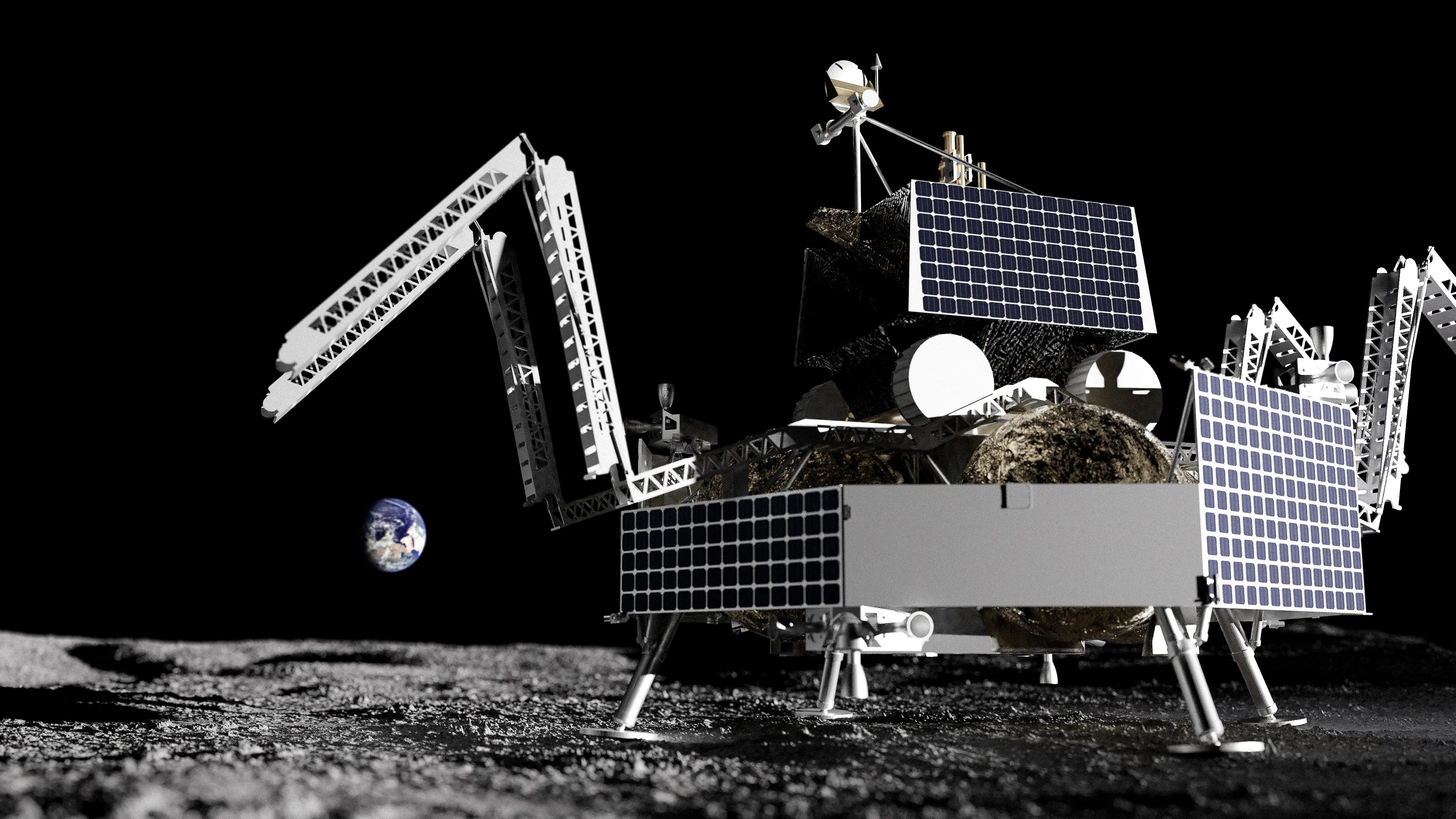
Into that window steps Griffin-1, the infrastructure-class lander developed by Voyager Technologies, formerly Astrobotic. Unlike the high-profile national programs that generate constant public updates, Griffin-1 has proceeded with a quieter commercial intensity. After completing months of environmental testing at NASA’s Jet Propulsion Laboratory—vibration, thermal-vacuum extremes, and acoustic loads that simulate launch and the harsh lunar environment—the vehicle returned to Pittsburgh for final assembly. Its target lies in the Nobile Crater region near Mons Mouton, another of the south pole’s most desirable neighborhoods. Carrying more than 450 kilograms of cargo, including the sizable FLIP rover from Astrolab and instruments from multiple nations, Griffin-1 is designed not merely to land but to deliver usable infrastructure. Its schedule, still aimed at late 2026 or the earliest weeks of 2027 on a Falcon Heavy, positions it as a potential first-arriver if China remains delayed and the American commercial timeline holds.
NASA Administrator Jared Isaacman has framed the stakes with unusual clarity. Speaking in recent months, he has repeatedly described the south pole as a place of limited parking spots. The surface of the Moon may be vast, comparable in area to Africa, but the usable south polar real estate is more like a few neighborhoods in a major city. Elevated ridges and peaks that receive prolonged sunlight while offering proximity to cold traps are rare. Large landers, especially those approaching the scale of future crewed vehicles, will scatter debris and create safety zones measured in kilometers. The first successful presence, particularly one equipped with mobile assets such as rovers and hoppers, can effectively claim operational space. Isaacman has noted that China targets many of the same locations and that an early foothold could complicate or deny access to others. He has spoken of the risk that a rival presence, once established, might restrict the training environment the United States needs for sustained exploration and eventual Mars missions. In his view, the competition is not abstract; it is first-come, first-served on ground that cannot easily accommodate multiple independent operations.
The best landing sites emerge from years of orbital mapping, illumination modeling, and slope analysis. NASA has refined its list for early human missions to nine candidate regions: the Peak near Cabeus B, Haworth, Malapert Massif, Mons Mouton Plateau, Mons Mouton itself, two sections of the Nobile rim, de Gerlache Rim 2, and Slater Plain. These areas balance the competing demands of power, science, and safety. Mons Mouton Plateau stands out for its relative flatness and size, offering flexibility for multiple landings and extended operations. The rims around Nobile and de Gerlache provide strong illumination combined with nearby permanently shadowed regions ideal for volatile prospecting. Malapert Massif offers height and continuous sunlight but steeper approaches. Shackleton’s rim, favored by Chinese planners, remains one of the most compelling for ice access yet is technically demanding. Broader studies have identified more than a hundred potential spots across the polar region that meet basic feasibility criteria, but only a small fraction rank as high priority when all engineering and scientific factors are weighed. In practice, the number of truly premium sites—those capable of supporting sustained power, communications, and resource extraction—is measured in the low dozens at most, and far fewer when the needs of large-scale infrastructure are considered.
The current moment is defined by this scarcity. Griffin-1’s quieter progress and the weather-driven slip of Chang’e-7 have created a temporary opening in a contest that both sides understand as strategic. A successful American commercial landing would place hardware and mobility assets on the surface first, gathering data and establishing operational norms. A Chinese success later in 2027 would still deliver powerful scientific returns and demonstrate the ability to operate complex systems in the polar environment. Neither outcome is assured. Soft landings in this terrain have proven difficult, and schedules remain fluid. What is clear is that the south pole is no longer an open frontier. It is a constrained domain where early presence carries lasting consequences, and the next twelve to eighteen months will largely determine who holds the most valuable ground when human crews eventually arrive.