

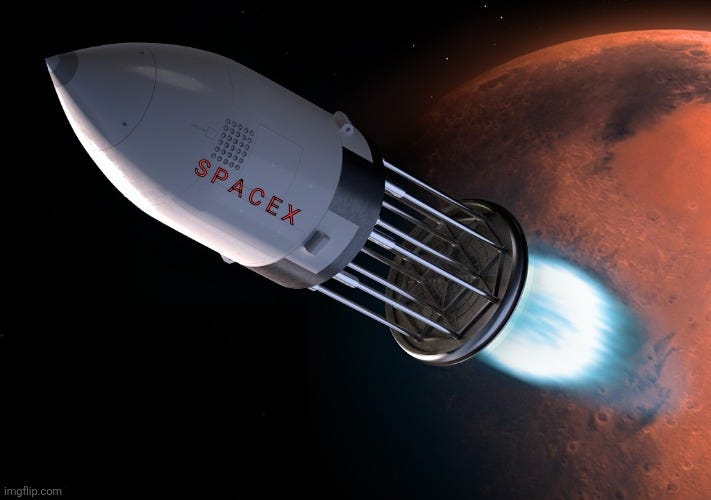
Imagine a ship the size of a small skyscraper rising from the quiet dust of the Moon, or assembling piece by piece in high Earth orbit, then lighting a trail of controlled nuclear pulses across the void. In weeks—not months—it delivers not a handful of containers but entire factories, power plants, and habitats to the surface of Mars. This is not science fiction from the 1950s. It is the nearly forgotten promise of nuclear pulse propulsion, better known as Project Orion, updated for the age of reusable rockets and renewed ambition.
For decades we have accepted that reaching Mars means long, lean voyages. Chemical rockets, even the mighty Starship, must carry enormous amounts of propellant just to push modest cargo across interplanetary space. Nuclear technology changes the arithmetic. Two nearer-term approaches already under development set the stage. Nuclear thermal propulsion (NTP) runs hydrogen through a compact fission reactor, heating it to extreme temperatures and expelling it for roughly twice the efficiency of the best chemical engines. Nuclear electric propulsion (NEP) turns reactor heat into electricity that drives highly efficient ion thrusters, trading raw thrust for even greater fuel economy. Both can cut trip times and increase payload compared with pure chemical systems. Yet neither matches the sheer scale and speed once envisioned for ships powered by nuclear explosions themselves.
The Pulse That Moves Mountains
Project Orion, studied intensively from 1958 to the mid-1960s, proposed something audacious: a spacecraft propelled by a rapid series of small nuclear detonations behind a massive pusher plate. Shock absorbers smoothed the jolt into usable acceleration. The result combined the high thrust of a chemical rocket with the high efficiency normally reserved for electric systems. Specific impulse—the measure of how much push you get from each kilogram of propellant—ranged from roughly 2,000 to 6,000 seconds in the baseline designs, many times better than chemical rockets and still superior to solid-core NTP.
Because the energy comes from nuclear reactions rather than chemical bonds, the vehicles could be enormous. Designers examined several scales:
A “small” 10-meter pusher-plate module, compatible with the Saturn V of its day, could leave Earth orbit weighing a few hundred tonnes and still deliver tens to more than a hundred tonnes of useful payload on a Mars round trip measured in months rather than years.
Larger 20- to 40-meter designs scaled the performance further, carrying hundreds of tonnes while retaining the ability to accelerate briskly.
The most ambitious reference concepts reached thousands of tonnes of gross mass. In theory a single such ship could transport payloads measured in thousands of tonnes—entire industrial starter kits—on fast trajectories that made Mars feel almost local.
Modern analyses of those old studies still show the same striking advantage. Where a chemical architecture might deliver 100 tonnes of landed cargo after many tanker flights and careful refueling, a nuclear-pulse freighter of moderate size could carry several times that mass in one departure, or the same mass far more quickly and with greater reserves. Larger vessels would multiply the difference again. The propellant—specialized pulse units—packs so much energy that the ship’s mass fraction becomes dramatically more favorable. In practical terms, one Orion-class voyage could accomplish what would otherwise require a fleet of conventional ships.
From First Landing to Living World
Cargo is the hidden governor of colonization speed. Habitats, nuclear surface reactors, ice-mining equipment, greenhouses, spare parts, and the machinery to make more machinery all have mass. Every kilogram that arrives sooner, or in greater bulk, shortens the time between a precarious outpost and a self-sustaining settlement.
Faster ships also change the human equation. A one-way transit of a few weeks instead of six to nine months reduces radiation exposure, bone and muscle loss, and the psychological weight of isolation. Crews arrive fresher and can stay longer or rotate more frequently. Pre-deployed infrastructure arrives in larger packages, so the first crews step into something closer to a ready base than a bare landing site. The cumulative effect is compounding: more mass per opportunity means earlier ISRU (in-situ resource utilization) plants, earlier propellant production, earlier expansion of living space. What might take decades of steady chemical logistics could compress into a handful of ambitious campaigns.
Building the Ships: Moon, Orbit, and Starship
The original Orion concepts sometimes imagined launching from Earth’s surface—an idea that raises obvious environmental and political difficulties. Today the more practical paths begin farther out.
Starship and similar heavy-lift vehicles can loft the heavy components—pusher plates, shock-absorber assemblies, structural spars, and magazines for pulse units—into orbit. Once there, robotic and human crews assemble the vehicle in space, free of atmospheric constraints and fallout concerns. A completed Orion would then light its pulses only after reaching a high enough orbit or after departing for deep space.
The Moon offers another attractive staging ground. Lower gravity and the absence of a dense atmosphere make launching large structures easier. Lunar resources—metals, possibly volatiles—could eventually supply structural mass or even components of the pulse units. A lunar shipyard feeding orbital assembly yards would turn the Earth-Moon system into a true shipbuilding complex, with Starships shuttling workers, tools, and refined materials.
In either case the infrastructure required is substantial, yet it is the same class of infrastructure already contemplated for sustained lunar presence and Mars logistics. Nuclear pulse propulsion simply raises the payoff for building it.
The Legal Horizon
Two treaties stand in the way. The 1963 Partial Test Ban Treaty prohibits nuclear explosions in the atmosphere, outer space, and underwater. The 1967 Outer Space Treaty forbids placing nuclear weapons or other weapons of mass destruction in orbit or otherwise stationing them in outer space, and it requires celestial bodies to be used exclusively for peaceful purposes. Nuclear pulse units are, at root, specialized nuclear explosives. Even if intended solely for propulsion, their use collides with these agreements.
Changing the legal regime would require deliberate, high-level action: amendments or carefully drafted exceptions that distinguish peaceful propulsion from weapons, perhaps restricting detonations to deep space or to trajectories that pose no risk to Earth, and establishing verification and liability rules. Such changes would need broad international buy-in or at least acquiescence from other spacefaring powers.
Among recent American presidents, Donald Trump is the most plausible figure to attempt it. His administration already elevated space as a national priority, created the Space Force, and showed a willingness to challenge existing international frameworks when they were seen as obstacles to American leadership. The Trump administration, or a successor administration in the same mold, would be more likely than most to treat the treaties as living documents subject to renegotiation in the name of rapid expansion beyond Earth. Whether that political will materializes, and whether other nations would accept the revisions, remains an open question. The technical case, however, has always been clearer than the diplomatic one.
A Different Sky
Nuclear pulse starships will not replace every chemical or nuclear-thermal vessel. They are tools for the heavy lifting—the moment when humanity decides that Mars should receive not probes and flags but the seeds of a second home. The engineering challenges remain real: materials that can endure repeated blasts, reliable pulse-unit production, radiation protection, and the sheer complexity of assembling something so large. Yet the underlying physics was taken seriously by some of the best minds of the mid-twentieth century. What stopped Orion was not a failure of calculation but a failure of permission.
If that permission is ever granted, the numbers change. Cargo capacity rises by factors that turn logistics from a bottleneck into an accelerator. Transit times shrink until Mars feels closer. Colonization timelines that once stretched across generations could fold into decades. The ships themselves—whether modest 10-meter workhorses or vast multi-thousand-tonne freighters—would stand as proof that the solar system is not a barrier but a domain we can cross with purpose and power.
Project Orion was never only about bombs and plates. It was about refusing to accept that the distance between worlds must remain an obstacle measured in years and scarcity. In an era of reusable rockets, lunar return, and renewed talk of permanent presence beyond Earth, the old idea is waiting for a second chance. Whether it receives one will depend as much on law and leadership as on engineering. But if it does, the first true nuclear starships will not merely visit Mars. They will help make it home.