

This is a follow up story to an interview I conducted for SpaceDaily long ago and if anybody is interested you can find that ancient archived original article here:
https://spacedaily.com/the-nuclear-heart-of-the-earth/
I had the pleasure of interviewing Professor Herndon over 20 years ago about his georeactor theory. It was 2003, the year The Core hit theaters — that gloriously absurd disaster film in which a team of scientists drills to the center of the Earth to restart a stalled inner core with nuclear weapons before the planet’s magnetic field collapses entirely. Herndon had served as a scientific advisor on the production, and when I caught up with him fresh from the film’s red carpet premiere, I found a man genuinely delighted by the novelty of being treated, for one evening at least, like a movie star rather than a geochemist working largely outside the mainstream. He told me it was quite a boost for science to be paraded past the cameras alongside Hollywood’s leading names. I doubt many working scientists ever get that particular experience.
What struck me most, though, wasn’t the Hollywood glamour. It was how quietly confident he was that decades of accumulating evidence would eventually vindicate an idea most of his colleagues had spent thirty years politely ignoring.
From Gas Giants to a Reactor at the Center of the World
Herndon’s path to the georeactor hypothesis didn’t begin with Earth at all — it began with a puzzle astronomers had noticed in the late 1960s and never fully resolved: Jupiter radiates roughly twice as much energy into space as it receives from the Sun. Saturn and Neptune showed the same strange excess. For twenty years, the explanation planetary scientists settled on was leftover heat from each planet’s original gravitational collapse, some 4.5 billion years in the past. When Herndon began seriously turning the problem over around 1990, that answer didn’t sit right with him. Jupiter is nearly all hydrogen and helium — both superb conductors of heat — and it seemed implausible to him that primordial warmth could still be leaking out, undiminished, after four and a half billion years of highly efficient cooling.
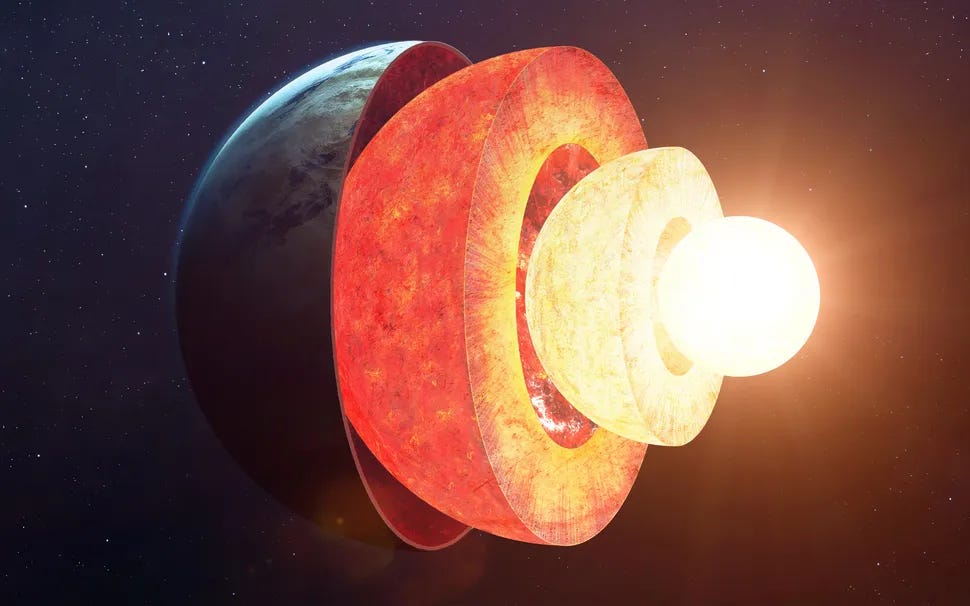
His alternative was a genuinely novel one: planetary-scale nuclear fission reactors, forming naturally at the gravitational centers of large enough bodies wherever sufficient concentrations of uranium and thorium could accumulate. He published the gas giant work first, then in 1993 extended the same logic to our own planet, proposing that Earth’s solid inner core conceals a small, dense sphere of uranium — a natural fission reactor he called the georeactor — quietly generating heat, and, in his view, powering the geomagnetic field itself.
The Case For
The strongest evidence Herndon has pointed to over the decades comes from helium. Basalts erupted from deep mantle sources at places like Hawaii and Iceland carry a curious signature: elevated ratios of helium-3 to helium-4, higher than standard planetary formation models comfortably explain. In 2001, Herndon and physicist Daniel Hollenbach ran the first full numerical simulation of a deep-Earth reactor and found it produced helium isotope ratios strikingly close to what’s actually measured in those volcanic rocks — a result later refined by researchers at Oak Ridge National Laboratory. It remains, to this day, the single strongest pillar under the hypothesis.
There’s also real historical precedent for natural fission itself, which is easy to forget is not some exotic impossibility. In 1972, French analysts discovered that an ore sample from the Oklo deposit in Gabon showed clear signs of having undergone sustained nuclear fission roughly two billion years ago — entirely without human involvement. Billions of years ago, natural uranium carried a far higher proportion of the fissile isotope U-235 than it does today, and under the right geological conditions — groundwater acting as a neutron moderator, sufficiently porous, uranium-rich ore — a natural reactor could ignite and sustain itself. Oklo proves the underlying physics is sound. It happened once, here, that we know of.
The Case Against
But proving natural fission can happen at a shallow ore deposit is a long way from proving it happens, at planetary scale, at the very center of the Earth — and this is where most geochemists part ways with Herndon.
The central objection concerns chemistry, not physics. During Earth’s early molten differentiation, elements didn’t simply sink by weight into a waiting core; they partitioned between two immiscible liquids — molten iron and molten silicate rock — according to chemical affinity. Gold, lighter than uranium, overwhelmingly followed the iron into the core, because it forms metallic bonds. Uranium, under the oxidizing conditions most geochemists believe characterized the early solar nebula, bonds instead with oxygen, forming an oxide that dissolves into the buoyant silicate mantle rather than sinking with the metal. On the standard model, the vast majority of Earth’s uranium and thorium never had a plausible pathway to the core at all.
Separately, physicists have been able to test the hypothesis directly rather than argue about it in principle. A functioning georeactor of the size and power Herndon’s models require should produce a detectable flux of antineutrinos, and detectors like KamLAND and Borexino are sensitive enough to catch exactly that signature. Successive experimental runs have progressively tightened the ceiling on how much power any hypothetical central reactor could be generating, squeezing the plausible range well below what his early models called for. A direct academic reassessment by Degueldre and Fiorina went further still, concluding that the reactor’s formation and continued operation appear physically unlikely under standard assumptions.
The Reduced Nebula, and How Strong the Evidence Really Is
Herndon’s answer to the chemistry objection is itself a real, serious scientific claim, not a dodge. He argues that Earth did not form under the oxygen-rich conditions most geophysics assumes, pointing to enstatite chondrites — a rarer class of meteorite formed under markedly lower-oxygen conditions — as a closer chemical match to Earth’s interior than the more commonly cited ordinary chondrites. Under sufficiently reducing conditions, he argues, uranium would behave less like an oxygen-loving element and more like an iron-loving one, riding the metal down into the core alongside it.
This isn’t fringe invention on his part. Mainstream cosmochemistry has, over the past fifteen years or so, genuinely shifted somewhat in this direction — isotopic studies, particularly of calcium-48 ratios, have lent real support to the idea that Earth’s building blocks were more reduced than once assumed. Herndon saw a real pattern before much of the field caught up to it.
Where the evidence still falls short of rescuing his specific claim is in the numbers. Even researchers who take the reduced-Earth picture seriously have run laboratory metal-silicate partitioning experiments under those more reducing conditions, and they still find only minor, trace amounts of uranium entering the metallic phase — nowhere near the wholesale actinide migration his georeactor requires. The meteorite evidence has moved toward him. It hasn’t moved nearly far enough.
Conspiracy, Convection, and the Cost of a Radical Idea
Herndon has never been shy about naming what he believes is really going on: a scientific establishment defending careers and reputations built on theories he considers wrong. It’s a charge worth taking seriously enough to examine rather than dismiss outright, and worth being honest about, too — the geomagnetic dynamo, mantle convection, and plate tectonics rest on an enormous, independently cross-validated body of evidence: seismic tomography that images mantle flow directly, GPS measurements that clock plate motion in real time, magnetic striping on the seafloor that records reversals like tree rings. Herndon’s later work doesn’t just propose an alternative energy source for the core — it argues for discarding mantle convection and plate tectonics altogether, a far larger claim than the georeactor alone, and one that asks the field to abandon far more than most of his other evidence would justify.
Whether that reflects institutional bias or simply a step too far even for an otherwise defensible hypothesis is a judgment I’ll leave to the reader. I only know that he has funded a great deal of this research himself, on his own conviction, for over thirty years.
What Tectonics Teaches Us About Waiting
It’s worth remembering that plate tectonics itself spent the better part of half a century as a fringe idea. Alfred Wegener proposed continental drift in 1912 and was largely dismissed, sometimes ridiculed, by the geological establishment of his day — until seafloor spreading evidence in the 1960s turned decades of confident rejection into the bedrock of modern Earth science almost overnight. The lesson isn’t that every rejected idea is secretly correct. It’s that scientific consensus, for all its genuine value, has been wrong before, for decades at a stretch, and that being outside it is not, by itself, evidence of being wrong.
Twenty years after our conversation, the georeactor hypothesis remains exactly where it was: neither proven nor disproven. The helium isotope evidence hasn’t gone away. Neither has the neutrino data constraining it, nor the chemistry that makes the Earth-specific version of the claim difficult to sustain. What has become clearer to me, writing this now, is that the underlying physics — a natural nuclear reactor forming and sustaining itself at a planetary center — is genuinely sound. Oklo proved it can happen. The only real question was ever whether it happened here.
Perhaps it didn’t. The specific, falsifiable version of Herndon’s claim — Earth, Jupiter, Saturn, this solar system, these measurements — has had thirty years to be vindicated by the evidence, and so far the evidence has mostly pushed back. But our solar system is one system, around one ordinary star, and the galaxy holds many hundreds of billions more, orbited by planets numbering in the trillions. Somewhere among that staggering multitude, under just the right combination of actinide abundance, formation chemistry, and timing, the conditions Herndon describes must surely be met — not everywhere, perhaps not even commonly, but somewhere. If that’s true, then Herndon may not be wrong so much as premature: not the man who discovered what powers our own planet, but quite possibly the first to correctly describe a phenomenon that is real, and physically sound, and simply happening somewhere else.
I don’t know if Professor Herndon is right about the Earth. Nobody does yet, with certainty, in either direction. But I’ve thought about our conversation many times over the past twenty years, and I suspect I will go on thinking about it for twenty more — which is, in the end, exactly what a good scientific question is supposed to do to a person.