

The headlines this year belong, almost entirely, to industrial humanoids. Tesla’s Optimus sorting battery cells in Fremont. Figure’s robots taking up positions on automotive assembly lines. Agility Robotics moving totes through warehouses for Toyota and other major logistics operators. It is a genuinely remarkable story, and it is being told correctly as far as it goes. But it is also, if we are honest about the words we are choosing, a story being told with a borrowed and slightly too-small vocabulary.
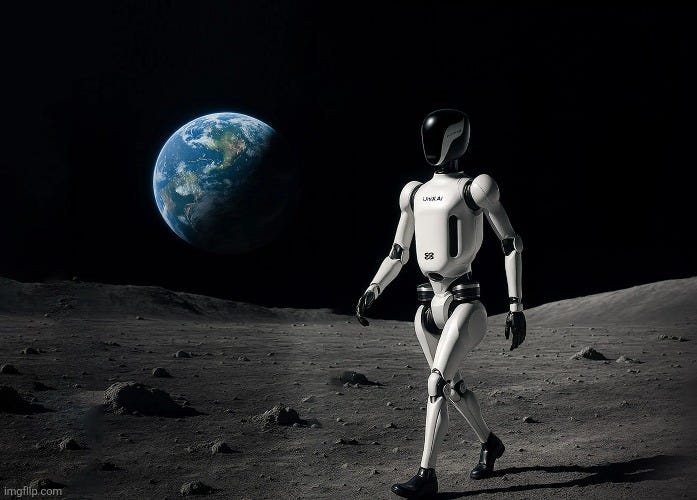
Calling this moment the rise of the “manufacturing humanoid” or the “factory humanoid” is not wrong, exactly. It is simply describing the entrance hall and calling it the building. Manufacturing, as any operations textbook will tell you, is a subset of a much larger category: production. Production includes manufacturing, yes, but it also includes design, quality control, logistics, distribution, and the delivery of services all the way to a final customer. A humanoid that welds a car door is doing manufacturing work. But the same underlying machine, wearing a different set of skills, could just as easily be moving that car through a dealership showroom, assisting in the hospital where its owner is later treated, working the fields that grew the cotton in its owner’s clothes, or standing beside astronauts on a future lunar outpost. The correct word for a machine capable of all of that is not “factory robot” with a new coat of paint. It is a production humanoid — a general-purpose worker built for the entire economy, not one corner of it.
A Body Built for Every Room Already Built
What makes this shift different from every wave of automation that preceded it is not cleverness alone. Traditional industrial robots, the fixed arms that have populated factory floors for half a century, are extraordinarily good at one narrow task performed the same way, ten thousand times a day, inside a cage built specifically to contain them. They could never simply walk into a hospital ward, a farmhouse, or a hotel room, because the world was never built for their shape. A humanoid, by contrast, is built on purpose to fit the one shape every workplace on Earth already accommodates: ours. It climbs the same stairs, opens the same doors, holds the same tools, and stands at the same counters that a human worker would. That single design decision — form matched to an environment that never had to change — is what allows the same basic platform to move fluidly from a factory floor to a warehouse aisle to a kitchen to, eventually, almost anywhere human labor has ever been needed. Intelligence supplies the adaptability; the humanoid form supplies the access. Together, they produce something the specialized robot of the last fifty years never could: a worker that does not need its world redesigned around it.
That is why the current wave of industrial deployments, real and impressive as they are, is best understood as a beginning rather than a destination. Machines that today sort battery cells and stack warehouse totes are already being demonstrated folding laundry, tidying living rooms, and handling hotel housekeeping in early pilot programs. NASA has spent two decades quietly developing its own robonaut lineage for work in space, precisely because the same logic that applies on a factory floor applies equally well on a space station: humanoid form lets a robot use tools and interfaces that were designed for human hands, without redesigning an entire spacecraft around a different kind of machine. Social and companion-oriented androids, still early and often unsettling in their present form, point toward yet another branch of the same tree. Industrial humanoids are the first, most visible chapter of this story, not its conclusion.
An Old Pattern, Wearing a New Face
It is uncomfortable, but not inaccurate, to note that every great expansion in human material prosperity has rested on some engine of cheap labor. Ancient civilizations built their monuments, their agriculture, and their armies on the backs of enslaved people, a moral catastrophe that took millennia to even begin to reckon with. When that engine was abolished, in one of the genuine triumphs of the modern era, economies did not stand still; they found other engines. Horsepower, in its literal sense, carried enormous shares of transport, agriculture, and industry for another century. Then came the machines that made even the horse obsolete for most purposes: the automobile, the tractor, the assembly line. Each transition displaced an old form of labor and, in doing so, lowered the cost of nearly everything that labor had touched, from food to transportation to finished goods, raising living standards for enormous numbers of people who had no direct stake in the machines themselves.
Production humanoids are positioned to be the next link in that same chain, and quite possibly the largest one yet. What separates this transition from the ones before it is scope. The steam engine replaced muscle. The assembly line replaced repetition. But no single prior invention has offered a plausible path toward replacing the cost of human labor itself, across nearly every industry simultaneously, rather than within one. A machine that can plausibly work a construction site, tend a field, staff a hotel, assist in a hospital ward, and staff a factory line is not an improvement to one industry’s cost structure. It is a proposed reduction to the baseline cost of production everywhere at once.
The Economics of Abundance
Labor has always been one of the largest, stickiest costs embedded in the price of nearly everything people buy. It shows up in the price of groceries, in the cost of a hotel stay, in the fee for a hospital procedure, in the sticker price of a car, layered in at every single stage between raw material and finished product or service. If a capable, adaptable, humanoid worker can be built, powered, and maintained at a cost meaningfully below what it costs to employ a person for the same work, then that cost layer does not simply shrink in one industry. It compresses simultaneously across almost the entire economy, because nearly every product and service passes through some stage of human labor on its way to a customer. Elon Musk has taken to calling the endpoint of this trajectory an age of abundance, a world in which the scarcity that has organized economic life since the beginning of recorded history — not enough hands to do all the necessary work — finally begins to loosen its grip.
It is worth being honest that no one can promise this transition arrives smoothly, or arrives at all on the timeline its most enthusiastic advocates predict. Every past labor transition, including the ones that ultimately made societies richer and freer, was also disruptive, uneven, and painful for the people caught in the middle of it. A shift of this scale will raise real and difficult questions about work, purpose, and distribution that cheaper production costs alone will not answer. But the underlying economic logic is neither speculative nor new. It is the same logic that has driven every previous leap in material abundance, applied now to a machine general enough, for the first time, to touch nearly every industry at once rather than just one.
Naming the Thing Correctly
Words shape how clearly we see what is actually happening, and right now the vocabulary lags behind the ambition. Calling this moment the rise of the factory humanoid or the manufacturing humanoid captures the opening scene and mistakes it for the whole story. The medical assistant, the farm worker, the hotel housekeeper, the astronaut’s robotic counterpart, and the welder on an assembly line are not five separate categories of machine arriving by coincidence in the same decade. They are five early expressions of a single, broader category still in the process of being built: the production humanoid, a general-purpose worker for a general-purpose economy. Industrial humanoids grabbed the headlines first because factories were simply the easiest place to start. What comes after is not a footnote to that story. It is the story, and it is only just beginning.