

Sunlight is abundant in space, yet it is not always enough. In the outer solar system, solar power falls off dramatically. On the Moon, the night lasts two weeks. In permanently shadowed polar craters, the Sun never rises. For long-duration missions and future surface bases, engineers have long turned to nuclear power.

Two main approaches dominate current plans: radioisotope systems that convert heat from radioactive decay into electricity, and fission reactors that split atoms to produce far higher power levels. Both are moving from heritage technology into new roles supporting Artemis, lunar outposts, and eventual missions to Mars.

The Proven Workhorses: Radioisotope Power

Radioisotope thermoelectric generators, or RTGs, have flown for decades. They use the heat from the natural decay of plutonium-238 to generate steady electricity through thermocouples, with no moving parts. Voyager 1 and 2, still operating more than 45 years after launch, rely on them. So do the Curiosity and Perseverance rovers on Mars and several outer-planet missions.

RTGs provide modest power—typically tens to a few hundred watts—but they work continuously regardless of sunlight or temperature. Newer designs and alternative isotopes are under study to stretch limited plutonium supplies and support commercial lunar landers that must survive the long night. These systems remain the practical choice for probes and smaller surface assets that need reliable, long-lived power in the tens-of-watts range.
Fission Power for the Surface

Human outposts and industrial-scale operations demand far more energy. NASA, working with the Department of Energy, is developing fission surface power systems intended to deliver continuous electricity on the Moon and later Mars. Current goals call for a lunar reactor demonstration by around 2030, with power outputs in the range of tens to roughly 100 kilowatts—enough to support habitats, rovers, resource processing, and scientific instruments through the lunar night and in shadowed regions.

These compact reactors would use high-assay low-enriched uranium and operate for years without refueling. Waste heat must be rejected in vacuum, coolant behavior managed in low gravity, and the entire system kept light enough for lunar landers. Successful demonstration on the Moon would open the path to higher-power systems needed for sustained Mars surface operations.

Nuclear Propulsion and Pathfinder Missions

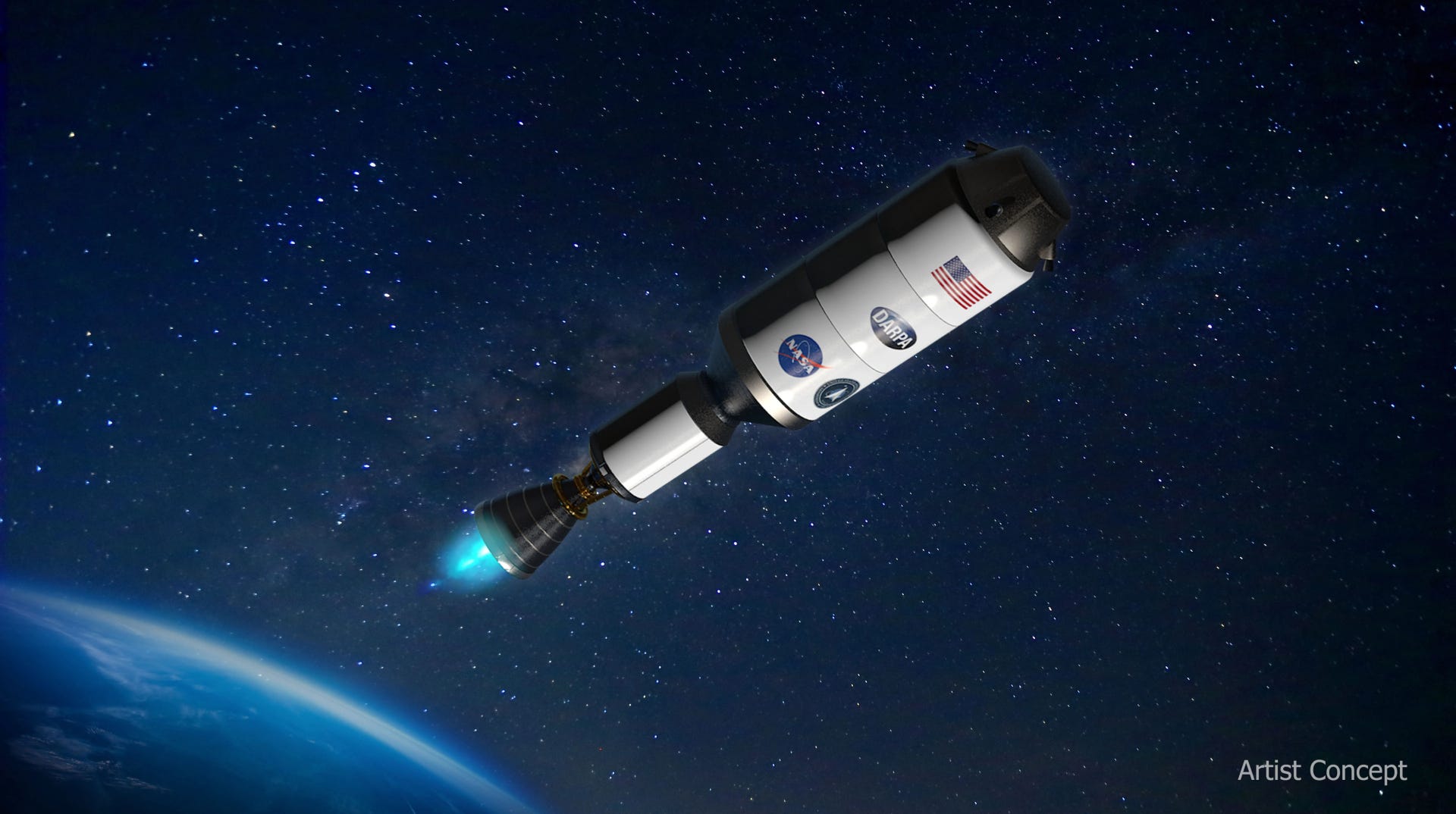
Nuclear technology is also advancing for in-space propulsion. Nuclear electric propulsion uses a reactor to generate electricity that drives efficient ion or Hall thrusters, enabling higher payload fractions and faster trip times for deep-space missions. NASA has outlined a pathfinder spacecraft, sometimes referred to as Space Reactor-1 Freedom, that would demonstrate nuclear electric propulsion on a trajectory toward Mars later this decade while also maturing reactor technology relevant to surface power.

Earlier nuclear thermal propulsion efforts, which heat propellant directly with a reactor for higher thrust, have seen fluctuating support. The core challenge remains the same: proving reactors can be launched, started, and operated safely and reliably far from Earth.

Challenges Ahead

Space nuclear systems face unique hurdles. Mass and volume are tightly constrained by launch and landing capabilities. Radiation must be shielded from crews and electronics. Regulatory approval, public acceptance, and international coordination add complexity. Fuel availability, especially for radioisotope systems, remains a practical limit. Cost and schedule pressure are constant.

Yet the physics is compelling. Solar arrays struggle in polar darkness or at large distances from the Sun. Chemical batteries and fuel cells are finite. Nuclear power offers continuous output measured in years rather than days or weeks. As plans for lunar bases and crewed Mars missions solidify, that continuous power is shifting from optional to essential.

The next few years will test whether compact fission reactors can move from design studies and ground tests into flight hardware. If they succeed, the Moon and eventually Mars will gain a power source that does not depend on the Sun—opening longer stays, more ambitious science, and the first steps toward industrial activity beyond Earth.