

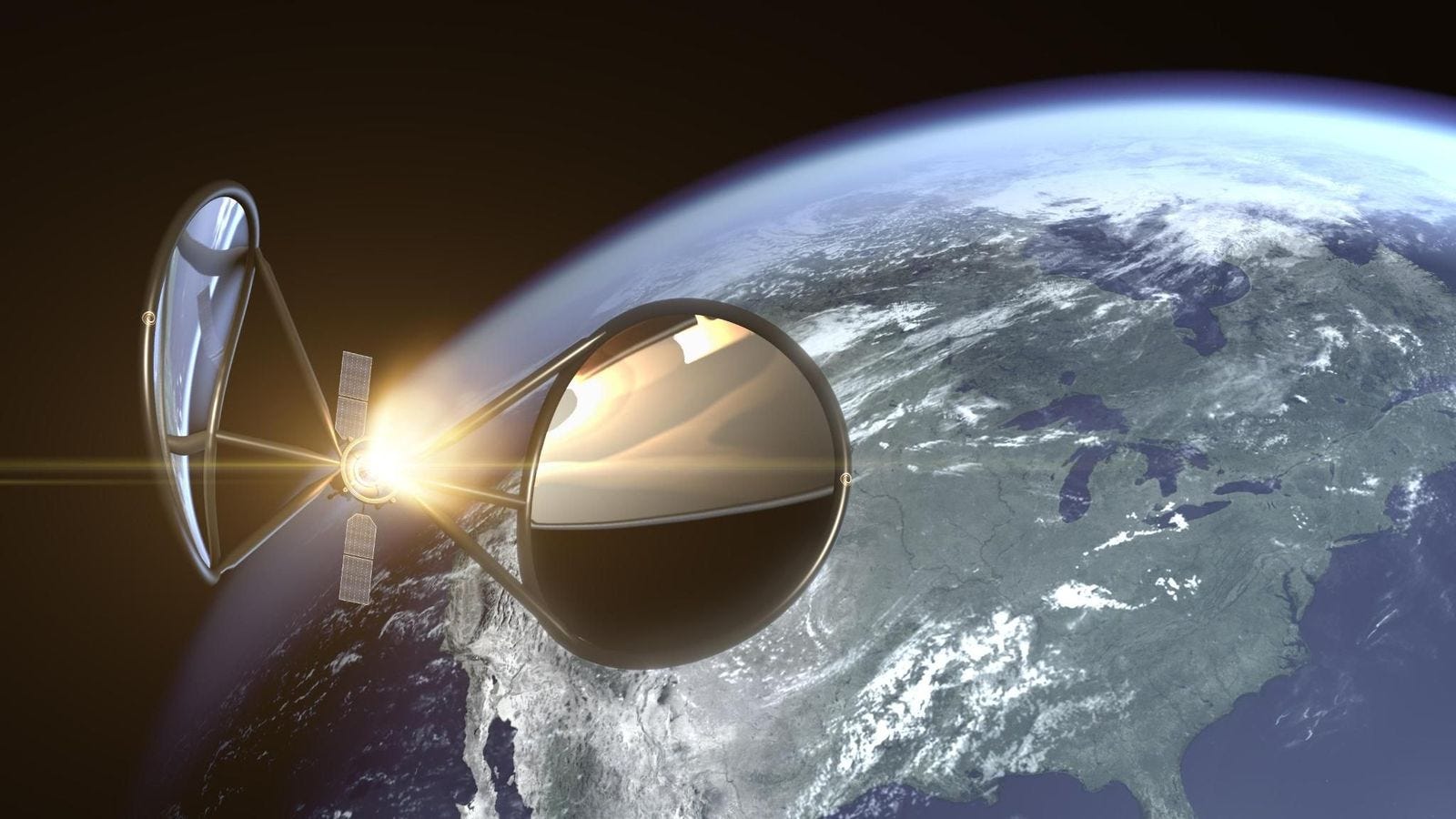
In the vast and increasingly crowded expanse of near-Earth space, most spacecraft have long been tethered to fixed paths. They drift in carefully chosen orbits, using limited propellant only for gentle station-keeping or slow, energy-efficient transfers that can stretch across weeks or months. Portal Space Systems, a Bothell, Washington-based company founded in 2021, is determined to change that paradigm. At the heart of its vision stands Supernova, a spacecraft powered by solar-thermal propulsion that promises to turn the Sun itself into a high-performance engine for rapid, sustained movement across the orbital regimes of Earth and beyond.
Led by Jeff Thornburg, a propulsion engineer who previously contributed to SpaceX’s high-performance engines, Portal has revived and refined a concept studied by NASA and the Air Force for decades but never brought to operational reality in the commercial sector. Solar-thermal propulsion works by concentrating sunlight with large, deployable mirrors onto a compact, 3D-printed heat exchanger thruster known as Flare. The intense heat—reaching temperatures of around 1,500 degrees Celsius in ground tests—warms a storable ammonia propellant. As the heated propellant expands and races through a nozzle, it generates thrust that combines the responsiveness of traditional chemical systems with efficiencies approaching those of electric propulsion, all without the complexity or regulatory hurdles of nuclear options.
The result is a vehicle capable of delivering up to six kilometers per second of delta-v—enough change in velocity to leap from low Earth orbit to medium Earth orbit in a matter of hours, from medium to geostationary orbit in under a day, or from low Earth orbit into cislunar space within a few days. A thermal battery integrated into the system stores heat so that maneuvers remain possible even when the spacecraft passes through Earth’s shadow. Unlike conventional satellites designed primarily to stay put, Supernova is built to move repeatedly and purposefully over a projected operational life of more than five years, and its architecture supports the possibility of eventual refueling.
This capability arrives at a pivotal moment. Commercial constellations continue to multiply, raising the stakes for collision avoidance and responsive servicing. National security operators face the need for space domain awareness and the ability to reposition assets quickly in an uncertain geopolitical environment. Debris removal, on-orbit inspection, and the delivery of critical payloads across widely separated orbits all become far more practical when a spacecraft can answer the call in hours rather than months. Portal envisions fleets of such vehicles providing mobility as a service—acting as agile platforms that can protect, observe, or transport on demand.
Progress has been steady and deliberate. Portal successfully demonstrated its Flare thruster at full power under vacuum conditions, validating performance under flight-like temperatures. Smaller precursor systems, including the Mini-Nova technology demonstrator and the upcoming Starburst vehicle, have begun building flight heritage and refining critical subsystems. In August 2026 the company announced a major milestone: a dedicated SpaceX Falcon 9 launch in 2028 for the first full Supernova spacecraft on a mission named Motus Via Sol—“movement with the sun.” Excess capacity on that flight will be offered to rideshare customers through a partnership with Maverick Space Systems, with Supernova’s own maneuverability potentially allowing flexible deployment orbits after separation.
The company is scaling its manufacturing footprint in the Seattle area to support production rates that could eventually reach one vehicle per month. Backed by private investment and significant interest from the U.S. Space Force, Portal is positioning solar-thermal propulsion not as an experimental curiosity but as a practical tool for the next era of space operations. By drawing power directly from the Sun rather than carrying all energy in chemical form or converting it inefficiently through solar arrays and ion engines, Supernova offers a pathway to higher performance at lower long-term cost.
What emerges is more than a new spacecraft design. It is a reimagining of what it means to operate in space. For decades the orbital environment rewarded patience and predictability. Portal Space Systems is building the tools for agility and initiative. When the first Supernova unfurls its concentrators and feels the focused warmth of sunlight driving it toward a new destination, it will mark more than a technical demonstration. It will signal that the age of truly mobile spacecraft has begun—vehicles free to answer the dynamic needs of a rapidly evolving space domain, guided by the same star that has always lit our path outward.
Interesting idea, though the possibility of satellites now being able to change their orbits will add to the complexity of mission. The orbital 1-way highway will now become an orbital intersection.