

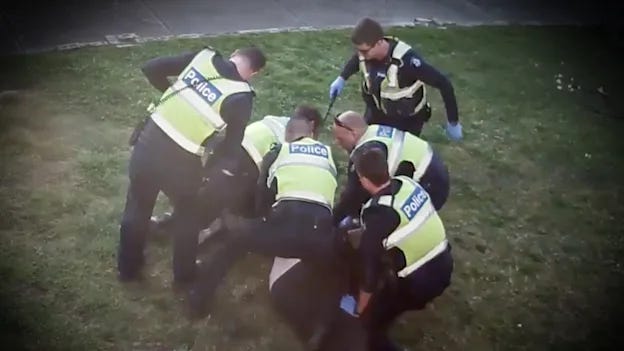
Victorian Police beating up a disabled pensioner at the front of his home after luring him outside. Unaware that he had CCTV.
We often hear about government corruption in faraway states like China, Russia, North Korea and other dictatorships. We also hear about police corruption in poverty stricken places like India or South America. We often ask ourselves how people put up with such blatant disregard for human rights in these backward nations. Why don’t they rise up and overthrow these abhorrent criminals?
It is because such institutions frequently control the media and many citizens have been brainwshed into thinking it is unpatriotic to question the powers that be. It is also because people are afraid to be the first to stand up and face the full fury of these evil empires. Even talking about it can lead to prosecution for treason or even murder.
But what about here in the West?
I could cite historical accounts of famous crimes by police but those have already been written about in depth many times before. I could list the disgraceful number of aboriginal deaths in custody but again it would just be repeating already heavily covered reports. So here is my own personal account of how I learned that police corruption isn’t restricted to “other countries” and how a blue wall of silence is maintained by these two faced monsters.
The first time I published this online I was warned by numerous people that I was making a big mistake and people in australia just didn’t talk about police corruption. They warned me the police would probably have me killed. I decided to do it anyway.
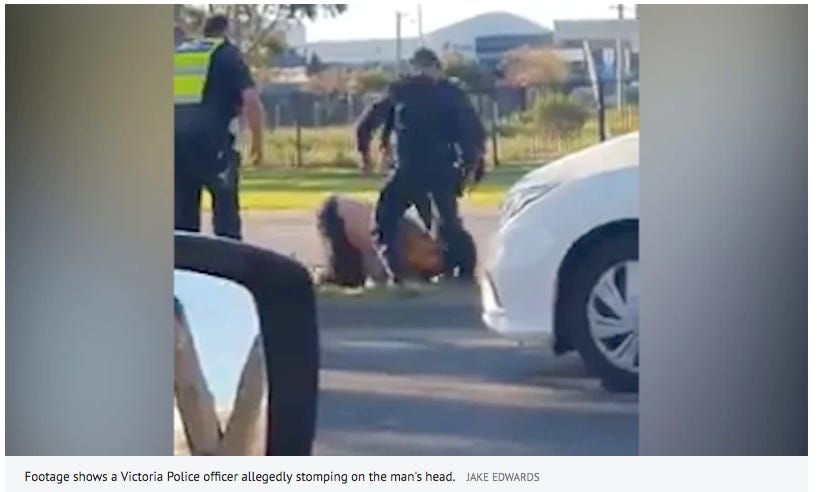
Australian Police Brutality and the Culture of Silence.
By Wayne Smith
When I came to Australia back in 1989 I was a naive 18 year old from a small country town in Norfolk, England. I had no criminal record and had tried to join the Melbourne Police. I was told I would need to aquire a drivers licence before I could qualify. I worked at a nightclub to pay the rent and moved into a backpackers in Preston. I was an Australian by birth but my family had moved to England when I was 5 years old. So Australia was a fascinating place to me where people spoke in an accent and Melbourne seemed huge.
One of the managers at the backpackers was a Tasmanian lady whom I hardly knew but sometimes paid my rent to. It was therefore a surprise when she rang up from the central city asking for me. She told me she had spent all her money on grog and asked if I would pay for her taxi home. Being a gentleman I agreed to do so. It was only a few dollars and I figured it couldn’t hurt to make a new friend.
The next day her boyfriend came to my room to thank me. He then asked if I wanted to come for a drive with him, his girlfriend and another guy staying there. I had nothing planned that evening and agreed to go along. I didn’t know many people in Melbourne and I thought it might be fun. Unfortunately they neglected to mention the small matter of the car being stolen.
It was the scariest drive of my life. A truck was rammed at one point on a dare. I think we ran over a cat. They stopped at a carpark to steal another car because they were low on petrol and I figured this was an opportunity to get away from these people. I didn’t want to offend them. We all lived at the same address but they clearly lived in a different world to me.
The Police arrived before I could even figure out which way to start walking. They were from Flemington Police Station and I recall one officer tapping me hard in the chest with a Maglight as he interrogated me. I instinctively reached up and held the torch to stop this from happening. The officer then screamed in my face to leave his torch alone. It was surreal. Police were everywhere and their menacing manner had me very frightened. Having taken our details they then bundled us into a paddy wagon. The nightmare had only just begun.
Sitting together in the back of the vehicle we talked about what was going to happen next. I was clueless but the others were experienced felons and soon filled me in on what to expect. They told me we had been arrested by Flemington Police and this was very bad. We would be beaten up at the station and if I defended myself I’d get beaten even harder as well as charged with assault.
I was incredulous. I certainly didn’t believe them. Yet I was terrified. We could hear the police in the front laughing as they drove over speed humps at high speed. This caused us to crash our heads into the roof of the wagon each time. As soon as we arrived at the station everyone was separated. I was kept just inside the entrance. A line of police stood almost at attention staring off into space while a short police officer confronted me. It was like something out of a movie.
He stood facing me and said. “We can do this the easy way or the hard way.” He then proceeded to punch me in the stomach. I used to be an amateur boxer and it was a surprisingly weak effort but I wasn’t an idiot. I realised that bravado would only lead to harder punches. So I screamed my lungs out and begged for help.
They took me to a small back room and chained me to a desk. I had never been so angry in my life. I knew I had the right to remain silent and chose not to say a single word to these cowardly thugs. So they began torturing me. Every time they ripped hair out of my scalp or punched me I started screaming and every time they tried to talk nicely to me I ignored them. The only time I spoke was to tell them they were lowlife. Which ofcourse elicited more violence.
My mind turned to escape and during one of the periods I was left alone I tried to break out through the window. I wriggled a nail loose which was surprisingly easy. I think it had been tried many times before. Then I used it to cut through the mesh enclosing the window. I was almost home free I figured. Then I realised the desk was concreted down.
At one point they took me to a cell where one of the others was also being held. I asked him to look after my wallet as he had already been searched and I didn’t want these animals knowing my identity. With a name like Smith I figured it might be possible to disapear if all they had was a name. He just shook his head. Then the door burst open and a huge police officer came in. I remember a boot and then it becomes blurry. I was told the next day that the officer kicked me in the head and I flew across the cell. I must have passed out.
The next thing I recall is being back in the small room. A lady passed by in the coridoor outside and I called out for help. I thought she might be a lawyer as she wasn’t wearing a uniform. She just laughed at me and asked if I was ready to make a statement. Eventually one of the others was brought in and he told me I should agree to make a statement. He said everyone else had talked and the police were taking off their belts in the next room.
I didn’t believe him about the others talking. He seemed ingenuine and I was later proved correct after talking to the others, but I agreed to make a statement. In the interview room I acted as unhelpful as possible and said I didn’t remember anything. The interviewing officer said. “I put it to you that I think you are lying.” I replied. “I put it to you that I couldn’t care less what you think.”
Eventually we were all released after signing a form declaring we were happy with the way we had been treated. At first I refused but then the others told me I’d be held on remand if I didn’t sign. The police could keep me there for days. So I signed. We were all glad to get out before the morning shift started and a fresh round of bashings.
I had to turn up for bail once a week at Preston Police Station but when I appeared they didn’t know who I was. They had somehow lost the paperwork. I hoped this mean’t the whole case was lost and never bothered turning up again. I had moved to a flat just down the road from the backpackers. It had been arranged weeks earlier.
Ofcourse the police came looking for me. I went around to the backpackers to check for any mail I might have received and was told the police had come around kicking down doors and threatening to murder me. I decided it was time to get some legal advice. So I went to see a legal aid adviser.
To my horror he told me: “People go into Flemington Police Station and don’t come out. Same with Moonee Ponds. Run and hide.” I followed his advice and left the state. I went to Queensland and didn’t return for five years. Facing court I told my lawyer everything and said he was to plead me innocent.
The lawyer then pleaded me guilty and I was fined $750. Lawyers are just as terrified of the police as I am. I received no criminal record as I had no priors and nothing since. Even today I have no criminal record. I returned to Queensland and have lived there ever since.
I could have joined the Police as originally planned but my heart was no longer in it. The experience reshaped me in ways I never could have imagined back in England. Now, whenever a police officer is reported dead on the television news a smile comes to my face. I wouldn’t call it a voluntary act. All of my respect for the police was beaten out of me a very long time ago. I now enjoy talking to others about their experiences with police brutality and have realised it is far too common. Whole Police Stations turn a blind eye so how can it be a few rotten apples?
The End?
I have published this personal experience with police custody, severe systemic misconduct and physical abuse many times over the ensuing decades and it is invariably taken down by publishers after receiving threats from the Australian Police. The famous phrase “Power tends to corrupt, and absolute power corrupts absolutely” was written by English historian and politician John Dalberg-Acton in 1887. He was absolutely right.
When people try to tell me the police have since been reformed I generally laugh. Then I tell them that is exactly what people thought back in the 1980’s before the Fitzgerald Inquiry (1987–1989) in Queensland—which exposed systemic bribery and protection rings—and the Wood Royal Commission (1995–1997) in New South Wales which uncovered deep-seated evidence tampering, assault, and police corruption.
The most corrupt state police force of all largely escaped such scrutiny. While Victoria did eventually hold a major police royal commission—the Commission into the Management of Police Informants (2018–2020), which investigated the "Lawyer X" Nicola Gobbo scandal—the state historically avoided a similar sweeping, top-to-bottom institutional corruption inquiry during the 1980s and 1990s.
Successive Victorian governments and police leadership resisted a broad royal commission. Probably terrified of being overwhelmed by the degree of corruption after seeing the result in tamer states. Instead of establishing temporary Royal Commissions that dissolve after delivering a report, Victoria opted to build permanent, independent anti-corruption architecture to oversee the police problem.
In 2004, the Victorian state created the Office of Police Integrity (OPI) specifically to unearth police misconduct. In 2012, this framework was strengthened by transitioning into the permanent Independent Broad-based Anti-corruption Commission (IBAC), which holds ongoing powers to investigate police corruption and misconduct.
The New South Wales Wood Royal Commission was completely swamped with calls as too many police were came forward to admit their corruption out of fear of getting caught first. For the first year, the commission faced a wall of silence. The New South Wales Police Service attempted to prevent individual officers from approaching the inquiry directly, forcing all contact through a departmental "Royal Commission response unit" rather than having police freely come forward early on.
The breakthrough came when investigators used covert surveillance and "crotch-cams" to catch King’s Cross Sergeant Trevor Haken taking bribes. The commission had a limited number of formal amnesties, immunities, and indemnities to hand out, so corrupt officers realized that the first person to confess and implicate others would get a deal, while those who stayed silent would go to prison. The inquiry didn’t have the manpower to deal with the tsunami of panic admissions that followed. That brotherhood mentality collapsed when the ship started to sink and ratting out the other rats first became the only way police officers could avoid drowning.
In regards to Queensland, Tony Fitzgerald has repeatedly warned that public sector and integrity abuses persist and subsequent reviews—including one he co-led in 2022—highlighted ongoing risks of misconduct and a need for constant vigilance. Fitzgerald has frequently expressed concern that governance standards can slip back toward past abuses without active, independent oversight. Other legal and integrity experts similarly argue that continuous monitoring is vital to prevent institutions from relapsing into old cultural habits.
The police are still the biggest criminal organisation in Australia. In fact the police are probably the biggest criminal organisation in the world. If we can’t trust those paid to uphold the law, individuals who have made an oath to protect the public, then who exactly can we trust?
The USA is not alone, then. I'll answer the question you pose at the end of your first paragraph: so long as it doesn't happen to me, it's not my problem. That's the general attitude I perceive.