

The Challenge of the Starship
To build a vessel capable of crossing the immense voids between stars, aerospace engineers must confront the unforgiving mathematics of rocket propulsion. Traditional rockets are bound by a limitation where carrying more fuel makes the ship heavier, requiring even more fuel just to accelerate that extra mass. This vicious cycle makes reaching speeds close to that of light practically impossible with standalone vehicles. To achieve interstellar velocities within a human lifespan, we cannot rely on a single breakthrough technology. Instead, we must combine several distinct, highly advanced concepts into a single, cohesive architecture where each system solves the vulnerabilities of the next, transforming the hostile elements of space into the very forces that propel us forward.
The Initial Launch and the Magnetohydrodynamic Push
The journey begins not with an onboard engine, but with an external power source left behind in our solar system. A massive array of orbital stations taps into the energy of our sun to fire a hyper-accelerated particle beam across light-years toward the departing starship. Unlike a laser, which transfers very little momentum, a relativistic particle beam carries physical mass, allowing it to push against the ship with immense kinetic efficiency. The starship intercepts this beam using a magnetic sail, which deflects the oncoming particles to generate massive forward thrust without carrying a single gram of onboard fuel. To supercharge this effect, the starship does not use a static magnetic shield. Instead, a series of electromagnetic generators running down the length of the ship creates a dynamic, rippling wavefront of magnetic energy. By synchronising these waves so they move forward toward the oncoming particle beam, the ship actively compresses and accelerates the beamed particles, acting as a high-powered linear induction engine that extracts maximum kinetic energy from the launch beam.
The Dynamic Hull and Neutralising Interstellar Drag
Once the starship accelerates to a significant fraction of the speed of light and leaves the range of the launch beam, it enters the interstellar medium, a thin but deadly soup of gas and dust. At these extreme velocities, colliding with stationary space gas acts as a massive aerodynamic brake, a bottleneck that famously ruined earlier concepts like the classic interstellar ramjet. The starship solves this by repurposing its rippling magnetic system into a dynamic propulsion mechanism. As the ship plows into the interstellar hydrogen gas, the magnetic generators create a continuous backward ripple down the hull. This movement acts like a high-speed peristaltic pump, trapping the incoming gas ions in magnetic buckets and firing them out the rear of the ship at a velocity higher than the ship is travelling. This active acceleration neutralises the forward drag of space gas and converts the friction of the interstellar medium into net positive thrust, allowing the ship to maintain its cruise velocity indefinitely.
The Ghost Lattice, Scout Network, and Active Dust Clearance
While magnetic fields can easily manipulate and accelerate charged gas ions, they are completely useless against interstellar dust grains, which are electrically neutral particles of rock and carbon. Hitting a single grain of dust at relativistic speeds would release energy comparable to a detonating nuclear weapon, obliterating a conventional solid starship. To survive this threat, the starship abandons the concept of a solid hull entirely, adopting a highly porous, rotating lattice structure that resembles an open geometric cage. Because the ship is made of ninety-five percent empty space, the mathematical probability of a dust grain striking a solid surface drops drastically. The continuous rotation further ensures that any given structural element is exposed to the oncoming flux only a small fraction of the time (approximately five percent), diluting impact risk through geometry and motion.
To eliminate residual risk from larger grains, a fleet of small, automated scout drones flies well ahead of the main vessel, acting as a long-range early-warning and intervention network. When a drone detects a dust grain millions of kilometres ahead, it beams precise trajectory data back to the main ship and, where necessary, engages the grain directly or cues shipboard systems. High-powered lasers vaporise or ablate the particle, either destroying it outright or imparting a transverse velocity change via asymmetric heating so that the remnant misses the ship’s cross-section entirely. This active clearance converts early warning into early intervention.
Any structural members that must exist are protected by thin, continuously regenerable sacrificial coatings of low-density material. These coatings absorb minor residual impacts, vaporise readily, and are replenished by autonomous robotic systems using vapor deposition. Because the coatings carry minimal mass, they produce little secondary debris. Thick, rigid forward shields are deliberately omitted: a dense bumper would reintroduce a large solid cross-section, generate dangerous shrapnel or plasma ejecta, and contradict the lattice philosophy.
Shield Maintenance and the Deceleration Phase
Even with high porosity, active laser clearance, and regenerable coatings, the solid components of the ship experience minor ablation from stray atomic impacts over a decades-long voyage. Automated robotic systems continuously monitor the grid surfaces and redistribute protective layers from unimpacted areas to fill micro-craters and smooth hot spots, ensuring erosion remains even and controlled. No heavy reserve of unshielded repair mass is required.
Upon approaching the destination star system, the starship solves the problem of slowing down without carrying deceleration fuel. It reverses the direction of its magnetic wavefront system, transforming the dynamic pump back into a highly efficient magnetic brake. The stream of charged particles flowing outward from the target star pushes against these magnetic fields, creating electromagnetic drag that acts as a natural cosmic parachute, smoothly slowing the vehicle to orbital speeds and delivering humanity’s first true starship safely to a new world.
The Scale of Power Requirements
Powering an interstellar magnetohydrodynamic traveling-wave system requires a staggering amount of energy. To understand the scale, we calculate the kinetic energy of the interstellar gas the ship plows into every second. If a medium-sized starship with a cross-sectional area of one hundred square metres travels at thirty percent the speed of light through the typical density of interstellar space, it collides with roughly one hundred billion gas ions every microsecond. To capture these ions in magnetic fields, accelerate them backward down the hull, and compress them into a high-speed exhaust plume, the onboard system must generate continuous power in the range of ten to fifty gigawatts—equivalent to the total output of ten to fifty large commercial nuclear power plants running at maximum capacity simultaneously.
The Limits of Conventional Fission ReactorsStandard nuclear fission reactors are entirely inadequate. The primary bottleneck is specific power—the ratio of power to mass. Conventional fission reactors require immense shielding, massive turbines, and giant cooling systems to dissipate waste heat in vacuum, making them far too heavy. Even advanced space-oriented small modular reactors produce power only in the megawatt range, so a starship would need thousands of them. The added mass would impose a severe penalty under the rocket equation and defeat the drag-neutralising drive.
The Direct Fusion Drive Alternative
To supply tens of gigawatts without unmanageable weight, the starship utilises a direct fusion drive. Fusion forces isotopes of hydrogen or helium together under immense pressure, mimicking stellar energy generation. The engine serves simultaneously as propulsion mechanism and electrical generator: as ultra-hot plasma expands within the magnetic chamber it pushes against the coils, inducing a high-voltage current that is harvested directly. This eliminates heavy generators and steam turbines. Because fusion fuel has an energy density millions of times higher than chemical propellants, a relatively small, lightweight reactor can deliver the required gigawatts while keeping total ship mass low enough for relativistic cruise.
The Reality Check on Fusion Propulsion
Nuclear fusion propulsion is no longer pure science fiction, yet it is not a mature, off-the-shelf technology. Private firms and government agencies are transitioning fusion from theory into experimental hardware. Prototypes have achieved first plasma, and commercial plants targeting grid-scale magnetic-field fusion are under construction. These milestones prove that controlling superheated plasma is structurally possible, but scaling to continuous multi-gigawatt output for interstellar flight remains a monumental engineering challenge.
Assessing Starship Feasibility
From the perspective of pure physics the concept is realistic. Every component—from the relativistic particle beam to the magnetohydrodynamic traveling-wave hull, the porous lattice, the scout-laser network, and regenerable coatings—abides by known physical laws. It introduces no imaginary physics, no faster-than-light workarounds, and no exotic matter. It resolves the rocket equation and neutralises interstellar drag using sound magnetohydrodynamic principles while addressing dust through geometry, early warning, and active intervention. From a near-term manufacturing perspective the ship is highly futuristic. It cannot be built with current industrial infrastructure nor launched from Earth; its realism belongs to a future era of deep-space construction.
The Path to Construction
This concept requires no brand-new physics, only that humanity become a mature spacefaring civilisation. Construction demands automated mining on the Moon or asteroids for raw carbon and helium isotopes, free of Earth’s gravity well. Once orbital shipyards can weave large superconducting lattices and space-based power networks can drive multi-gigawatt beams, assembly becomes large-scale engineering rather than scientific speculation.
The Ultimate Speed Limit
The cruise velocity is bounded by materials science and interstellar-medium density rather than the rocket equation. Driven by a multi-gigawatt planetary particle beam and sustained by its drag-neutralising magnetic hull, the vessel can realistically achieve twenty to thirty percent of the speed of light. At thirty percent—roughly ninety thousand kilometres per second—the starship reaches Alpha Centauri in approximately fourteen years. Pushing significantly higher introduces a severe barrier: impact kinetic energy and secondary radiation grow rapidly, threatening to overwhelm even a high-porosity lattice and melt superconducting coils through thermal loading.
A pure particle-beam system without the magnetohydrodynamic hull could theoretically accelerate a solid ship beyond fifty percent of light speed, yet such a vehicle would be vaporised by the interstellar medium. The twenty-to-thirty-percent threshold is therefore the maximum safe structural velocity for the combined system, applying to both launch and cruise phases.
Naming the Interstellar Engine
The propulsion system is best called the Magnetohydrodynamic Peristaltic Inductor, or Peristaltic Wave Drive. The name captures both its magnetic nature and its fluid-like motion: moving magnetic fields ripple along the hull to squeeze, trap, and pump cosmic plasma, converting interstellar drag into forward momentum.
The Technological Evolution Landscape
Realisation depends on scaling existing industrial technologies rather than inventing new physics. The particle-beam launch array rests on laboratory particle-accelerator principles but requires a massive space-based power grid. The magnetohydrodynamic wave hull uses well-understood plasma physics yet demands lightweight, high-temperature superconducting magnets at capital-ship scale. The high-porosity rotating lattice, scout-drone network with laser engagement, and robotic vapor-deposition systems rely on advanced structural materials, autonomous robotics, long-range sensing, and adaptive optics—all achievable once robust space-based manufacturing and power infrastructure exist.
The Visual Architecture of the Starship
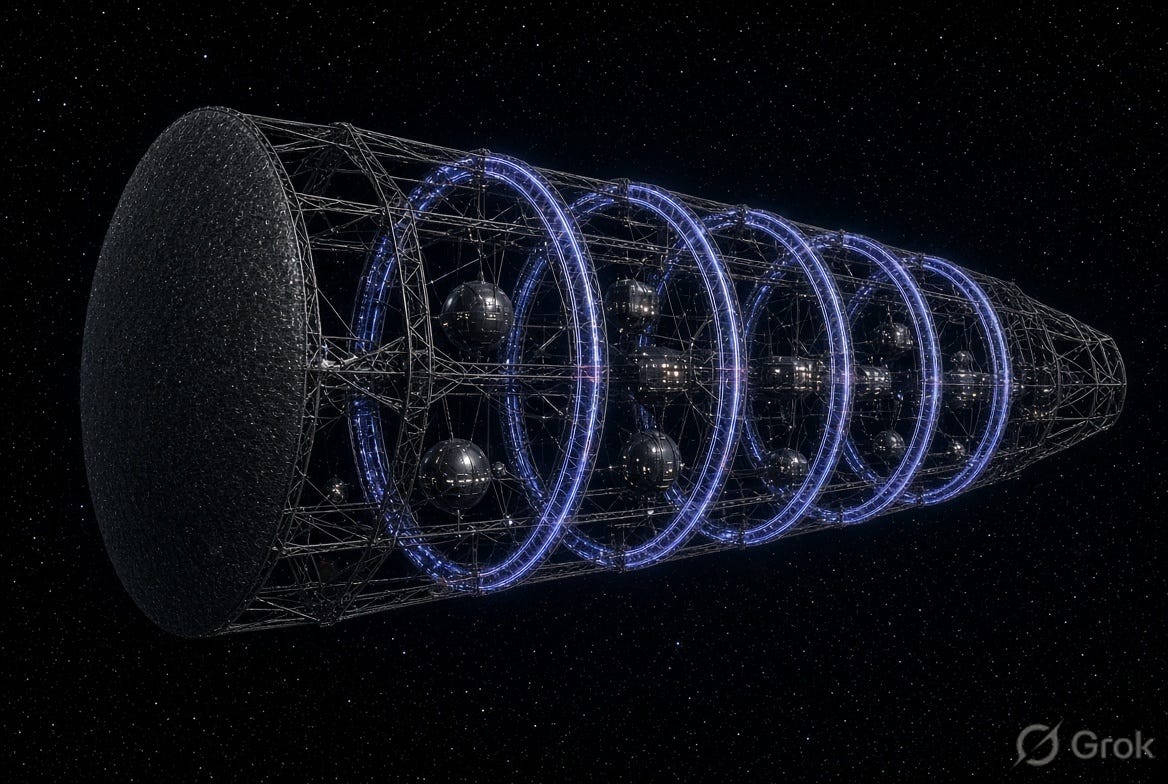
A real starship built around a Peristaltic Wave Drive looks completely alien compared with the streamlined metallic vessels of science fiction. Operating in vacuum at relativistic speeds, it needs neither aerodynamic surfaces nor a solid nose cone. Its form is dictated by particle-collision statistics and electromagnetic fields, resembling a colossal, ethereal skeleton gliding through the dark.
The main body stretches several kilometres as a long, hollow cylinder—an open geometric cage woven from thin, high-strength carbon-composite filaments. Ninety-five percent of the vehicle is empty space. The structure rotates continuously about its central axis, providing artificial gravity for internal components while constantly shifting the positions of the lattice gaps so that any given solid element faces the oncoming flux only briefly. Forward regions remain as open as the rest of the lattice; no dense bumper disc is fitted. Thin, regenerable sacrificial coatings cover the filaments where needed and are maintained by roaming robots.
Running the full length of the skeletal lattice are the ring-shaped superconducting coils of the Peristaltic Wave Drive. These massive loops encircle the hollow cage like ribs, glowing faintly as multi-gigawatt currents ripple through them. When active, the ship is sheathed in an invisible, pulsing magnetic field that shapes the surrounding plasma into a glowing tunnel. Deep inside the spinning cage, suspended by magnetic tethers so they never touch the outer walls, sit the spherical fusion-reactor cores and heavily shielded crew habitats—isolated pods floating within the geometric framework, separated from the high-radiation zones of the outer rings.
Scout drones operate far ahead, their lasers occasionally flashing as they clear detected grains. The overall aesthetic is one of skeletal elegance: a monumentally large, spinning cage of dark carbon and glowing magnetic loops, engineered so that the dangers of deep space either pass cleanly through its body or are actively removed long before contact.