

Dreams Older Than the Space Age Itself
Long before anyone had the technology to attempt it, the idea of humans living permanently off-world, not on another planet’s surface but simply floating free in space, had already taken firm hold of the imagination. Konstantin Tsiolkovsky was speculating about rotating cylindrical habitats as early as 1903. By the 1920s, John Desmond Bernal had sketched out the concept of giant spherical space cities. Aerospace engineer and futurist Dandridge Cole went further still in 1963, proposing that an asteroid could simply be hollowed out, spun for artificial gravity, and lit from within by mirrored sunlight to create a permanent pastoral colony inside a rock. None of this was built. All of it fed directly into what came next.
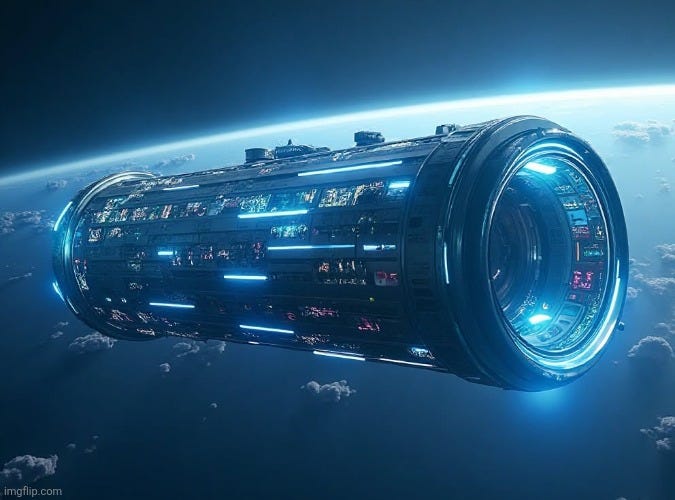
In the 1970s, Princeton physicist Gerard K. O’Neill took these scattered speculations and gave them a rigorous engineering treatment, running a series of NASA-backed workshops that produced the designs still referenced today: Island One, a rotating sphere; Island Two, a larger sphere; and Island Three, the now-famous paired cylinder, capable in his estimation of housing a million people or more. A parallel NASA-Stanford study that same decade proposed an alternative, the Stanford torus, a wheel-shaped ring chosen specifically because it required less structural mass for the same amount of livable area. Science fiction ran with all of it. Babylon 5 borrowed the cylinder. Elysium put a torus on the big screen. Kim Stanley Robinson’s 2012 novel 2312 imagined nearly every large asteroid in the solar system hollowed out into what he called a terrarium, each one landscaped to mimic a different corner of Earth. Space hotels, honeymoon suites in zero gravity, entire cities spinning gently in the dark: for fifty years, this has been the genre’s favorite daydream.
What Is Actually Being Built Right Now
The honest state of the real industry in 2026 looks almost nothing like any of that, and the gap is worth stating plainly rather than glossing over. Every commercial space station currently in active development is small, near-Earth, and designed for short stays rather than permanent settlement. Vast is targeting an early 2027 launch for its Haven-1 module, a single unit accommodating four people for roughly ten days, notable mainly for actually pursuing artificial gravity through rotation rather than leaving crews weightless. Axiom Space, further along than most in real flight experience with four completed private astronaut missions to the International Space Station, is building toward a free-flying station by first attaching modules to the ISS itself, though the company has recently faced real financial and leadership turbulence. Starlab, a joint venture between Voyager Space and Airbus, is aiming to launch a single large module aboard Starship by the end of the decade. And Blue Origin, in partnership with Sierra Space, is developing Orbital Reef, explicitly marketed as a mixed-use business park in orbit, expected to host around ten people once operational, with reported friction between the two partner companies clouding its progress. All of this is being driven by one hard deadline: NASA intends to retire the International Space Station around 2030 and wants commercial replacements ready before the gap opens.
Look closely at those numbers. Four people. Ten people. A dozen at the very largest planned configuration. Every one of these is a real, funded, dated project, and every one of them is closer in scale to a research outpost or a small hotel than to anything resembling a settlement. The gulf between what is actually being built and the O’Neill-scale vision of millions living permanently in space is not a difference of degree. It is a difference in kind, and as of today, nothing bridges it.
What It Costs, and How That Compares to the Ground
Space habitation has never been cheap, and the specific numbers are worth putting alongside each other. NASA’s own studied and costed attempt to capture a small near-Earth asteroid, weighing only around 500 tons, roughly the size of a boulder rather than a habitat, was priced at 2.6 billion dollars, and that mission never even launched before it was cancelled for budgetary reasons in 2017. A single seat on Virgin Galactic’s ninety-minute suborbital hop, which never even reaches orbit, currently costs upward of 750,000 dollars. Maintaining the existing International Space Station, with a permanent crew of only six, already costs NASA and its partners billions of dollars every year. Scale any of the proposed O’Neill-style habitats up to their intended size, housing thousands or millions rather than half a dozen, and the costs involved move from merely enormous into figures nobody has seriously tried to estimate with any confidence, because nothing at that scale has ever been attempted.
Set against this, surface settlements on the Moon or Mars look, perhaps counterintuitively, like the cheaper near-term option, if only because they benefit from an existing body of gravity, radiation-blocking regolith, and material already sitting underfoot rather than material that has to be launched, captured, or mined from scratch in freefall. This is precisely the logic NASA itself follows in prioritizing lunar surface operations under Artemis before anything resembling a deep-space habitat, and it is very likely why every real, funded human settlement effort currently underway, whether NASA’s or Blue Origin’s own Blue Moon lander, points toward a surface first, with orbit and open space treated as a much later phase.
How Bezos Might Actually Get There
Jeff Bezos has never been shy about naming his own eventual destination, and by his own account it runs through two clearly stated prerequisites before anything resembling an O’Neill colony becomes possible. The first is driving down the raw cost of reaching space at all, which is the entire, explicit purpose of Blue Origin’s rocket business. The second, which he has described as the harder and more important gate, is learning to build with materials already in space rather than hauling everything up from Earth’s gravity well. Blue Moon, the company’s lunar lander, fits neatly as the opening move in that second phase, since the Moon offers the nearest, best-understood source of raw material, water ice at the poles, aluminum and other metals in its regolith, without the multi-year transit times that any asteroid mission beyond the immediate vicinity of Earth would require.
From there, a plausible staged path comes into view, even if no one at Blue Origin has laid it out this explicitly in public. Lunar resource extraction proves that off-world material can actually be gathered and processed. A modest orbital foothold, Orbital Reef, tests life support, construction, and commerce in space at a small, human scale. Beyond that, the logical next step, one that genuinely was studied seriously by NASA in the previous decade under the Asteroid Redirect Mission before political and budgetary winds killed it, would be capturing small near-Earth asteroids and relocating them to accessible orbits, harvesting exactly the kind of dense, pre-formed, radiation-shielding material that any large habitat eventually needs, since shielding alone can account for the overwhelming majority of a habitat’s total mass in most serious engineering studies. Only well beyond that, requiring propulsion and mission durations far beyond anything currently operating, does the main asteroid belt and its far richer, far more distant bodies enter the picture at all. Each stage plausibly takes not years but decades to mature into the next, and the full realization of anything approaching a million-person colony likely remains a project measured in generations, not decades, regardless of how quickly the earlier stages proceed.
Cylinder, Torus, or Something Excavated Rather Than Built
Assuming the destination is ever reached, the shape of what actually gets built remains genuinely undecided. The 1975 NASA-backed study behind both designs found, as a matter of pure geometry, that a torus requires less structural mass than a cylinder built to house the same population at the same rotation radius. But that comparison was never actually run at O’Neill’s own scale. The Stanford torus was sized for roughly ten thousand people; O’Neill’s Island Three cylinder, for a million or more, at some sixty times the diameter. The two studies answered different questions at wildly different sizes, so the torus’s efficiency edge says less than it seems to about which shape wins overall, and more simply that O’Neill chose the cylinder for its scale and its long, open, sky-like interior, not for its material economy. A hollowed asteroid offers a third path, trading that manufactured interior for free radiation shielding and an irregular shape harder to reconcile with O’Neill’s vision of long, symmetrical, sunlit land.
There is a reasonable case that this genuine uncertainty over final shape is exactly why Bezos consistently reaches for the word colony rather than cylinder when he speaks publicly, even though he has, on at least one occasion, used the more specific term when discussing the concept in technical depth. A colony describes a settlement, a society, a permanent human community, independent of whatever structural form eventually houses it. A cylinder commits to one specific geometry among at least three serious competing candidates, one that even the original 1975 study did not judge to be the most efficient of the available options. If the eventual habitat turns out to be a torus for its mass efficiency, or a hollowed asteroid for its resource efficiency and built-in shielding, the word colony still applies without needing to be revised. The word cylinder would not. Whether or not this is a conscious linguistic choice on Bezos’s part, it is difficult to shake the sense that colony is simply the more durable word, chosen, whether deliberately or not, to survive whatever the engineering eventually decides.
A Horizon Still Some Distance Off
None of this is close, and it would be dishonest to write about it as though it were. The nearest real projects in this entire field are small research stations meant to host a handful of people for a few days at a time, still years from their first flight. The technology to capture and hollow out even a modest asteroid was studied seriously once, found physically sound, and then shelved for lack of political will before it ever left the drawing board. The full vision, articulated most vividly and most often by Bezos himself, of a trillion people living across thousands of these structures, remains exactly what it has always been since O’Neill first proposed it half a century ago: a coherent, physically defensible, thoroughly unbuilt idea, waiting on a great many smaller steps to be taken first, each of them still measured, honestly, in decades rather than years.
I had some World Book Yearbook supplements from the late 50s to early 70s. The plans for space stations 60 years ago are still wild sci-fi today.