

Long before Jeff Bezos spoke of creating a garden Earth by moving industry off-world, and long before Elon Musk spoke of Mars as civilization’s backup drive, there was a strange, squat, white pyramid standing on four spindly legs in the New Mexico desert. It was called the DC-X, short for Delta Clipper Experimental, and it was never meant to reach orbit. Built by McDonnell Douglas in the early 1990s under the vision of aerospace engineer Max Hunter, who had nursed the underlying idea for thirty years, the DC-X existed to answer one narrow question: could a rocket take off, fly, and land itself vertically, tail-first, the way science fiction had always promised and reality had never delivered. It flew a handful of short, careful test flights, proved the concept could work, and was then quietly cancelled after a landing accident ended the program for good. Almost nobody outside the aerospace world noticed. But two men, in two different cities, were paying very close attention indeed.
Two Companies, Built From the Same Idea in Two Opposite Ways
What happened next is usually told as a story of two clashing personalities, and that telling misses the more interesting explanation sitting underneath it. Jeff Bezos founded Blue Origin in 2000, and by the middle of the following decade the young company had done something quietly telling: it hired a wave of aerospace engineers directly from the cancelled DC-X program itself. These were not people merely inspired by a rocket they had read about. They were the people who had built it, tested it, and watched it fly, walking straight into Bezos’s new company with a decade of hard-won institutional memory already in their heads. Elon Musk founded SpaceX two years later, in 2002, and took the opposite path entirely. Rather than inheriting a lineage, SpaceX built its own reusability program from nothing, through its own iterative, break-it-and-learn testing culture, the kind that produced a long string of very public, very expensive explosions on the way to eventual success.
This is arguably the single best explanation for why these two companies still feel so different a quarter century later, long after their founders’ personalities have been endlessly picked apart in the press. Blue Origin’s own motto, Gradatim Ferociter, step by step, ferociously, is close to a direct descendant of DC-X’s own careful, incremental test regime, carried into the company by the very engineers who had lived through it. SpaceX’s famously aggressive, rapid-iteration culture, by contrast, was never handed down from anyone. It was built by people with no legacy to protect and, arguably, nothing to lose. Same idea, same decade, same desert-tested dream of a rocket that lands itself. Two entirely different inheritances, and, as it turned out, two entirely different temperaments about to meet each other in person.
The Dinner That Started the Feud
They met properly for the first time in 2004, while both companies were still small enough to fit inside a single conversation. Musk invited Bezos to tour SpaceX’s offices, and Bezos returned the favor not long after, inviting Musk and his then wife up to see Blue Origin’s own operation in Seattle. It was over dinner following that visit that the trouble started. Musk, characteristically certain of himself, offered Bezos a piece of unsolicited advice about an approach Bezos was considering: SpaceX had already tried something similar, Musk told him bluntly, and it had turned out to be dumb. Bezos, according to the accounts later collected by biographer Walter Isaacson, did not take this especially well, privately noting that Musk seemed remarkably sure of himself for someone who had not yet successfully launched a single rocket. The two men, by most tellings, kept a polite distance from each other for the better part of the next decade.
It is worth pausing on how perfectly that single dinner previews everything that followed. Musk’s advice was delivered with the confidence of a man from a company built to fail fast and move on. Bezos received it with the wariness of a man whose whole culture, inherited from DC-X’s own patient test program, treated a single misstep as something to be studied, not shrugged off. Neither man was wrong about his own approach. They were simply, from the very first meal they ever shared, already operating on two incompatible clocks.
A Decade of Landings, Lawsuits, and Barely Concealed Insults
The quiet distance did not last. In 2015, Blue Origin’s New Shepard became the first rocket to fly to the edge of space and land itself vertically back on Earth, and Bezos allowed himself a small, public victory lap. When SpaceX achieved its own vertical landing of an orbital-class booster weeks later, a considerably harder engineering feat, Bezos welcomed Musk’s company to, in his words, the club, a gesture that read to many as gracious and to Musk, by most accounts, as faintly condescending given the difference in what each rocket had actually accomplished. The rivalry only sharpened from there. The two companies became entangled in a real legal dispute over a patented method for landing rockets on ocean platforms. Blue Origin filed a formal protest after SpaceX won NASA’s contract to build the Artemis program’s crewed lunar lander, delaying the award for months. Musk, for his part, took to needling Bezos publicly whenever the opportunity arose, at one point labeling him a copycat over ventures that seemed to trail behind Musk’s own.
Even the two men’s most recent public gesture carries the same old argument folded inside it. Earlier this year, Bezos posted an image of a tortoise on social media, tagging Blue Origin directly, and Musk could not resist replying with a pointed jab about how slowly it appeared to be moving. It was a small moment, easy to read as simple banter, but the reference was not accidental. The tortoise and the hare is one of the oldest stories in the Western canon precisely because it stages the same argument Musk and Bezos have now been having, in one form or another, for over twenty years: whether careful, incremental progress or fast, reckless iteration is the surer way to win a very long race. Bezos, whether knowingly or not, was reaching for the version of that fable where the tortoise wins.
Two Visions, Built on Two Different Kinds of Patience
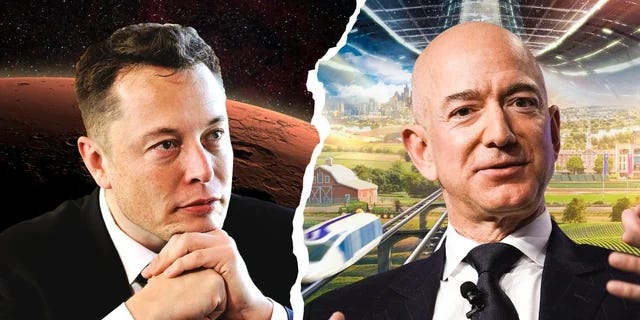
That same underlying temperament shows up just as clearly in what each man actually says he is building toward. Bezos has spent years describing a vision inherited from physicist Gerard O’Neill, under whom he studied at Princeton: enormous rotating colonies, holding up to a million people apiece, built specifically so that Earth’s heavy, polluting industry could be relocated off-world entirely, leaving the planet itself as what he now calls a garden. It is, unmistakably, a patient man’s dream, one Bezos himself admits will take generations and whose details he has said are for the future to work out. Musk’s vision runs on an entirely different kind of urgency. Mars, in his telling, is not a garden to be tended slowly. It is a backup copy of civilization, built against the possibility that Earth itself might not always be survivable, and every year that copy does not exist is, in his framing, a year of unnecessary risk. One vision assumes there is all the time in the world to get it right. The other assumes there might not be.
What the Rocket in the Desert Still Explains
None of this required either man to be secretly wrong about himself, and it would be too easy, and probably unfair, to read the whole rivalry as pure ego with nothing real underneath it. What the DC-X actually offers, a full three decades later, is something better than a simple explanation of two big personalities colliding. It offers a reason. One founder built his company by absorbing the hard-earned patience of engineers who had already lived through a careful, incremental rocket program and watched it end in a single accident that shut the whole thing down. The other built his company from nothing, free to fail loudly and often because there was no inherited caution left to protect. Both approaches have since put reusable rockets into routine operation. Both men still, by all appearances, cannot fully understand why the other insists on doing it his way. Perhaps that was decided over a dinner table in 2004, or perhaps it was decided a decade earlier than that, in a New Mexico desert, by a rocket neither of them ever touched but both of them clearly never stopped thinking about.