

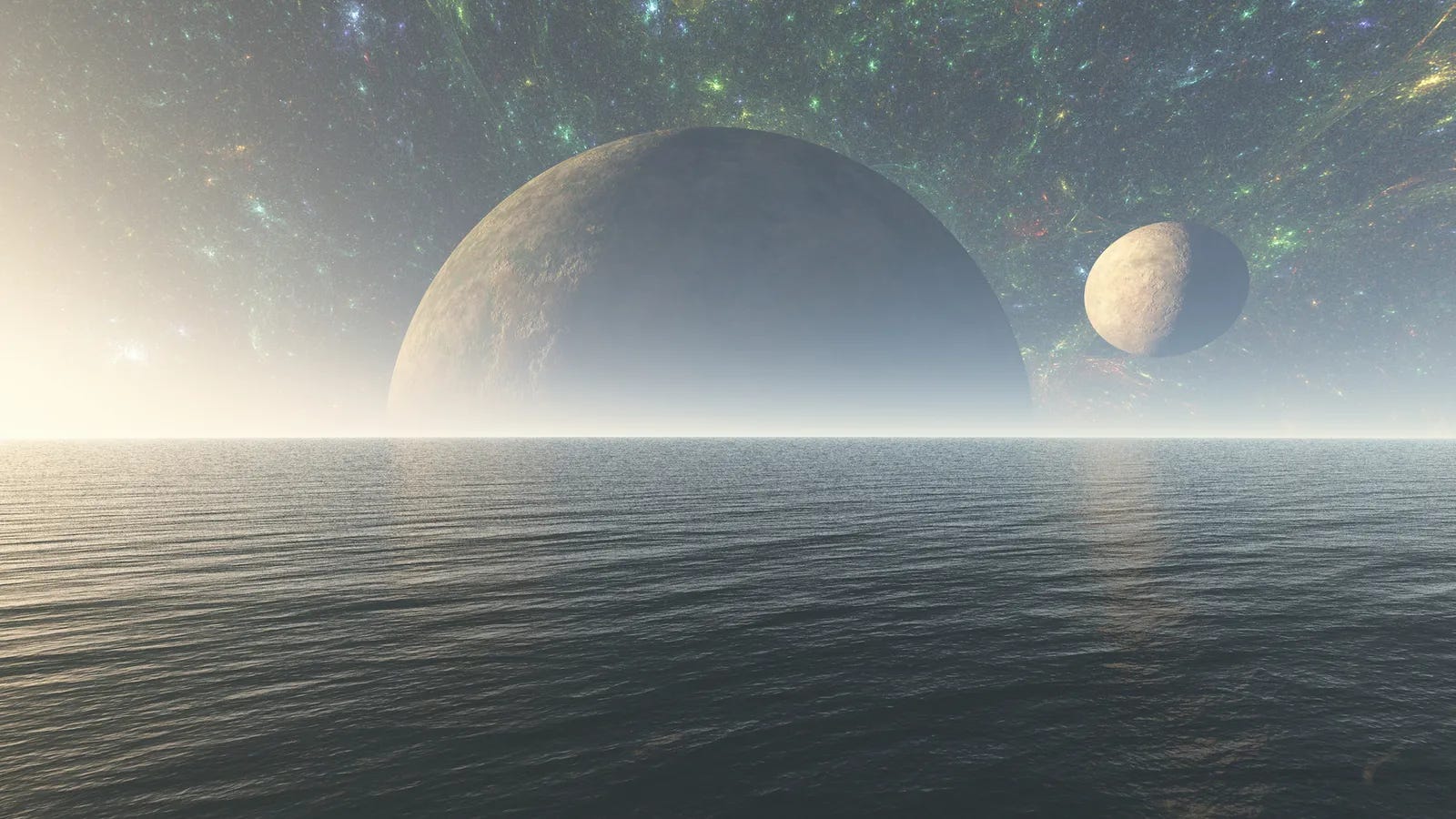
For centuries, humanity looked at the night sky and imagined life thriving on worlds similar to our own—rocky planets basking in the warm light of a nearby star. We assumed that liquid water, the fundamental solvent for life, could only persist on a planet’s surface within a strict “Goldilocks zone.” Recent discoveries have shattered this narrow worldview. Our exploration of the solar system and distant star systems has revealed that the universe is awash in water, hidden not just on temperate Earth-like planets, but beneath thick crusts of ice and inside dense exotic atmospheres. These are the ocean worlds, and they are radically redefining our understanding of where life might take hold in the cosmos.
The Proven Oceans of the Outer Solar System
The most profound paradigm shift in planetary science came from the frigid outer reaches of our solar system, where sunlight is weak and temperatures drop far below freezing. Here, planetary scientists discovered that gravitational tidal forces can replace sunlight as a cosmic heat source.
Jupiter’s moon Europa stands as a premier example of a confirmed ocean world. Beneath an icy shell up to twenty miles thick, Europa harbors a global liquid water ocean containing more than twice the water of all Earth’s oceans combined. This deep sea is kept warm by the constant gravitational tug-of-war between Jupiter and its neighboring moons, which flexes Europa’s rocky core and generates internal heat. Because this ocean sits directly atop a rocky mantle, it allows for chemical interactions that could fuel a deep-sea ecosystem, mimicking the hydrothermal vents found at the bottom of Earth’s oceans.
Further out, orbiting Saturn, the small moon Enceladus provides indisputable proof of its internal reservoir. In 2005, the Cassini spacecraft witnessed spectacular plumes of icy brine erupting from fractures in Enceladus’s south polar crust. Analysis of these plumes revealed not just water, but salts, silica, and complex organic molecules, confirming a global subsurface ocean that interacts with a warm, active seafloor. Meanwhile, Saturn’s giant moon Titan hides a deep liquid ocean beneath its crust of water-ice, uniquely contrasted by the rivers and lakes of liquid methane and ethane that flow across its frozen surface.
The Suspected Reservoirs
Beyond these proven oceanic realms lies a growing list of suspect worlds where global waters are strongly anticipated but await definitive confirmation. Jupiter’s moon Ganymede, the largest moon in the solar system, likely contains a multi-layered sandwich of ice and oceans trapped under immense pressure. Its sibling, Callisto, is similarly suspected of harboring an ancient, salty sea beneath its heavily cratered crust.
The icy horizons extend even further into the twilight of our solar system. Data from the New Horizons flyby suggested that Pluto may still retain a slushy subsurface ocean insulated by a thick crust of nitrogen and water ice. Even the large moons of Uranus, such as Ariel and Titania, have entered the conversation, with scientists re-examining old data to find hints of internal radioactive heating sufficient to maintain liquid layers.
Stepping Closer with Europa Clipper
To transition from suspecting habitability to confirming it, NASA launched the Europa Clipper mission. Designed to conduct dozens of low-altitude flybys of Jupiter’s enigmatic moon, this state-of-the-art spacecraft is equipped with an advanced suite of science instruments designed to peer through the ice.
Europa Clipper will not search for alien life directly, but it will determine if Europa possesses the ingredients necessary to sustain it. By using ice-penetrating radar, high-resolution thermal imaging, and magnetometers, the mission will measure the exact thickness of the icy shell, map the ocean’s depth and salinity, and search for active plumes. Understanding the geometry and chemistry of Europa’s ice-ocean interface will provide a blueprint for evaluating the habitability of sub-surface oceans across the galaxy.
Aquatic Worlds Beyond Our Sun
As our eyes open to the abundance of water within our own solar system, our telescopes are simultaneously detecting water on planets orbiting distant stars. Astronomers have identified a diverse spectrum of wet exoplanets, categorizing them based on where their water resides and how much of it they possess.
We have already detected water vapor in the atmospheres of several “hot Jupiters” and “warm Neptunes”—giant gaseous worlds where water exists as steam due to intense stellar heat. More intriguing, however, are the “super-Earths” and “sub-Neptunes,” planets between the size of Earth and Neptune. Systems like TRAPPIST-1 contain multiple planets in the habitable zone suspected of holding significant fractions of water by mass. Some of these worlds may be true deep-water planets, covered in a global ocean hundreds of miles deep, completely devoid of dry land. Others, classified as “Hycean” worlds, are hypothesized to have liquid oceans locked underneath thick, hydrogen-rich atmospheres, which trap enough heat to maintain liquid water even at great distances from their stars.
The Evolution of Cosmic Nomenclature
The terminology surrounding water-rich exoplanets is undergoing a significant scientific evolution, shifting from loose synonyms to precise classifications. Historically, terms like ocean worlds, ocean planets, aquaplanets, and water worlds were used almost interchangeably by astronomers and the public to describe any celestial body with an abundance of water. However, as planetary science advances and data from deep-space observations increases, scientists are redefining these terms to reflect fundamentally different structures, origins, and compositions. This shift is necessary because a planet with a shallow surface ocean behaves entirely differently from one where water makes up half of its total mass, or another where the ocean is buried beneath miles of solid ice.
Under the emerging definitions, aquaplanets typically refer to Earth-like planets with liquid water oceans directly on their surfaces, in contact with a rich atmosphere, making them prime candidates for standard habitability. In contrast, ocean worlds is increasingly used as a broader category that includes bodies with subsurface oceans trapped beneath icy crusts, such as Jupiter’s moon Europa or Saturn’s moon Enceladus. The term water worlds or ocean planets is being reserved for a more extreme class of exoplanets—often mini-Neptunes or heavy super-Earths—where water constitutes a massive fraction of the planet’s total bulk composition, resulting in deep global oceans that transition into exotic, high-pressure forms of ice deep within the interior rather than hitting a rocky seafloor.
NASA’s upcoming Nancy Grace Roman Space Telescope is expected to be a primary catalyst in cementing these distinct definitions. Equipped with a cutting-edge coronagraph instrument, Roman will be capable of blocking out the blinding light of parent stars to directly image individual exoplanets. This technology will allow astronomers to analyze the reflected light from these planets, providing crucial data on their atmospheric compositions, vapor pressures, and cloud structures. By observing the distinct chemical signatures of these planets, Roman will help scientists distinguish a true surface-ocean aquaplanet from a volatile-rich water world shrouded in steam.
This clearer vocabulary will refine the search for extraterrestrial life, helping astrobiologists separate planets that merely hold water from those that possess the exact environmental conditions necessary to sustain life as we know it.