

For more than six decades, humanity’s journey into the cosmos has relied almost exclusively on chemical rocketry. While chemical propulsion provides the massive, short bursts of thrust required to break free of Earth’s gravity, it is fundamentally constrained by fuel efficiency when traversing millions of miles of deep space. As space agencies turn their eyes toward sustained Mars exploration and deep-space commerce, a paradigm shift is underway.
In March 2026, NASA officially unveiled its pathfinder solution: Space Reactor-1 (SR-1) Freedom, an interplanetary spacecraft scheduled to launch in December 2028. Designed to demonstrate Nuclear Electric Propulsion (NEP) on a transit to Mars, SR-1 Freedom marks a historic leap from theoretical concept to flight reality, laying the groundwork for a robust nuclear-space industrial base.
The Physics of Nuclear Electric Propulsion (NEP)
To understand the breakthrough of SR-1 Freedom, it is essential to distinguish NEP from traditional chemical rockets and its sibling technology, Nuclear Thermal Propulsion (NTP).
A chemical rocket operates like a powerful, instantaneous kick; it burns its mass rapidly to provide immense thrust but runs out of propellant within minutes. In contrast, NEP operates like a gentle, persistent hand pushing a spacecraft continuously over months or years.
The core architecture of an NEP system consists of three main stages:
Fission Power Generation: A compact nuclear reactor splits uranium atoms to generate massive amounts of thermal energy (heat). Because it does not rely on sunlight, NEP remains perfectly efficient in the dim environments of the outer solar system where solar arrays fail.
Power Conversion: The thermal energy from the reactor is transferred to a power conversion system—specifically a high-efficiency closed Brayton cycle gas turbine—which transforms the heat into electrical energy.
Electric Thrust Acceleration: The generated electricity is fed into conventional plasma or ion thrusters (such as Hall-effect thrusters). This electricity ionises a gas propellant (typically xenon) into a plasma, which is then accelerated out of the engine nozzle at extremely high velocities using electromagnetic fields.
While NEP produces too little thrust to launch a vehicle off the Earth, its specific impulse—or fuel efficiency—is orders of magnitude higher than chemical alternatives. An interplanetary voyage requires only tens of kilograms of uranium fuel and a fraction of the propellant mass required by conventional rockets, drastically cutting down the weight of deep-space transport vehicles.
Anatomy of the SR-1 Freedom Spacecraft
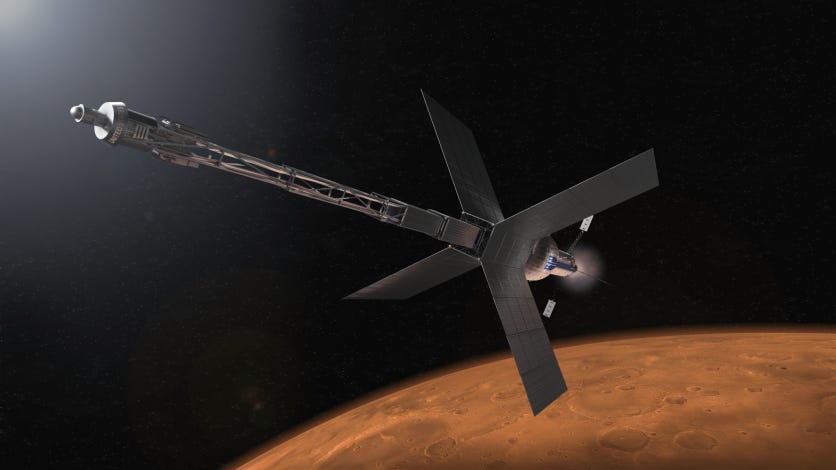
The SR-1 Freedom is a ~12-tonne spacecraft designed around practical, cost-effective engineering. To meet its ambitious 2028 launch window, NASA chose to repurpose the already-built Power and Propulsion Element (PPE), originally manufactured for the Lunar Gateway station.
Key technical specifications of the spacecraft include:
The Reactor: A 20-kilowatt-plus fission reactor fueled by High-Assay Low-Enriched Uranium (HALEU) uranium dioxide fuel.
Radiation Shielding: Advanced boron carbide structures wrap around the reactor assembly. Additionally, the reactor sits at the far end of a long truss structure to physically isolate and protect the spacecraft’s delicate onboard electronics from radiation.
Thruster Array: The vehicle integrates a mixed array of highly sophisticated electric engines, including three 12-kW Advanced Electric Propulsion System (AEPS) Hall thrusters (developed by NASA and Aerojet Rocketdyne) and four 6-kW Hall thrusters manufactured by Busek. Together, they form the most powerful electric propulsion network ever flown.
Mission Timeline and the Mars Encounter
The journey of SR-1 Freedom is carefully orchestrated to balance technical demonstration with rigorous planetary protection protocols:
Launch (December 2028): A heavy-lift launch vehicle, likely a Falcon Heavy, will place SR-1 Freedom directly into an Earth-escape trajectory. Crucially, the fission reactor will remain completely cold and offline during launch and will not be activated within Earth orbit.
Activation: Within 48 hours of launch, once safely clear of Earth, the nuclear reactor will be booted up. The spacecraft’s onboard solar arrays (retained from its original PPE design) will assist with power until the reactor takes over fully to drive the continuous-cruise ion thrusters.
The Cruise Phase: Over the course of a roughly one-year transit, the thrusters will fire continuously, steadily increasing the craft’s velocity as it moves past the point where solar power becomes weak.
Mars Arrival and “SkyFall” Payload (2029): Upon reaching the Red Planet, SR-1 Freedom will perform a flyby and deploy its primary scientific package: the SkyFall payload. SkyFall consists of three autonomous, Ingenuity-class scouting helicopters. These drones, equipped with ground-penetrating radar, will actively scan the Martian subsurface to map water ice reservoirs and identify secure landing zones for future crewed missions.
Securing the Nuclear Space Industrial Base
While the scientific returns from Mars will be substantial, the true underlying purpose of SR-1 Freedom is strategic. The mission represents a concrete effort to activate a domestic nuclear-space industrial base, establishing supply chains for HALEU fuel, flight heritage for space-grade turbines, and clear regulatory pathways for nuclear spaceflights.
The data and experience gathered from SR-1 Freedom will directly inform Lunar Reactor-1 (LR-1)—a planned 2030 fission surface power system designed to sustain human habitats during the two-week-long lunar nights—as well as future megawatt-class NEP systems. Ultimately, these advanced, higher-power iterations hold the potential to reduce human transit times to Mars from nine months down to just two or three, mitigating astronauts’ prolonged exposure to deadly cosmic radiation.
By merging decades of nuclear research with proven electric propulsion hardware, the SR-1 Freedom mission is poised to turn the page on a new chapter of space exploration—one where humanity is no longer bound by the limits of chemical fuel, but propelled by the enduring power of the atom.