

Imagine a program where NASA hands over modest funding and a blank slate to dreamers who sketch out ideas that sound like they leaped from the pages of a pulp science fiction novel. That is the NASA Innovative Advanced Concepts program, or NIAC for short. For years it has nurtured the wildest, most technically grounded visions of what space exploration could become decades from now. These are not blueprints for next year’s rockets. They are seeds of possibility, early studies that ask what if we could do something truly extraordinary.
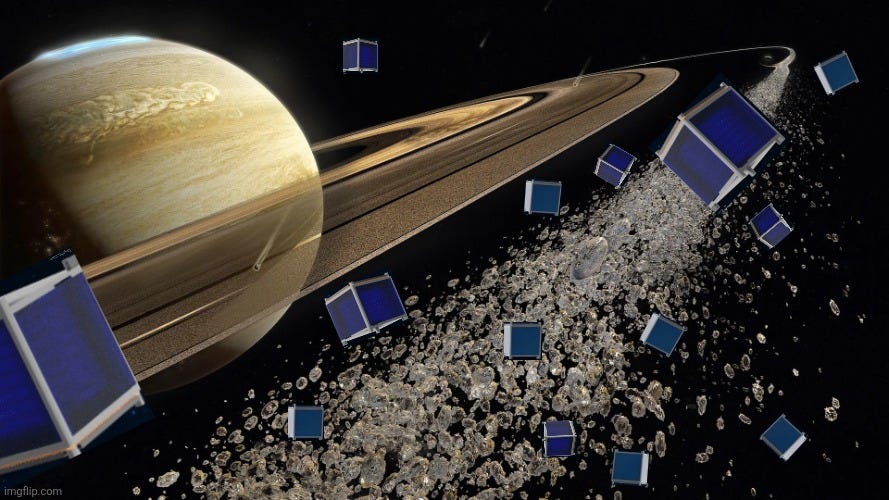
Picture thousands of tiny spacecraft, each no bigger than a coin, swarming through the glittering rings of Saturn. One NIAC concept calls for roughly ten thousand of these steerable femtosats to dive into the ring system itself. Traditional probes must keep a safe distance from the dense particles, but this distributed fleet can afford losses. Enough survivors would still map the composition of the rings, sample the planet’s atmosphere, and chart its magnetic field in three dimensions. What once seemed too dangerous for a single costly spacecraft becomes feasible when risk is spread across a cloud of inexpensive explorers.
Closer to home, the Moon holds secrets beneath its dusty surface. Ancient lava tubes stretch for kilometers, potentially offering natural shelters from radiation and extreme temperatures. The Lunar Underground eXplorer concept envisions hovering robots that descend into these dark caverns while trailing a slender fiber-optic tether. Laser light traveling through that fiber would deliver both power and high-speed data, even when the robot vanishes around a bend. The same energy could boost a clean cold-gas thruster, letting the vehicle float gently through pristine underground corridors without contaminating the science. Human bases might one day take refuge in these hidden halls, and LUX aims to scout them first.
Venus presents an even fiercer challenge. Surface temperatures hot enough to melt lead and crushing atmospheric pressure have limited every previous lander to mere minutes of life. A recent NIAC study explores hardening spacecraft so they can not only survive but roam. Spherical robots powered by advanced radioisotope systems, with electronics built to tolerate ultra-high temperatures and pressures, could roll across the hellish landscape for far longer than anything before. Mobility without exposed mechanisms would let them keep moving even as the environment tries to destroy them.
Astronauts on the Moon face their own extreme cold. The two-week lunar night plunges temperatures lower than anywhere on Earth, and permanently shadowed craters are colder still. One inventive proposal integrates compact radioisotope heaters directly into spacesuits. Tiny sources of americium-241 would provide steady, passive warmth without draining limited battery power. Explorers could work through the long darkness, reaching ice-rich regions that hold scientific treasure and potential resources for future settlements.
Some ideas stretch even farther, aiming to protect the only home we currently have. At the Sun-Earth Lagrange point, a controllable cloud of specially engineered dust particles could gently dim the sunlight reaching our planet by a little more than one percent. Shepherd spacecraft would keep the cloud in place with electrostatic forces. If the experiment ever needed reversing, simply turning off the shepherds would let the dust disperse within months. The concept offers a temporary planetary thermostat while humanity works on more permanent climate solutions.
And then there are the worlds orbiting distant stars. A new type of nulling interferometer would combine light from multiple telescopes in a clever hierarchical way that cancels the overwhelming glare of a star while preserving the faint reflected light of any planets. Placing two such systems roughly a hundred kilometers apart would deliver the resolution needed to map continents, oceans, and cloud patterns on Earth-like exoplanets around nearby stars. For the first time we might see the surface features of another living world, or at least one that looks ready for life.
These concepts, and many others like them, begin as Phase I studies lasting only months and funded at modest levels. The most promising advance to further phases, refining the technology and testing feasibility. Few will ever fly exactly as imagined. Yet the program’s real power lies in expanding the frontier of what engineers and scientists consider possible. NIAC keeps the spark of wonder alive inside a space agency that must also deal with budgets, schedules, and the hard realities of rocketry. In doing so, it reminds us that the next giant leap often begins with someone daring to ask a question no one else has thought to ask.