

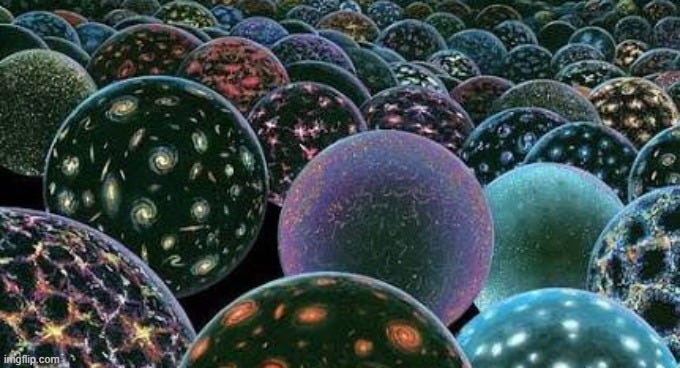
Imagine stepping out into a vast forest on a foggy morning. You can only see a few dozen yards in any direction before the mist swallows the trees. It would be natural, if you knew nothing else of the world, to assume that the forest ends just where your vision fails—that your little circle of clearing is all that exists. For centuries, humanity has stood in a similar clearing, looking out at the cosmos. We peered at the stars and thought our solar system was the entirety of creation. Then we discovered galaxies, only to assume our Milky Way was the lone island of light in an empty void. Today, we look out at the edge of the observable universe—a cosmic horizon defined simply by how far light has been able to travel to reach us since time began—and we are tempted to make the same old mistake. We are tempted to think that our universe is the only one.
Yet a growing chorus of modern physicists suggests that our universe is merely a single pond in an endless archipelago of worlds. The idea of a multiverse is often dismissed as science fiction, but it arises naturally from the mathematics of our best physical theories. If a physical process like the Big Bang can happen once, it implies that the mechanism is a fundamental rule of nature. To assume that such a mechanism fired exactly once across the infinite stretch of eternity requires a massive leap of faith. It is far more logically consistent to suspect that what we call the universe is just a local patch of a much larger, grander reality.
When we dive into the mathematics of how a multiverse might work, we find that the concept is not singular. Different theories of physics predict entirely different kinds of multiverses, stacked like layers of reality. The first and most straightforward type is a simple consequence of an infinite universe. If space goes on forever, then the laws of probability dictate that eventually matter must repeat itself. Because there are only so many ways to arrange atoms in a given volume of space, an infinite expanse means that somewhere out there, far beyond our horizon, is an exact duplicate of our galaxy, our planet, and you. In this kind of multiverse, the number of universes is truly infinite, and they all share the exact same laws of physics, operating under the same rules of gravity, electromagnetism, and chemistry. They are just separated by unimaginable distances.
A more radical structure emerges when we look at the mechanics of how our universe began. The leading theory of the early cosmos, known as cosmic inflation, suggests that a fraction of a second after the Big Bang, space underwent a period of hyper-expansion, ballooning outward faster than the speed of light. The mathematics indicates that this inflation is eternal; it never stops everywhere at once. Instead, it quietens down in little pockets, while the space between those pockets continues to expand furiously. Each pocket where inflation stops settles down into a bubble universe. In this eternal inflation model, the multiverse is an ever-growing foam of bubbles. The number of universes generated by this process is also infinite, continuously spawning new worlds across eternity.
This is where the physics gets truly mind-bending, because these bubble universes do not have to look like ours. This brings us to the insights of string theory, which attempts to unite all the forces of nature into a single framework. String theory requires extra hidden dimensions of space, and these dimensions can be folded and curled into an astronomical number of shapes—roughly 10^500. Each distinct shape alters the way particles interact, meaning each configuration yields a universe with completely different fundamental constants. In one bubble, gravity might be so weak that stars can never form. In another, the strong nuclear force might be so powerful that atoms instantly collapse.
This introduces the profound question of whether all these different multiverse concepts could be true simultaneously. The answer from theoretical physics is a resounding yes. They are not mutually exclusive; they are nested inside one another. You could have a vast landscape of eternal inflation generating an infinite number of bubbles. Inside each of those bubbles, the extra dimensions of string theory could freeze into a different shape, dictating a unique set of physical laws for that specific pocket of space. And within any single bubble, if the space inside it expands infinitely, the arrangements of matter will eventually repeat, creating infinite copies of that specific universe’s history.
This nested reality offers an elegant solution to one of the greatest riddles in science: the fine-tuning problem. Physicists have long noticed that the fundamental constants of our universe seem perfectly tailored for the existence of complex matter and life. If the mass of an electron or the strength of electromagnetism were altered by a microscopic fraction, the universe would be a sterile wasteland. Critics argued this implied a cosmic designer, but the multiverse provides a purely natural explanation. If there are countless universes with an infinite variety of physical laws, it is no longer a mystery why we find ourselves in one that supports life. We exist here because we could not exist anywhere else. We are the inhabitants of a rare, hospitable island in a lethal cosmic ocean.So if something moved from one universe to another universe with different laws of physics, would it instantly become part of that universe and follow its rules, or would it remain like an island universe in itself, still following its own rules?
If an object—or an explorer—were to step out of our universe and into another with fundamentally different laws of physics, the outcome would be a cosmic clash between the rules governing the intruder and the rules governing the destination. To understand what would happen, we have to look at what the laws of physics actually are. They are not like human laws that require an authority to enforce them, nor are they a cloak that an object wears. Instead, the laws of physics describe the intrinsic properties of the particles themselves and how they interact with the fields of space around them.Because of this, the intruder would not instantly transform to follow the new rules, nor would it smoothly exist as a self-contained island. Instead, it would almost certainly suffer immediate, catastrophic dissolution.
To visualize this, imagine a universe where the strong nuclear force—the atomic glue that holds quarks together to make protons and neutrons—is slightly weaker than it is in ours. If you were to transport a simple carbon atom from our universe into that one, the carbon atom does not inherently “know” it has changed universes. It brings its own quarks and its own internal glue. However, particles do not exist in a vacuum; they interact constantly with the quantum fields that permeate the space around them. In this new universe, the fundamental field responsible for the strong nuclear force operates at a lower intensity. The moment the carbon atom enters this space, the local fields would fail to support the tight bond holding its nucleus together. The atomic glue would instantly fail, and the atom would violently fly apart into a spray of loose subatomic particles.
A similar catastrophe would occur if you traveled to a universe where electromagnetism is stronger. The electrons orbiting your atoms would suddenly feel a massive, crushing pull toward the nuclei. The delicate balance that allows chemical bonds to form would be shattered. Your molecules would warp, your DNA would snap apart, and the chemical reactions that sustain life would grind to a halt in a fraction of a millisecond. You would not become an island universe operating by your own rules, because your existence depends on the surrounding space behaving in a very specific way. You cannot have a chemical reaction if the space you are standing in refuses to let electrons move the way they need to.
However, there is an exception to this rule, and it comes down to particles that do not care about the forces of nature. If you brought an object made entirely of dark matter or something purely subject to gravity, it might fare better. If the new universe still has gravity, even if it is much stronger or weaker, a chunk of neutral matter would simply feel heavier or lighter. It would not disintegrate because it does not rely on delicate atomic bonds to hold itself together. It would drift through the alien cosmos as a true island, indifferent to the fact that the local chemistry around it is completely broken.
For normal matter like us, crossing the boundary into a universe with different laws is a one-way ticket to fundamental decay. The universe would not force your particles to magically reshape themselves into its local variants; it would simply refuse to support the framework that keeps your particles organized. You would be broken down into the raw, fundamental ingredients of that new world, instantly recycled into whatever strange, alien structures its unique laws allow.
The question of what happens when two entire universes with different physical laws collide scales up this atomic destruction to a cosmic level. If our bubble universe were to bump into a neighbor that operates under a different set of constants, the collision would not be a soft impact like two soap bubbles bouncing off one another. Instead, it would trigger an apocalyptic event known in physics as a phase transition, creating a scar on the fabric of reality that moves at the speed of light.
To understand this cosmic collision, we have to look at how physicists model the boundaries of these bubbles. The edge of a universe is defined by the energy state of its space, which dictates its specific laws of physics. When a universe with an entirely different set of laws collides with ours, the boundary between them becomes unstable. The universe with the more stable, lower-energy state would begin to override the other. It would create an expanding bubble of new physics—a literal wall of destruction—that propagates outward through our space.
If this wall of an alien universe swept through our galaxy, the transition would be instantaneous and absolute. As the boundary passed through Earth, the fundamental constants of nature would shift in a microsecond. In that moment, the quantum fields that dictate the mass of electrons or the strength of atomic bonds would rewrite themselves. Atoms would instantly dissolve, stars would lose the internal pressure keeping them from collapsing into black holes, and light itself might cease to travel. It would not feel like a mechanical destruction, but rather an erasure of the very rules that allow matter to exist.
Remarkably, this is not purely a thought experiment; cosmologists are actively searching the sky for the faint, ancient echoes of just such an event. If our universe collided with another bubble during the hyper-expansion of the early Big Bang, the impact would have compressed the matter and radiation in that specific region of our sky. This would leave a permanent, giant circular print—a cosmic bruise—in the Cosmic Microwave Background, which is the leftover heat radiation from the dawn of time. Finding such a circle would simultaneously prove the existence of the multiverse and show that our universe survived a brush with an alien reality.
In the frameworks that predict a multiverse, there is no centre, no single starting point, and no region that holds any special importance. Just as modern cosmology has shown that our own universe does not have a central point, the multiverse scales up this reality, presenting an expanse that is truly decentralized.
To understand why a centre cannot exist, it helps to look at the mechanics of the two main theories that produce these worlds.
In the model of eternal inflation, the multiverse resembles an ever-expanding, endless foam of bubbles. The space between these bubbles is stretching faster than the speed of light, constantly generating new patches of space that settle into new universes. Because this hyper-expansion happens everywhere simultaneously and has no boundaries, every single bubble looks out at a horizon that appears to surround it. If you were standing inside any one of these bubble universes, it would feel like you are at the exact centre of your observable reality. However, this is merely an illusion of perspective, much like standing on the surface of an expanding balloon where every single point feels like the middle.
Similarly, string theory presents a vast landscape of possibilities where no particular universe or set of physical laws is the default or the standard. There is no master universe from which all others are measured. Instead, the multiverse is a democratic, egalitarian structure where every variation of reality exists on equal footing. One universe might be entirely dark and devoid of stars, while another is packed with complex matter, but neither is more important or fundamental than the other.
Whether this makes the multiverse a chaotic, random infinity depends on how you define order. On a local scale, it can certainly look like chaos. You have an infinite number of bubbles popping into existence, some instantly collapsing under intense gravity, others flying apart too fast for chemistry to happen, and a few managing to find a stable balance.
Yet, beneath this apparent chaos lies a profound form of mathematical order. The multiverse is not a lawless wasteland. Every single universe, no matter how strange its local rules might seem, is still a product of the overarching laws of the multiverse itself—such as quantum mechanics and the mechanics of inflation. The randomness we see is just the laws of physics exploring every single possible combination available to them. It is an infinity where everything that can happen does happen, governed not by a central throne, but by the ultimate laws of probability.
Determining exactly how many universes exist within these frameworks depends entirely on which layer of the multiverse you are looking at. For the classical infinite-space model and the eternal-inflation model, the count is strictly infinite. The cosmic machinery keeps running forever, churning out new realities without end. However, for the variations in the laws of physics themselves, the number is staggering but finite, limited by the ways those extra dimensions can fold. Yet when you multiply a finite but massive number of physical laws by an infinite number of bubbles, the total tally of worlds returns to infinity.
We currently lack the technology to peer outside our own bubble, leaving us like those ancient cartographers who drew dragons at the edges of their maps. Some scientists hope we might find indirect evidence, perhaps a subtle circular bruise in the cosmic microwave background radiation left behind if a neighboring bubble universe bumped into ours during the infancy of time. Until such a discovery is made, the multiverse remains a stunning mathematical prediction. It challenges our deep-seated urge to feel central to creation, reminding us that every time we thought we had seen the whole pond, the horizon simply moved further out, revealing an endless ocean waiting to be understood.