

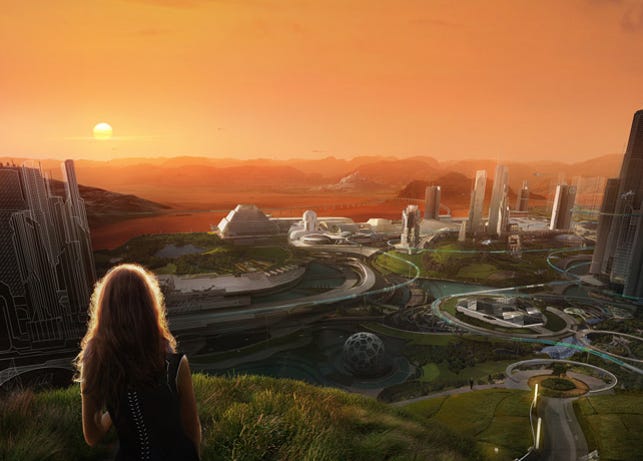
Earth is a fantastic starter home. It has breathable air, oceans perfect for vacationing, and a distinct lack of cosmic radiation melting our DNA. But as any responsible species will tell you, keeping all your evolutionary eggs in one fragile, meteor-susceptible basket is bad risk management. The goal of becoming a multiplanetary species is not about abandoning our home planet because we messed up the plumbing; it is about securing a cosmic insurance policy and satisfying an ancient, restless itch to see what is over the next hill. Becoming a multiplanetary species means transforming from a single-planet civilization into a cosmic network of humans, robots, and AI working together to turn dead rocks into living worlds.
The journey begins in our own backyard with the Moon and Mars. The Moon is our cosmic sandbox, a three-day commute where we can learn how to build habitats without immediately suffocating. It serves as a testing ground for technologies like 3D-printing bases out of lunar dust and harvesting ice from dark craters to make rocket fuel. Mars, on the other hand, is the main event. It is a harsh, freezing desert, but it has the raw materials needed to support a self-sustaining city. The immediate goals on these bodies are largely robotic and scientific, but the ultimate endgame is permanent human residency. This monumental shift is no longer just the playground of national agencies like NASA. A new breed of aggressive, deep-pocketed private players, most notably Elon Musk’s SpaceX with its towering Starship and Jeff Bezos’s Blue Origin, are fundamentally altering the economics of spaceflight. They are treating rocket booster reuse not as a luxury, but as a basic requirement, driving down launch costs to a fraction of what they used to be.
Yet, moving into space means grappling with a universe that is actively trying to kill us. The key challenges are terrifyingly biological and logistical. Without Earth’s protective magnetic field, cosmic radiation acts like a slow, invisible microwave. Zero gravity turns human bones into chalk and muscles into jelly. Furthermore, there is the grueling psychological toll of being cooped up in a pressurized tin can millions of miles away from a blade of grass. To survive, early pioneers will rely heavily on advanced robotics to dig underground shelters and automate the boring, life-critical tasks before humans even unbuckle their seatbelts.
If we want to make Mars truly comfortable, we will have to terraform it, which is essentially giving the planet a massive, intentional case of global warming. Right now, Mars is a frozen wasteland with an atmosphere so thin it would make your blood boil. To fix this, future engineers plan to thicken the air by releasing greenhouse gases. We could blast the Martian soil with giant orbital mirrors to melt the polar ice caps, or even redirect ammonia-rich comets to slam into the surface. Over centuries, these actions would release trapped carbon dioxide, warming the planet enough for liquid water to flow again. Eventually, hardy genetically modified plants could begin churning out oxygen, slowly turning the Red Planet into a green-and-blue second home.
Venus presents a completely different, hellish nightmare. The surface of Venus is hot enough to melt lead, and the atmospheric pressure is equivalent to being half a mile underwater. To make matters worse, Venus possesses a highly unstable crust that periodically undergoes catastrophic volcanic resurfacing, effectively turning the entire planet’s skin inside out every few hundred million years. Buying a plot of land on the Venusian surface is a terrible investment. The solution? We colonize the sky. About thirty miles up in the Venusian atmosphere, the temperature and pressure are shockingly Earth-like. Humans could inhabit massive, city-sized cities in the sky, suspended inside giant, high-tech blimps. Because the air inside these floating habitats would be lighter than the heavy Venusian atmosphere, the cities themselves would naturally float, allowing us to build a cloud-based civilization safely drifting far above the volcanic chaos below.
Venturing further out, the giant gas worlds of Jupiter and Saturn offer incredible, ice-crusted frontiers. While the gas giants themselves lack a solid surface to stand on, their moons are pristine real estate. Jupiter’s moon Europa and Saturn’s moon Enceladus hide massive, liquid oceans beneath miles of ice. Humans could build bases deep within these ice shells, using the thick frozen crust as a natural shield against deadly space radiation. Hydrothermal vents on the floors of these alien oceans could provide heat and chemical energy, creating isolated, subsurface metropolises where humans could live, fish for alien microbes, and study the solar system from the inside out.
Even further past Neptune lies the Kuiper Belt, a vast twilight zone of frozen dwarf planets like Pluto and countless icy asteroids. These distant outposts are incredibly cold and lonely, but they are rich in water ice and volatile chemicals. Human outposts in the Kuiper Belt would operate like cosmic gas stations and deep-space mining camps. These bases would likely be entirely underground, carved into the interiors of comets or dwarf planets, powered by advanced nuclear fusion reactors. They would serve as the ultimate stepping stones, launching pads for our final, grandest leap into the great dark void.
Eventually, our solar system will feel a bit crowded, and humanity will look toward other star systems, like Alpha Centauri. Because the distances are so mind-bogglingly vast, traveling there using traditional rockets would take tens of thousands of years. Instead, our first interstellar emissaries will likely be swarms of micro-robots propelled to a fraction of the speed of light by powerful lasers based back on Earth. These tiny scouts will pave the way for massive, multi-generational starships or human crews kept in deep cryogenic sleep. Spreading life across the stars is the ultimate expression of human curiosity and resilience. It is a multi-century project that will challenge our engineering, change our biology, and alter our perspective on our place in the cosmos. We are currently living in the opening credits of this grand adventure, standing on the shores of a cosmic ocean, finally getting ready to sail.