

The human expansion into space brings an inevitable cultural shift: the birth of extra-terrestrial athletics. As permanent settlements transition from scientific outposts to communities, the desire for recreation will follow. How Transplanting Earth’s favourite pastimes to the Moon presents severe physical and financial hurdles. The future of lunar sports lies not in duplicating terrestrial games, but in adapting to a world with one-sixth of Earth’s gravity and an unforgiving vacuum.
The Outdoor Perils and Indoor Costs of Lunar Athletics
Staging traditional sports in the outdoor lunar environment introduces extreme athletic hazards. Without an atmosphere, players must wear bulky, pressurized spacesuits that limit flexibility and vision. The lunar surface itself is a major threat, covered in sharp, abrasive dust called regolith. Falling at high speeds in a vacuum can tear suit materials or damage life-support backpacks. Furthermore, the lack of air resistance alters ball aerodynamics. Projectiles do not slow down or curve as much as on Earth, meaning a standard kick or throw travels much farther and faster, turning missed passes into lost equipment.
Moving these sports indoors to a pressurized shirt-sleeve environment seems like the obvious solution, but the financial reality is staggering. To accommodate the soaring trajectories of low-gravity projectiles, an indoor stadium requires massive clearance. Building a dome large enough to contain a standard soccer match or football game under one-sixth gravity demands unprecedented engineering. The cost of manufacturing, transporting, and maintaining the airtight structural integrity of such a colossal volume against the vacuum of space is prohibitively expensive for early colonial budgets.
Reimagining the Beautiful Game: Lunar Soccer by 2035
Despite these challenges, experts predict that lunar soccer will become a reality by the year 2035. To work within the constraints of the Moon, the game must undergo radical modifications. Outdoor lunar soccer will likely be played on specially cleared, dust-mitigated fields using a much heavier, specialized ball to compensate for the lack of air resistance. Because traditional running is inefficient in low gravity—often turning into a slow, bounding float—players will rely on modified skipping techniques or low-profile thruster boots for quick directional changes.
The 2035 timeline aligns with the expected maturity of flexible, smart-fabric spacesuits that offer greater agility. Matches will feature fewer players and shorter halves to prevent athletic fatigue inside life-support systems. Rather than high-flying kicks that would send the ball seemingly into orbit, lunar soccer will emphasize ground-based passing, tactical positioning, and utilizing perimeter netting to keep the ball in play, creating a fast-paced, highly strategic version of the beautiful game.
Flight and Physics: The Intricacies of Lunar Basketball
Basketball in a low-gravity environment completely redefines the geometry of the sport. On the Moon, an average human can jump roughly six meters into the air, remaining airborne for several seconds. This extended hang time transforms the game into a three-dimensional aerial ballet. Players can launch themselves from past the half-court line for a slam dunk, but navigating the ascent and descent requires immense skill.
To adapt to these six-meter leaps, the basketball hoop must be raised significantly, likely to a height of nine or ten meters. The court boundaries will also expand to accommodate the massive horizontal distance covered during a single jump. Defense becomes an exercise in anticipation, as blocking a shot requires jumping early to meet the shooter at the apex of their flight. The primary hazard shifts from ground collisions to mid-air crashes, requiring strict rules regarding aerial contact to prevent players from spinning out of control before they return to the lunar floor.
Why Moon Volleyball Will Conquer the Lunar Surface
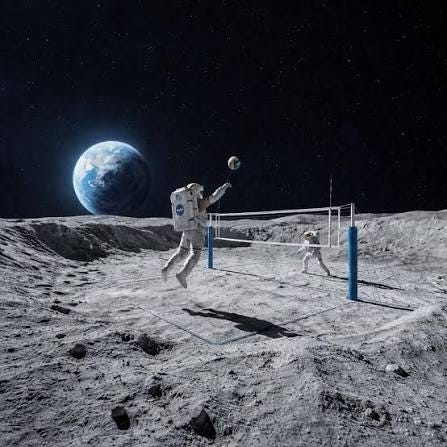
Among all terrestrial adaptations, Moon Volleyball stands out as the safest, most practical, and potentially most popular team sport on the Moon. The inherent design of volleyball resolves the greatest dangers of outdoor lunar athletics. It is a non-contact sport where a net physically separates opposing teams, instantly eliminating the risk of high-speed collisions between players in pressurized suits.
Furthermore, the game does not require athletes to run across vast distances or chase loose balls across cratered landscapes. Players remain within a defined, compact zone that can be easily cleared of dangerous regolith and lined with protective padding. The low gravity enhances the natural appeal of the sport, allowing for spectacular, slow-motion dives and defensive saves that would be impossible on Earth. Because the ball floats gracefully through the vacuum, teams can execute complex aerial setups and synchronized spikes. By offering maximum safety, minimal infrastructure requirements, and high spectator entertainment, Moon Volleyball is uniquely positioned to become the premier athletic discipline of the lunar frontier.
This is ancient, but it's in the same vein if you skip to around 15 mins!
https://www.youtube.com/watch?v=RAHzqNitBY0