

The second space age is no longer a distant projection; it is accelerating at a blistering pace. As testing of SpaceX's third-generation Starship, the massive Block 3, pushes through its critical ongoing phase—including highly anticipated orbital propellant transfer demonstrations—the logistical bottleneck to the cosmos is systematically breaking. Compounding this technical momentum, the Trump administration has announced an aggressive mandate to increase annual government and commercial launch cadences, effectively supercharging the orbital economy. This regulatory and technical windfall has triggered an unprecedented boom. Just a few years ago, lunar infrastructure was the exclusive domain of a handful of university labs and niche research grants. Today, a dense ecosystem of private aerospace companies has multiplied across the globe. These entities are no longer just sketching concepts—they are actively manufacturing, testing, and deploying the hardware for rovers, habitats, lunar pads, and early-stage lunar space elevators.
To look back at the 20th-century space race is to realize how much the paradigm has shifted. While the Apollo program remains a monumental feat of human bravery, it was ultimately a series of flags-and-footprints sorties—the cosmic equivalent of a weekend camping trip. Apollo astronauts brought everything they needed with them, left quickly, and relied entirely on a massive, unsustainable government checklist. What is unfolding today is the largest engineering endeavour in human history. We are not visiting the Moon; we are moving our industrial base there. We are transforming an alien world into a self-sustaining extension of human civilization, anchoring our species permanently into the fabric of the solar system.
Yet, the path to the stars remains fraught with friction. The Artemis program continues to battle bureaucratic delays and supply chain bottlenecks, narrowing the gap with China’s fiercely competitive International Lunar Research Station (ILRS) initiative. This geopolitical and commercial race is converging on a singular geographic prize: the Shackleton Crater at the lunar South Pole. Spanning over twenty kilometres across and plunging kilometres into pitch-black darkness, Shackleton has rapidly become the most valuable real estate in the solar system. Its elevated rims enjoy near-perpetual sunlight, offering an inexhaustible source of solar power. Meanwhile, its permanently shadowed interior shields vast, untouched reservoirs of water ice, preserved in deep freeze for billions of years. Whoever controls the rim of Shackleton controls the gateway to lunar prosperity.
To conquer this high-stakes terrain, humanity must first solve a deceptively simple, existential problem: dust. The Moon is covered in regolith, a razor-sharp, abrasive powder born from eons of micrometeorite impacts. Without atmosphere to erode it, this dust behaves like microscopic shards of glass. It destroys mechanical seals, jams spacesuit joints, degrades solar panels, and builds a powerful static charge that makes it cling to everything. Worse yet, when a massive rocket like Starship attempts to land, its exhaust plume blasts this shrapnel outward at hypersonic speeds, effectively sandblasting any nearby habitats or equipment.
Because of this, the immediate roadmap for lunar construction begins with launch and landing pads. Civil engineering on the Moon will start with the deployment of directed energy microwaves or concentrated solar lasers. Pioneering companies are mastering the art of "regolith sintering"—using intense heat to melt the native lunar soil into durable, glassy tiles. By assembling these interlocking pavers, autonomous robots will construct stable, dust-free landing zones. These lunar pads will secure the vital front door to the surface, preventing the destructive sandstorms.
Once these secure ports are established, focus will scale toward building the heavy machinery of a permanent base. The next phase centers entirely on water extraction and processing facilities inside the frozen craters. Water is the crude oil of the lunar economy. Beyond providing life support for astronauts, it can be split into hydrogen and oxygen to manufacture high-energy rocket propellant on-site. A Moon that can refuel its own vehicles becomes the launching pad for the entire solar system, dropping the cost of deep-space travel by orders of magnitude.
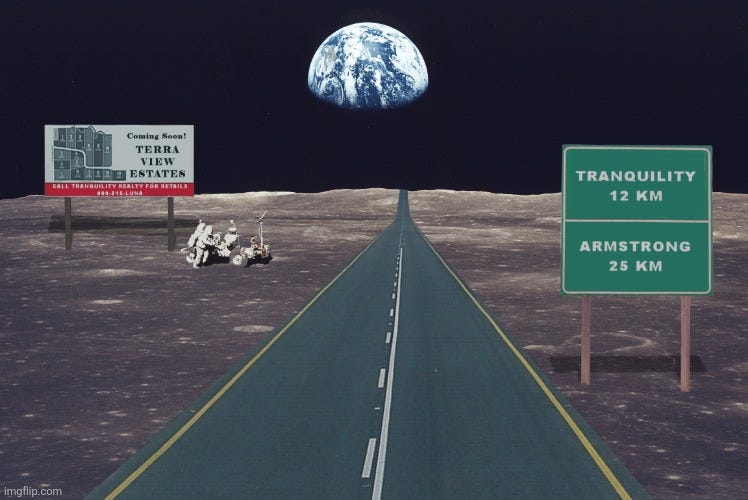
However, moving heavy mining rigs, hauling metric tonnes of volatile ice, and shuttling crew between scattered habitats requires a reliable transit network. Navigating loose, unpredictable dust slopes is highly inefficient, drains rover batteries, and risks catastrophic immobilization in a vacuum. The ultimate maturation of the lunar economy relies on the construction of permanent lunar roads. These paved, heat-treated regolith highways will connect lunar pads to ice mines, and power fields to habitats. They will be the arteries of a new world, seamlessly binding humanity’s first permanent off-world civilization together.
As this infrastructure scales, transport will eventually expand beyond the surface via lunar elevators. Unlike Earth-based space elevators, which remain scientifically unfeasible with current materials, a lunar space elevator is entirely possible today. Because the Moon’s gravity is vastly weaker, existing high-strength polymers can be anchored to the lunar surface and extended to a counterweight past the Earth-Moon Lagrangian point. These lunar elevators will allow cargo and raw resources to be reeled straight up out of the Moon's gravity well without using rocket fuel. Together with moon roads, these engineering triumphs will transform our celestial neighbour from a desolate outpost into a bustling, interplanetary logistics hub.