

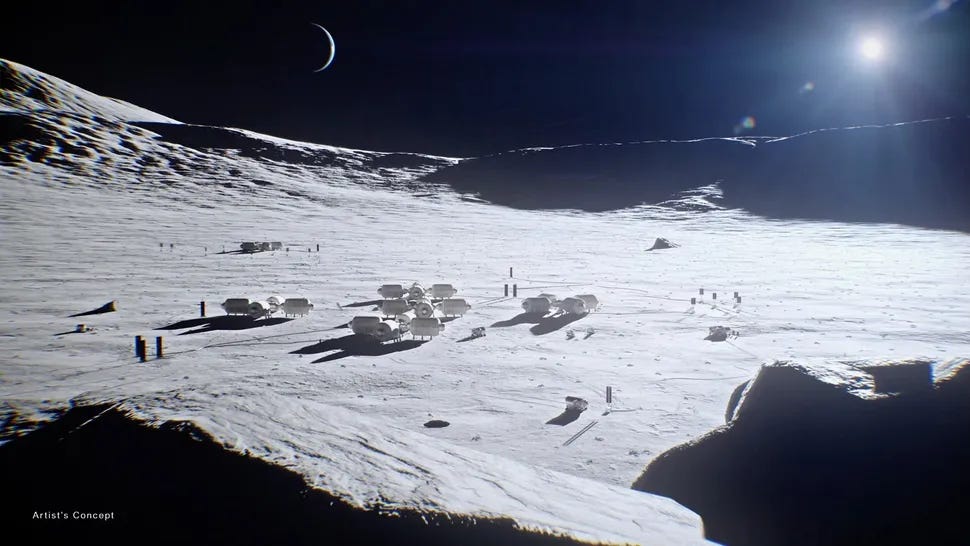
In the quiet intensity of a late autumn weekend at Kennedy Space Center, NASA laid out the next concrete steps toward a permanent human foothold on the Moon. The announcements centered on Phase One of the Moon Base program, a period focused on robotic exploration, infrastructure demonstrations, and commercial deliveries that is expected to run through the end of the decade. At the heart of the news was a new contracting framework that opens the door to as much as ten billion dollars in future lunar cargo missions, alongside the green light for a nuclear-powered rover that will scout the south polar region in preparation for everything that follows.
The centerpiece is the Commercial Lunar Payload Services 2 arrangement, a ten-year multiple-award contract under which eight companies may compete to design, build, fly, and operate landers carrying NASA science instruments, technology demonstrators, and early infrastructure. The selected firms are Blue Origin, Firefly Aerospace, Intuitive Machines, ispace-U.S., Lockheed Martin Space, Northrop Grumman Space Systems, SpaceX, and Voyager Technologies. The ten-billion-dollar figure represents a ceiling rather than an immediate outlay; individual missions will be competed and awarded as task orders over the coming years. At the same time, NASA raised the ceiling of the existing Commercial Lunar Payload Services contract from 2.6 billion to 4.2 billion dollars so that ongoing deliveries can continue supporting the initial phase of base development without interruption.
These arrangements are not abstract procurement exercises. They are designed to create a reliable, competitive pipeline of cargo landers capable of placing meaningful mass on the lunar surface near the south pole, the region chosen for its near-constant sunlight on the crater rims and the ice believed to lie in the permanently shadowed depths nearby. When astronauts eventually arrive, the logic goes, they should find the first elements of a base already waiting rather than having to begin every task from an empty landscape.
One of the most distinctive elements of the announcement is PROMISE, the Polar Rover for Observation, Mapping, and In-Situ Exploration. Rather than designing an entirely new vehicle from a blank sheet, NASA’s Jet Propulsion Laboratory is assembling the six-wheeled rover largely from spare flight hardware and engineering test models left over from the Curiosity and Perseverance Mars missions. The decision is both pragmatic and ambitious. Proven mobility systems, cameras, and structural components will be adapted for the lunar environment and paired with a multi-mission radioisotope thermoelectric generator. That nuclear power source will allow the rover to keep working through the long, bitterly cold lunar night and to venture into the permanently shadowed regions where solar power is useless and water ice is thought to persist.
PROMISE is scheduled for launch late in 2028 and is expected to operate for roughly eighteen months. Its instruments will include a drill capable of reaching about a meter into the regolith, spectrometers, temperature and radiation sensors, and imaging systems. The goal is to characterize the surface and subsurface, map potential resources, and gather the detailed environmental data needed to choose precise locations for future landings, habitats, power systems, and mobility routes. Blue Origin received a ninety-four-million-dollar base contract, with a performance-based option of an additional one hundred forty million dollars, to deliver the rover to the south pole using its Blue Moon Mark 1 lander. The award expands an earlier task order under which the same company is already responsible for delivering two lunar terrain vehicles.
Supporting the surface activity is a parallel effort to strengthen the transportation network between Earth and the Moon. NASA awarded six task orders valued at approximately 1.3 billion dollars under its Venture-Class Acquisition of Dedicated and Rideshare program to Arrow Science and Technology, Blue Origin, and Impulse Space. These missions will use a mix of launch vehicles and orbital transfer stages to move cargo into cislunar space and, in some cases, onward toward the lunar surface. Additional smaller awards are advancing components of a compact power and communications tower known as miniCAST, another early piece of infrastructure intended to support later operations.
Taken together, the announcements reflect a deliberate shift in how NASA approaches lunar exploration. Instead of waiting for a single large architecture to be ready, the agency is building capability incrementally through commercial partners, accepting that some missions will succeed more fully than others while steadily accumulating hardware, data, and operational experience on the surface. Phase One is the period in which the groundwork is laid: robotic scouts mapping the terrain, cargo landers proving they can deliver useful payloads, power and communications systems being tested in the actual environment, and the first mobility platforms arriving to prepare paths for human explorers.
The south pole remains the focal point because of its unique combination of near-continuous illumination on elevated terrain and the scientific and practical value of the ice believed to exist in nearby shadowed craters. Water ice can become oxygen, hydrogen propellant, and drinking water. Reliable power can come from solar arrays placed on the peaks of eternal light or, later, from nuclear systems. Communications and navigation networks can grow outward from initial nodes. PROMISE and the expanding fleet of commercial landers are the tools that will turn those possibilities into measured facts rather than hopeful projections.
NASA Administrator Jared Isaacman captured the philosophy simply: the Moon Base is being built mission by mission. When crews return, they should step onto a surface that already holds the first functional pieces of a sustained presence. The ten-billion-dollar contracting framework, the increased support for current deliveries, the nuclear rover assembled from proven Mars hardware, and the supporting transportation awards are the latest and most substantial steps toward making that vision real. The work remains difficult, the timelines ambitious, and the lunar environment unforgiving, yet the path is no longer theoretical. It is under contract, under construction, and already pointed toward the south pole.