

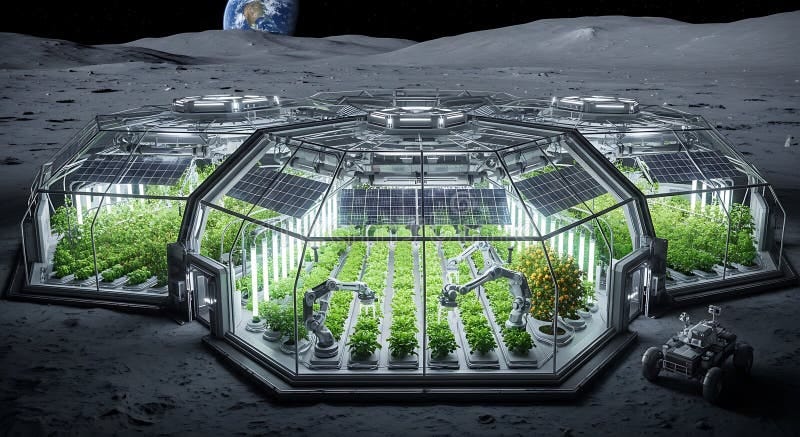
The dawn of a permanent human footprint on our nearest celestial neighbor depends not on the might of our rockets, but on the quiet resilience of a sprouting seed. As space agencies and private enterprise converge on establishing sustainable habitats, moon agriculture has emerged from the realm of science fiction into an urgent economic and technical frontier. Transporting every calorie and kilogram of fresh produce from Earth carries an unsustainable financial and logistical toll, making the capacity to cultivate crops directly from the lunar environment the definitive linchpin for deep-space exploration.
The technical hurdles of cultivating life in the high-radiation, low-gravity environment of the lunar surface are immense. Raw lunar regolith severely compacts and inhibits root expansion when introduced to water, while simultaneously harboring toxic reactive compounds that stifle unconditioned plant biology. To bypass these structural limitations, pioneering researchers are turning to in-situ resource utilization, engineering advanced chemical and mechanical beneficiation procedures to extract vital mineral nutrients—such as phosphates and metallic ions—directly out of raw moon dust.
By washing and treating these extracted minerals, scientists can formulate custom liquid fertilizers designed to feed crops within closed-loop hydroponic and aeroponic modules. These controlled-environment systems optimize every single drop of recycled water and spectrum of artificial illumination, ensuring that moon agriculture functions as a high-efficiency life support mechanism rather than a traditional open field.
From an economic perspective, transitioning toward localized biological production radically alters the cost architecture of space exploration. With launch costs scaling exponentially per kilogram placed into lunar transfer orbit, the initial capital expenditure required to deploy automated nutrient-extraction processing plants and modular greenhouses is rapidly offset by the dramatic reduction in continuous cargo resupply flights.
As automated sensor networks and artificial intelligence monitor plant stress indicators in real-time, the economic viability of commercial outposts, industrial mining operations, and scientific laboratories on the Moon becomes securely anchored. Ultimately, perfecting the closed-loop efficiencies of moon agriculture does more than anchor humanity’s future among the stars; it yields vital, ultra-resource-efficient agricultural innovations that circle back to fortify food security in extreme climates on Earth.