

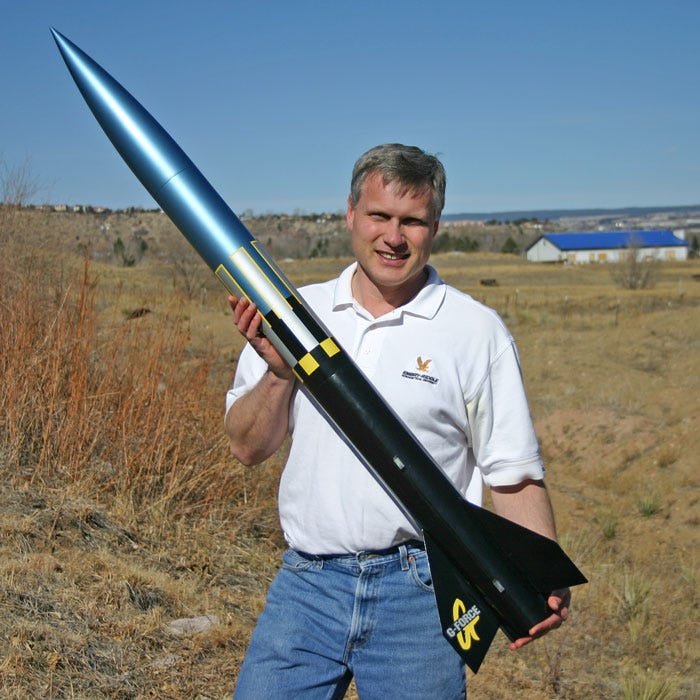
Model rocketry began as a safe, accessible way for enthusiasts to experience the principles of rocketry without the dangers of earlier experimental work. Today it spans everything from simple cardboard-and-balsa kits launched in parks to multi-stage high-power vehicles that reach thousands of feet, carry electronics, and require formal certifications and FAA waivers.

Origins

The modern hobby took shape in the late 1950s. Earlier amateur rocketry often used metal casings and dangerous propellants, leading to accidents. In response, safety-focused designs emerged that used lightweight materials (cardboard, plastic, balsa) and commercially manufactured solid-propellant motors with built-in delay and ejection charges.

Orville and Robert Goddard’s earlier liquid-fuel work inspired the field, but the practical model rocket was standardized by companies such as Estes Industries. The National Association of Rocketry (NAR), founded in 1957, established safety codes, motor certification and organized flying. These standards turned rocketry into a structured educational and recreational activity rather than an uncontrolled experiment.

By the 1960s and 1970s, model rocketry had become a popular STEM gateway. Kits taught basic aerodynamics, stability, recovery systems and the rocket equation in a hands-on way. Launch events drew families, schools and clubs across the United States and later internationally.

The Rise of High-Power Rocketry

As the hobby matured, flyers wanted larger, more capable vehicles. This led to high-power rocketry (HPR), which uses motors with significantly greater total impulse. Two main organizations oversee the activity in the United States: the National Association of Rocketry and the Tripoli Rocketry Association.

High-power flyers progress through certification levels. Level 1 allows certain mid-power motors; Level 2 and Level 3 unlock progressively larger and more powerful systems, often requiring written exams, successful flights and demonstrated recovery. Launches take place at designated sites under FAA certificates of authorization, with strict safety distances, range protocols and insurance provided through the national organizations.

Modern high-power rockets frequently incorporate dual-deployment recovery (drogue at apogee, main parachute at lower altitude), onboard altimeters, GPS trackers, cameras and telemetry. Some experimental projects explore hybrid or, more recently, limited liquid bipropellant motors under controlled research rules.

Contemporary Activity

Model and high-power rocketry remain active worldwide. Local clubs hold regular launches. Major events such as Tripoli’s LDRS (Large Dangerous Rocket Ships) draw hundreds of flyers and feature impressive projects. University rocketry teams compete in contests that push design, propulsion and recovery systems, often bridging into amateur rocketry skills that later feed professional aerospace careers.

Commercial manufacturers continue to supply kits, motors and electronics. Estes remains a major entry-level brand, while companies specializing in high-power motors and components serve the advanced end of the hobby. Online communities, simulation software and 3D-printed parts have lowered barriers to custom designs.

Safety remains central. Certified motors, established codes, range safety officers and recovery requirements keep the activity remarkably safe relative to its energy levels. Regulatory frameworks balance access with public and aviation safety.

Enduring Appeal

Model rocketry endures because it combines craftsmanship, physics, electronics and the visceral satisfaction of flight. A beginner can still launch a simple kit in an afternoon. An experienced flyer can spend months designing, building and refining a vehicle that reaches the edge of controlled airspace and returns under parachute with data and video.

Sixty-plus years after its formal organization, the hobby continues to evolve—incorporating better materials, smarter avionics and occasional experimental propulsion—while retaining the core principles of safety and accessibility that defined it from the start. For many participants it remains the most direct personal connection to the broader world of rocketry and spaceflight.