

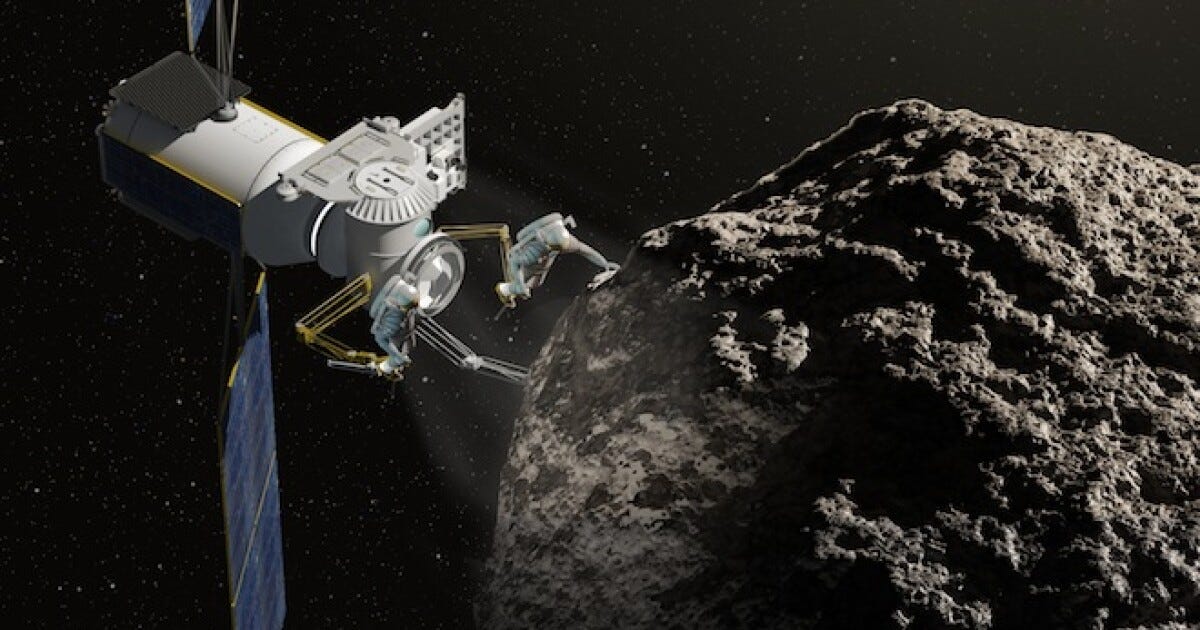
Asteroids are the leftover building blocks of the solar system—rocky, metallic, and carbon-rich fragments that never coalesced into planets. For decades they have been objects of scientific curiosity. In the 2020s they have also become the focus of a more practical question: can we extract their resources and put them to use?
The short answer is that commercial asteroid mining has not yet begun. No company has extracted material from an asteroid, processed it at scale, and delivered a product to a paying customer. Yet the foundations are being laid through sample-return missions, robotic prospecting flights, and a clearer understanding of which resources matter most—and where they will actually be valuable.
What Asteroids Offer
Near-Earth asteroids (NEAs) are the most accessible targets. Tens of thousands have been catalogued; a subset requires less energy to reach than the lunar surface. They fall into broad compositional classes.
Carbonaceous (C-type) asteroids contain water-bearing minerals, organic compounds, and other volatiles. Water can be split into hydrogen and oxygen for rocket propellant, life support, and radiation shielding. In the emerging view of space resource experts, water is the near-term prize because it can be used in space itself, dramatically reducing the mass that must be launched from Earth.
Metallic (M-type) asteroids are richer in iron, nickel, cobalt, and platinum-group metals. Some may represent the exposed cores of differentiated protoplanets. These bodies attract attention for structural metals that could be used in orbital construction and for high-value elements that are scarce in Earth’s crust. Stony asteroids sit between the two extremes.
NASA’s Psyche mission, launched in 2023 and scheduled to arrive at its metal-rich target in 2029, will provide the first detailed look at a large M-type body. Earlier sample-return missions—Japan’s Hayabusa2 at Ryugu and NASA’s OSIRIS-REx at Bennu—have already delivered grams of primitive material and confirmed that water-rich and organic-bearing asteroids exist within reach.
The Commercial Landscape
A handful of startups are attempting to move from concept to flight. AstroForge has flown early deep-space missions aimed at characterizing metal-rich targets and testing refining approaches; further rendezvous attempts are planned. TransAstra is developing optical mining techniques that use concentrated sunlight to liberate volatiles, along with systems for capturing small bodies or debris. Other firms are focused on regolith collection, in-space processing, or the logistics of moving material once it is extracted.
These efforts remain at the demonstration stage. Spacecraft are small, budgets are limited compared with national science missions, and setbacks—communications failures, power issues, missed targets—are part of the learning curve. Larger aerospace companies and agencies are watching closely, filing patents and funding studies, but the pure-play mining ventures are still proving basic capabilities.
Economics and Reality
Headline valuations that multiply an asteroid’s estimated metal content by current terrestrial commodity prices are largely meaningless. Returning bulk material to Earth’s surface is extraordinarily expensive. The more credible near-term business case is in-space utilization: producing propellant for cislunar tugs and depots, supplying feedstock for orbital manufacturing, or delivering metals and volatiles to support lunar or Martian infrastructure.
Studies examining supply chains to Mars, for example, show that carefully chosen asteroids—processed with propellant made on-site from local water—could in principle deliver structural metals more efficiently than launching everything from Earth. Target selection is critical. The wrong asteroid can consume more energy than the resources are worth.
Technical hurdles remain substantial. Microgravity makes conventional digging and anchoring difficult. Dust behavior, material cohesion, and thermal extremes differ from terrestrial mines. Processing equipment must be autonomous, reliable, and lightweight. Prospecting data is still sparse; remote spectra and a few returned samples do not yet equal the detailed ore-body knowledge miners take for granted on Earth.
Legal frameworks are evolving in parallel. The Outer Space Treaty prohibits national appropriation of celestial bodies but is silent on resource extraction by private entities. National laws in the United States and several other countries assert that companies may own the materials they extract. The Artemis Accords, signed by dozens of nations, treat resource use as compatible with the treaty. Clearer international norms will be needed as activity increases.
A Supporting Role in the Larger Economy
Asteroid mining is best understood as one element of a broader shift toward using space resources. Lunar polar ice is closer and is already a focus of NASA’s Moon Base plans and commercial lander missions. Asteroids complement that effort: some NEAs are energetically favorable, and their diversity offers both water and metals. In the long run, the asteroid belt contains far larger inventories, but the first practical steps will almost certainly involve the nearer, smaller bodies.
Progress will be incremental. The next decade is likely to see improved prospecting, small-scale extraction tests, and the first kilograms of asteroid-derived material used in space. Whether that leads to a self-sustaining industry depends on launch costs continuing to fall, in-space transportation maturing, and demand for propellant and construction materials growing with lunar and cislunar activity.
Asteroids are not treasure chests waiting to be opened. They are raw material depots in a harsh environment, reachable only with careful engineering and realistic economics. The companies and agencies now flying the first missions are testing whether those depots can become part of a working space economy. The answer will shape how far humanity can operate beyond Earth.