

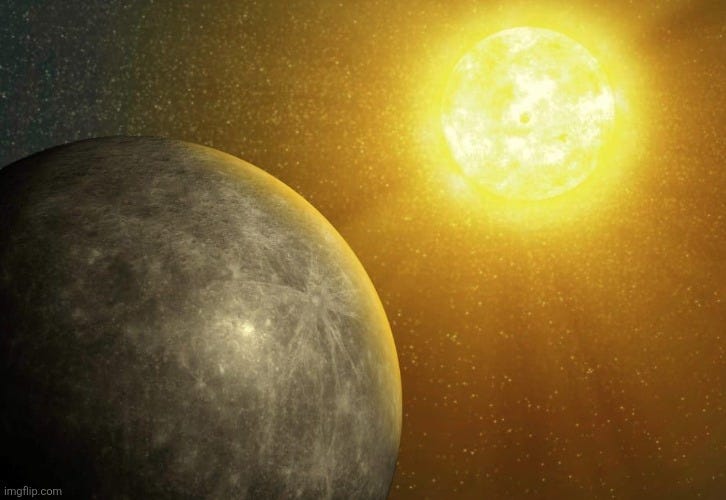
A New Era of Inner Solar System Exploration
On November 21, 2026, the joint European and Japanese BepiColombo spacecraft successfully entered orbit around Mercury after an eight-year voyage. Following in the footsteps of NASA’s MESSENGER probe, BepiColombo is only the second mission in history to orbit the solar system’s innermost world. While its twin orbiters will spend the coming years mapping the planet’s scorched terrain and magnetosphere, this milestone reignites a bold long-term question. Far from being an uninhabitable wasteland, the polar regions of Mercury hold a surprising combination of resources and physical traits that could make them a premier destination for future human settlement.
The Strategic Advantages of Mercury’s Poles
Because Mercury has almost no axial tilt, the floors of deep impact craters near its north and south poles never see direct sunlight. Radar observations suggest these permanently shadowed traps hold between 100 billion and one trillion tons of water ice, alongside frozen organic compounds. This abundance of water could sustain human life, supply agricultural domes, and be split into hydrogen and oxygen for rocket propellant. Just beyond the rims of these freezing craters, elevated peaks sit in near-constant sunlight, offering uninterrupted access to solar energy that is roughly seven to ten times more intense than on Earth.
Beyond water and power, Mercury offers distinct physical advantages over other off-world destinations. Its surface gravity is roughly 38 percent of Earth’s, more than double the Moon’s gravity and virtually identical to Mars. Higher gravity could significantly reduce the muscle atrophy and bone loss astronauts suffer in low-gravity environments. Mercury is also much closer to Earth than the asteroid belt or the icy moons of Jupiter and Saturn, allowing for far shorter communication delays and more frequent supply windows. Furthermore, Mercury is the only rocky planet besides Earth to possess an active global magnetic field, which provides a modest shield against the relentless solar wind. Combined with a crust and mantle extraordinarily rich in metals—the planet is roughly 70 percent metal by mass—Mercury could serve as an industrial powerhouse for space-based manufacturing.
Extreme Temperatures and Engineering Hurdles
Despite the mild, twilight-like thermal stability found right along the polar crater rims, Mercury remains one of the most hostile environments in the solar system. Outside the polar shadows, surface temperatures soar to 430 degrees Celsius during the long solar day and plunge to minus 180 degrees Celsius at night. Any polar outpost would require extreme thermal management to prevent habitats from overheating under reflected sunlight or freezing in the dark. Intense ultraviolet and X-ray radiation from the nearby Sun, coupled with periodic solar flares, would also force colonists to build heavily shielded structures.
Reaching the planet presents an equally daunting engineering challenge. Because Mercury sits deep within the Sun’s gravitational well, spacecraft accelerating toward it gain tremendous speed. Entering orbit requires shedding massive amounts of kinetic energy, demanding more fuel or complex planetary flybys than missions to the outer solar system. Landing heavy cargo on an airless world without parachutes further compounds the propulsion problem, meaning early colonization would depend on advanced solar-electric propulsion, reusable landers, and robotic pre-deployment.
Geological Enigmas and Subterranean Mysteries
Beneath its cratered surface, Mercury hides geological puzzles that future explorers will need to unravel. The planet is dominated by an enormous iron-nickel core that makes up roughly 85 percent of its radius, leaving only a thin rocky shell. Scientists still do not know whether Mercury formed in a metal-rich region of the early solar nebula or had its outer mantle stripped away by a cataclysmic giant impact. Understanding this core will also explain how such a small world generates its magnetic field.
On the surface, spacecraft have spotted peculiar, rimless depressions known as hollows—bright, shallow holes that appear geologically young and may still be actively forming as volatile minerals vaporize in the solar heat. Building near unstable, outgassing ground poses a clear hazard to surface infrastructure. Conversely, Mercury’s volcanic plains conceal massive collapsed pits and intact lava tubes. Because of the planet’s lower gravity, these underground caverns could be miles wide, offering ready-made, radiation-proof shelters with stable temperatures if engineers can safely map and access them.
From Lunar Bases to Mercurian Outposts
Visually and structurally, Mercury bears a striking resemblance to Earth’s Moon. Both are airless, heavily cratered rocky bodies battered by micrometeorites and cosmic radiation. Crucially, both harbor water ice inside permanently shadowed polar craters right next to sunlit crater rims. This architectural similarity means the Moon can serve as a direct proving ground for Mercury.
Every technology developed to establish a sustained human presence at the lunar south pole—from autonomous ice-mining rovers and dust-mitigation seals to closed-loop life support, nuclear fission surface power, and regolith 3D-printing—can be adapted for Mercury. Once humanity masters living and working inside the polar craters of the Moon, expanding inward to Mercury will no longer be a leap into the unknown, but a natural extension of proven lunar engineering.