

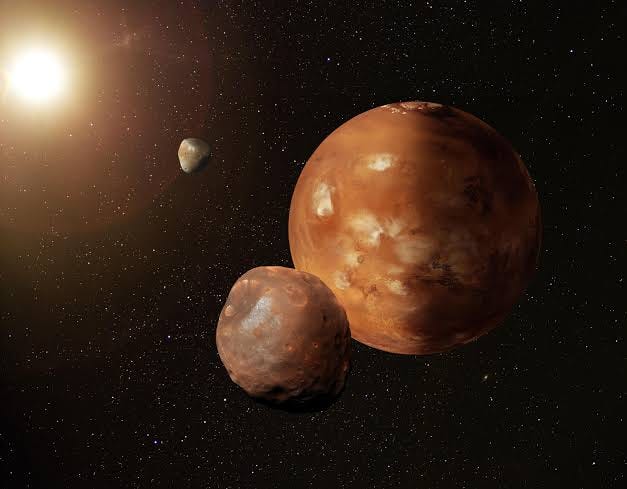
The two small moons of Mars have long occupied a peculiar place in planetary science, hovering at the edge of familiarity yet stubbornly resisting easy classification. Phobos, the larger and closer of the pair, measures roughly twenty-seven kilometres across at its widest and races around the Red Planet in just under eight hours, so near that it rises in the west and sets in the east for an observer on the surface below. Deimos, smaller and more distant, takes a little more than thirty hours to complete a circuit and appears as a faint, slow-moving point of light. Both are irregular, heavily cratered, and dark, their surfaces reflecting only a few per cent of the sunlight that falls upon them. Their bulk densities are low, around one point nine grams per cubic centimetre for Phobos and even less for Deimos, suggesting interiors that may be porous or contain significant voids. To the casual eye they resemble nothing so much as captured asteroids, fragments of the main belt that somehow wandered too close to Mars and never escaped.
Yet their orbits tell a different story. Both moons travel in nearly circular paths that lie almost exactly in the equatorial plane of Mars. Captured bodies typically arrive on eccentric, inclined trajectories; circularising and aligning those paths requires mechanisms that stretch the bounds of plausibility, especially for the more distant Deimos. Early ideas invoked atmospheric drag from a thicker primordial Martian atmosphere or tidal interactions over billions of years, but the timescales and efficiencies remain contentious. Spectroscopic observations compound the puzzle. The reflectance spectra of Phobos and Deimos broadly match those of primitive carbonaceous asteroids, particularly the dark D-type or C-type objects found in the outer main belt and among the Jupiter Trojans. This spectral kinship has long favoured the capture hypothesis. At the same time, the dynamical regularity of the orbits has steadily pushed researchers toward an alternative: that the moons formed in place from debris generated by a giant impact early in Martian history.
The impact scenario draws inspiration from the accepted origin of Earth’s Moon. A body perhaps the size of Vesta or Ceres strikes Mars, ejecting material that settles into a circumplanetary disk. Within that disk, moons can accrete. Modern simulations show that such an event can produce satellites with the observed sizes and orbital characteristics of Phobos and Deimos, sometimes with the help of a larger, temporary inner moon that later spirals inward and is lost. The great northern lowlands of Mars, the Borealis basin, have been proposed as the scar of that ancient collision. In this picture the moons would contain a mixture of Martian crustal material and remnants of the impactor, processed through the heat and violence of the impact and subsequent reaccumulation. Spectral similarities to asteroids could then be explained by space weathering, the presence of fine-grained regolith, or the condensation of outer-disk material under cooler conditions.
A more recent refinement suggests that Phobos and Deimos may share a common progenitor that itself formed in orbit around Mars. Orbital reconstructions indicate that the two moons’ paths crossed between one and two point seven billion years ago. The implication is that a larger parent body was disrupted, perhaps by a secondary impact, leaving the two fragments we see today. Tidal evolution then carried Phobos inward of the synchronous orbit while Deimos remained outside, slowly drifting outward. This model reconciles the dynamical evidence for a shared origin with the possibility of an earlier in-situ formation event.
These competing narratives cannot be settled by remote sensing alone. Composition is the decisive test. If the moons are captured asteroids, their bulk chemistry and mineralogy should resemble primitive carbonaceous chondrites, rich in hydrous minerals, organics, and materials that never experienced the high temperatures of planetary differentiation. If they formed from a giant impact, their makeup should show a clear affinity to Martian crust or mantle, perhaps diluted by impactor material. Only laboratory analysis of returned samples can provide the isotopic ratios, mineral assemblages, and volatile inventories needed for a definitive answer.
That laboratory analysis is the central promise of the Martian Moons eXploration mission led by the Japan Aerospace Exploration Agency. Scheduled for launch in October 2026 aboard an H3 rocket from Tanegashima Space Center, the spacecraft will travel for roughly a year before arriving at Mars in 2027. Once there it will settle into a quasi-satellite orbit that allows prolonged proximity to Phobos while remaining bound to the planet. From this vantage the mission will map the moon’s surface in extraordinary detail, measure its topography, and probe its composition with a suite of spectrometers, including a gamma-ray and neutron instrument contributed by NASA. A small rover named Idefix, developed jointly by the French and German space agencies, will be deployed to the surface. Weighing twenty-five kilograms on Earth, the rover will experience an effective weight of only about fifteen grams on Phobos, allowing it to hop and crawl across the low-gravity terrain for up to one hundred days, analysing soil texture and mineralogy at multiple sites.
The main spacecraft itself will then descend for one or two brief landings. Sampling systems include a corer capable of extracting material from a depth of two centimetres and a pneumatic device that uses pressurised gas to loft surface grains into a collection chamber. The goal is to gather at least ten grams of regolith, a quantity small by terrestrial standards yet transformative for planetary science. After sample collection the spacecraft will depart Phobos, perform flybys of Deimos for comparative observations, and begin the journey home. In 2031 a return capsule will separate and land in Australia, delivering the first material ever deliberately returned from the Martian system.
The scientific return extends beyond the origin question. Samples may contain hydrous minerals or organic compounds that illuminate the delivery of water and prebiotic chemistry to the inner solar system. Remote observations of both moons and of Mars itself will constrain the evolution of the entire Martian sphere, from the early impact environment to the present-day interaction between the moons and the planet’s thin atmosphere and radiation field. Engineering achievements are equally significant: the mission will demonstrate the technologies required for round-trip travel between Earth and Mars, including precise navigation in the complex gravitational environment near Phobos and the handling of samples under planetary protection protocols.
Whether the returned grains prove to be fragments of an ancient asteroid or the reconstituted debris of a Martian catastrophe, they will rewrite a fundamental chapter in the history of the solar system. The moons of Mars have waited more than a century and a half since their discovery by Asaph Hall for a definitive origin story. In the coming years that story will finally be written, not in the language of remote spectra and orbital dynamics alone, but in the precise chemical signatures of matter carried across interplanetary space and examined under terrestrial microscopes. The answers will ripple outward, refining models of moon formation around terrestrial planets, clarifying the role of giant impacts in the early solar system, and perhaps illuminating the pathways by which the building blocks of life moved among the worlds of the inner solar system.