

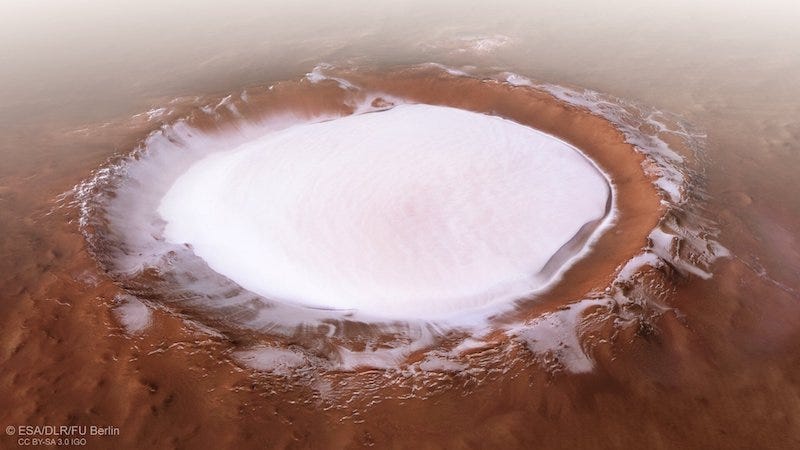
Image of Korolev Crater taken by the European Space Agency’s Mars Express orbiter in 2018.
Recent data from planetary probes reveals that Martian ice water is shockingly clean—cleaner, in fact, than anyone expected. For decades, scientists assumed that any H2O trapped in the Martian polar caps and sub-surface glaciers would be a gritty, frozen sludge. We pictured it as the planetary equivalent of that crusty, freezer-burned block of ice at the bottom of a chest freezer that smells faintly of old fish sticks. Instead, it turns out Mars is packing pristine, ultra-pure glaciers that would make high-end Earth bottled water brands look like puddle runoff.
This is fantastic news for future astronauts, but it comes with a massive, chemical catch. You cannot just chip off a piece of the red planet, drop it into a shaker, and pour yourself a Martian martini.
If you tried to serve a cocktail on the rocks using pure Martian ice, your guests wouldn’t just complain about the lack of olives. They would suffer from severe, rapid thyroid shutdown. The cosmic party pooper here is a class of chemical salts known as perchlorates. While the water ice itself is remarkably free of cosmic dust, heavy metals, and alien microbes, it is heavily seasoned with these toxic compounds. On Earth, perchlorates are primarily used to manufacture rocket fuel, fireworks, and explosives. On Mars, they are just sitting around in the soil and ice like a terrible, invisible garnish.
Perchlorates are incredibly stable, highly soluble, and exceptionally good at lowering the freezing point of water, which is why liquid brines can exist on the freezing Martian surface. Unfortunately, they are also exceptionally good at blocking the human thyroid gland from absorbing iodine. Drinking a glass of untreated Mars water would essentially put your metabolism into a permanent coma. It is the ultimate cosmic irony: the universe has provided a giant, glowing billboard of crystal-clear water, but it is pre-packaged with a lethal dose of literal rocket propellant.
To make this water drinkable, future colonists will need to run every single drop through a rigorous chemical detox. This process involves industrial-grade reverse osmosis filters or deploying specialized, perchlorate-munching bacteria to clean up the mess. It turns out that living on Mars will require a lot of chores, and “de-poisoning the ice cubes” is right at the top of the list.
So, while Elon Musk and NASA engineers celebrate the fact that they won’t have to melt through miles of muddy gravel to get a drink, the rest of us will have to wait. The water on Mars is clean, beautiful, and absolutely pristine. But until the first automated water-treatment pubs open up in the Jezero Crater, you are much better off sticking to Earth water for your happy hour. It might have a little microplastic in it, but at least it won’t launch your thyroid into deep space.