

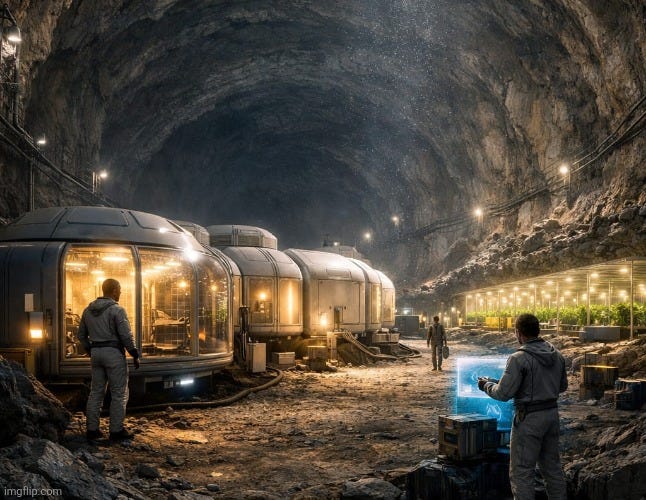
The Moon’s surface has long defined our image of the place: a barren, sun-blasted plain of gray dust and ancient craters under a sky of pure black. Yet beneath that familiar face lies a different landscape entirely, one shaped not by impacts alone but by the slow, fiery architecture of volcanic rivers that once flowed across the young lunar world. In places these rivers cooled from the outside in, forming hard crusts over still-molten rock that later drained away and left behind long, hollow tunnels. These are the lunar lava tubes, and they may offer one of the most practical and protective environments available for the first permanent human footholds on another world.
Lava tubes form when basaltic magma flows across a surface and the outer layers solidify while the interior continues to move. On Earth such tubes are common in places like Hawaii and Iceland, typically measuring meters to tens of meters across. On the Moon the story scales upward dramatically. Lower gravity allowed ancient flows to travel farther and to remain fluid longer. The absence of an atmosphere meant cooling occurred differently, and the resulting tubes could grow to extraordinary size. Orbital data from NASA’s Lunar Reconnaissance Orbiter, Japan’s Kaguya, and India’s Chandrayaan missions have revealed chains of collapse pits and elongated depressions that align with the expected paths of these buried channels. Some of the most compelling evidence comes from “skylights,” circular openings where the roof of a tube has collapsed, offering rare windows into the darkness below. Gravity measurements and radar sounding further suggest empty volumes of surprising scale lying just beneath the mare plains.
Estimates of their dimensions remain provisional yet consistently impressive. Certain candidate tubes appear to stretch for tens of kilometers, with interior widths and heights measured in the tens or even hundreds of meters. One well-studied feature near the Marius Hills on the Oceanus Procellarum has been interpreted as a tube large enough to contain a substantial modern city block, and possibly far more. Other candidates in the Gruithuisen region and along the edges of major impact basins hint at similar or greater volumes. These are not narrow crawl spaces. They are potential caverns whose floors, walls, and ceilings could enclose habitats the size of stadiums or longer linear settlements stretching into the distance. The structural integrity of such voids is believed to be high; the lunar basalt, cooled in vacuum and under low gravity, forms strong arches capable of spanning distances that would collapse under terrestrial conditions.
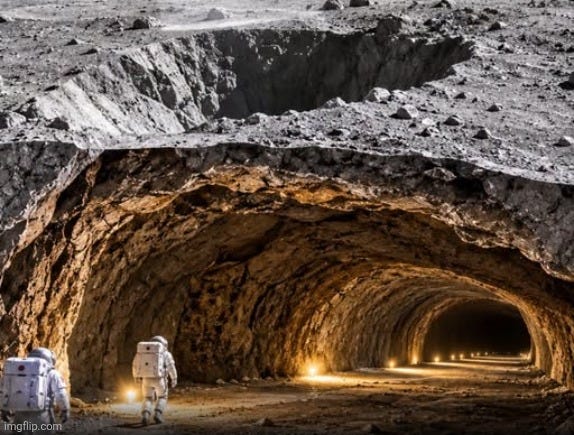
The practical advantages for habitation begin with radiation. The lunar surface is bathed continuously in galactic cosmic rays and, during solar events, in intense streams of energetic particles. A few meters of regolith provide meaningful shielding; tens of meters reduce the dose to levels comparable to or better than those experienced on the International Space Station. The roofs of lava tubes, often estimated at ten to forty meters thick or more, deliver this protection without the need to pile tons of soil over pressurized modules. The same thickness also stops micrometeorites that constantly rain onto the surface and shields against the extreme temperature swings of the lunar day-night cycle. Inside a sufficiently deep tube the thermal environment is expected to remain relatively stable, hovering near the average subsurface temperature rather than oscillating between the boiling heat of noon and the cryogenic cold of night. Dust, that abrasive and electrostatically charged nuisance of surface operations, would be largely excluded once the entrance is controlled.
These natural cavities could therefore serve as ready-made shelters into which inflatable or rigid habitat modules might be placed with far less construction effort than equivalent surface bases. Power systems, life-support equipment, and living quarters could be deployed under a permanent rock ceiling, reducing the mass that must be landed from Earth and simplifying thermal control. The large internal volumes also open possibilities for long-term growth: laboratories, workshops, greenhouses, and recreation spaces could expand along the length of a tube without the constant need to excavate or pile additional shielding. In the longer term, the same environment might support more ambitious concepts such as sealed agricultural zones or even small industrial facilities protected from the harsh exterior.
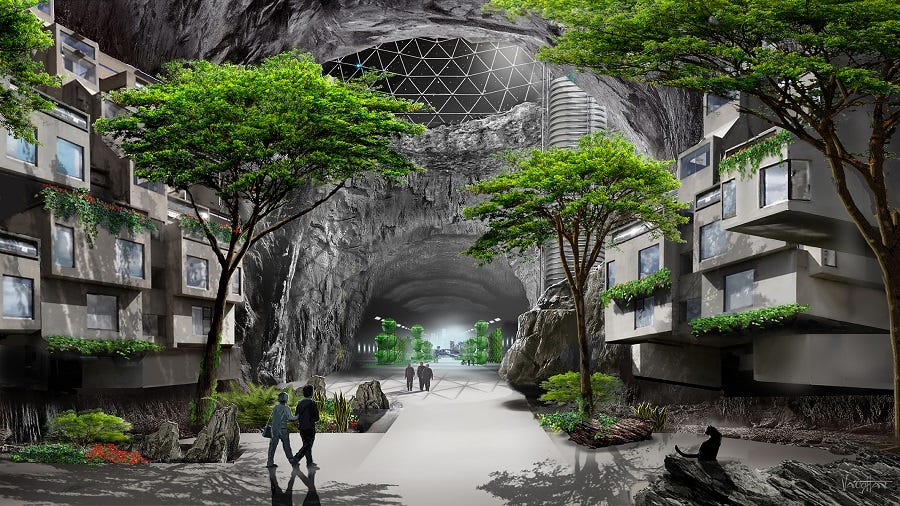
Access remains the central engineering challenge. Skylights provide dramatic entrances but are often steep-walled and unstable at the rim. Ramps, elevators, or carefully engineered tunnels would be required to move people and cargo safely between the surface and the tube floor. Robotic scouts must first map the interiors, testing for rockfalls, measuring radiation and temperature profiles, and confirming that the voids are continuous rather than interrupted by collapses or solidified plugs. Seismic activity on the Moon is mild compared with Earth, yet the tubes themselves may contain fractures or weak zones that need assessment. Proximity to useful resources matters as well. Tubes located near the poles could benefit from nearby ice deposits in permanently shadowed craters, while those in the equatorial maria sit closer to abundant solar power and certain mineral concentrations. The ideal site would combine structural soundness, convenient access, and strategic location relative to landing zones and future infrastructure.
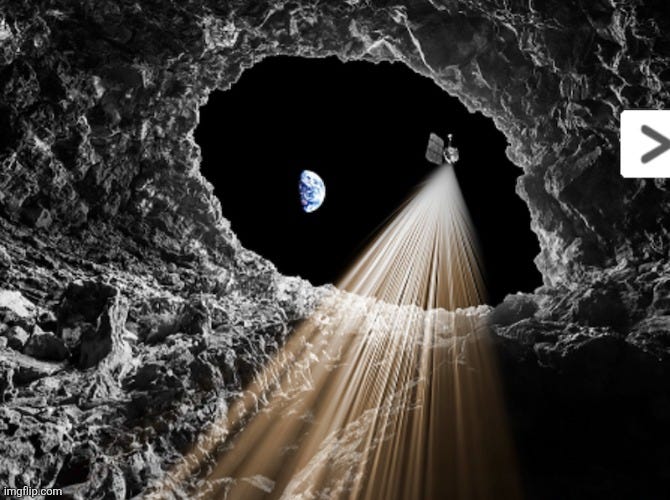
Exploration of these underground spaces is already beginning in earnest through orbital surveys and the planning of future robotic missions. Concepts for small tethered robots or hopping probes that can descend skylights and traverse the dark floors are under study. Human missions under the Artemis program will initially focus on the surface, yet the knowledge that substantial natural shelters exist nearby is reshaping long-range thinking about base architecture. Instead of treating the Moon solely as a hostile exterior that must be fought with every kilogram of shielding and insulation, planners can begin to regard it as a world that already contains ready-made refuges.
The lava tubes therefore represent more than geological curiosities. They are potential catalysts for a different kind of lunar presence, one that works with the Moon’s own history rather than against its surface extremes. In the quiet darkness of these ancient volcanic channels, protected by meters of solid rock, the first generations of lunar settlers might find not only safety but room to grow. The same forces that once poured molten rock across a young Moon may, billions of years later, offer humanity its most practical path to living there.