

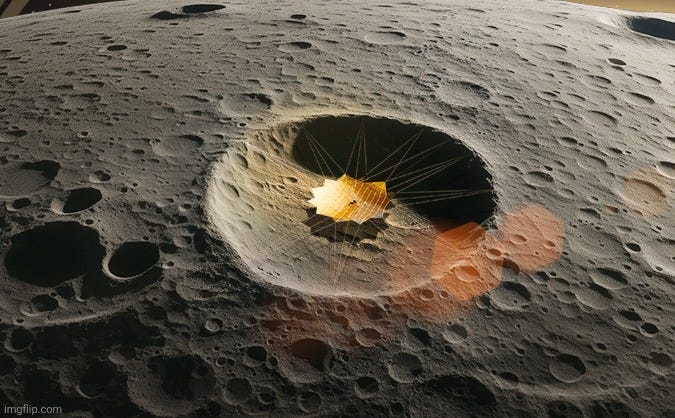
There is no dark side of the Moon, whatever Pink Floyd led several generations to believe. Both faces of the Moon receive roughly equal sunlight over the course of a month. What the Moon does have, thanks to being tidally locked in its orbit, is a far side, one hemisphere that never once faces Earth, hidden from us for the entirety of human history until a Soviet probe finally photographed it in 1959. For most of the Space Age, that far side has been treated as a curiosity, a place to land a rover for the novelty of it. Astronomers now see it as something closer to the quietest room left in the solar system, and they are racing to get there before anyone fills it with noise.
The thing worth protecting is not darkness. It is silence, specifically radio silence, and the scale of it is almost comic once you say the number out loud. The Moon itself weighs something like seventy three quintillion tonnes, and every gram of that mass sits, for half of each lunar orbit, directly between the far side and the entire electromagnetic racket generated by human civilization. Television broadcasts, radar, mobile networks, the billions of satellites and transmitters surrounding Earth, all of it gets physically blocked by the biggest, simplest shield imaginable. Earth’s own atmosphere compounds the problem for anyone trying to listen from the ground, since its upper ionosphere bounces and scrambles exactly the lowest, faintest radio frequencies scientists most want to hear. The Moon has no ionosphere to get in the way. Between the shielding and the silence, the lunar far side is, by the account of the researchers who have spent careers chasing this, the best environment for low frequency radio astronomy anywhere in the inner solar system, full stop.
What that silence actually buys astronomers is access to a period of cosmic history that is otherwise completely unreachable. Long before the first stars switched on, the infant universe passed through what cosmologists call the Dark Ages, a stretch of hundreds of millions of years with no starlight at all, nothing but expanding clouds of hydrogen slowly cooling in the darkness. That hydrogen left behind one faint signature, a radio signal stretched by the universe’s own expansion down into frequencies so low that Earth’s noise and atmosphere drown it out completely, everywhere, always. Nobody has ever directly observed this era. The lunar far side may be the only place close enough to actually try.
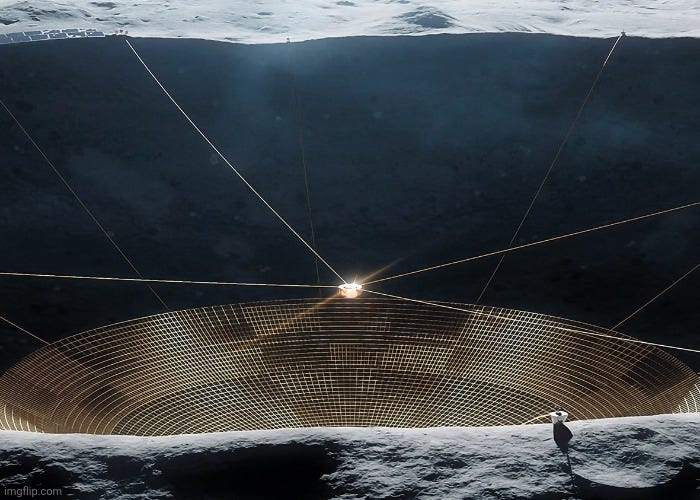
Getting there has turned out to be harder than the physics alone would suggest. China reached the far side first in any meaningful sense, landing the Chang’e 4 mission there in 2019 along with a basic radio antenna, though the lander’s own electronics ended up contaminating some of the very quiet it had traveled so far to find, a lesson in how easy it is to bring the noise with you. NASA and the Department of Energy have spent years since preparing a more deliberate answer called LuSEE Night, a small pathfinder radio telescope built specifically to prove the far side performs the way theory predicts before anyone commits serious money to something bigger. It was originally meant to launch in 2025. As of the most recent public updates, it still had not flown, now riding toward late 2026 aboard a lander from Firefly Aerospace, the mission slipping the way ambitious lunar hardware so often does. China, for its part, is not waiting around either, with plans for something called LARAF, a far larger array built from 270 individual radio antennas spread across the same terrain. NASA’s own engineers have floated something stranger still on paper, a kilometer wide dish strung inside a natural crater by wall climbing robots, a concept so far beyond current budgets that even its own advocates describe its future as genuinely uncertain.
None of this is simple engineering, and the far side punishes carelessness in ways the near side does not. A telescope sitting there cannot talk to Earth directly at all, since the Moon’s own bulk blocks any straight line signal, which means every mission needs its own relay satellite just to phone home. Lunar nights and lunar days both last a punishing fourteen Earth days apiece, swinging hardware between extremes most electronics were never designed to survive. And the entire project rests on a kind of trust that has rarely held up well in any newly opened frontier: everyone else staying quiet. Scientists working on this problem have started describing the current moment in genuinely worried terms, warning that the same rush of national and commercial lunar activity now aiming at the Moon’s poles and surface could just as easily start cluttering the far side with communications satellites and powered landers, each one leaking exactly the kind of interference the whole project depends on avoiding. One researcher, only half joking, called it a looming Wild West, the quietest place left in reach of Earth now facing the very real possibility of being talked over before anyone finishes listening.
There is something almost poetic in that tension. Humanity spent its entire existence unable to see the far side of its own Moon, and the moment we finally reached it, we discovered its most valuable property wasn’t anything visible at all, but the silence we’d never been able to hear from anywhere else. Whether that silence survives the next decade of lunar ambition, ours and everyone else’s, may end up deciding whether we ever actually get to listen to the universe’s first, faintest whisper, or whether we drown it out with our own, right as we finally got close enough to hear it.