

Lunar Craters
The Moon’s face has always told a story of violence. Every dark blotch, every bright ray, every shadowed pit is the signature of a collision — some ancient beyond imagining, others startlingly recent. This week that story got a new chapter, and it is a big one.
How Craters Are Born
Craters form when something moving very fast hits something that isn’t moving at all. On Earth, weather, water, and plate tectonics erase most of the evidence within a few million years. The Moon has none of that. No atmosphere to burn up incoming debris, no wind to soften an edge, no rain to fill a hole. Once a crater is punched into the lunar surface, it stays essentially frozen in time, sometimes for billions of years.
The classic process goes like this: an asteroid or comet fragment slams into the surface at speeds of many kilometers per second. The kinetic energy releases as an explosion, vaporizing and melting rock, excavating a bowl-shaped cavity, and throwing debris outward in a spray that can stretch for miles. Bigger impacts create central peaks where the floor rebounds upward after the initial shock, and the largest of all — the multi-ring impact basins — reshaped entire regions of the Moon early in its history. Some of the Moon’s biggest scars stretch more than a thousand miles across, monuments to an era of bombardment far more intense than anything happening today.
A Brand New Crater, Caught in the Act
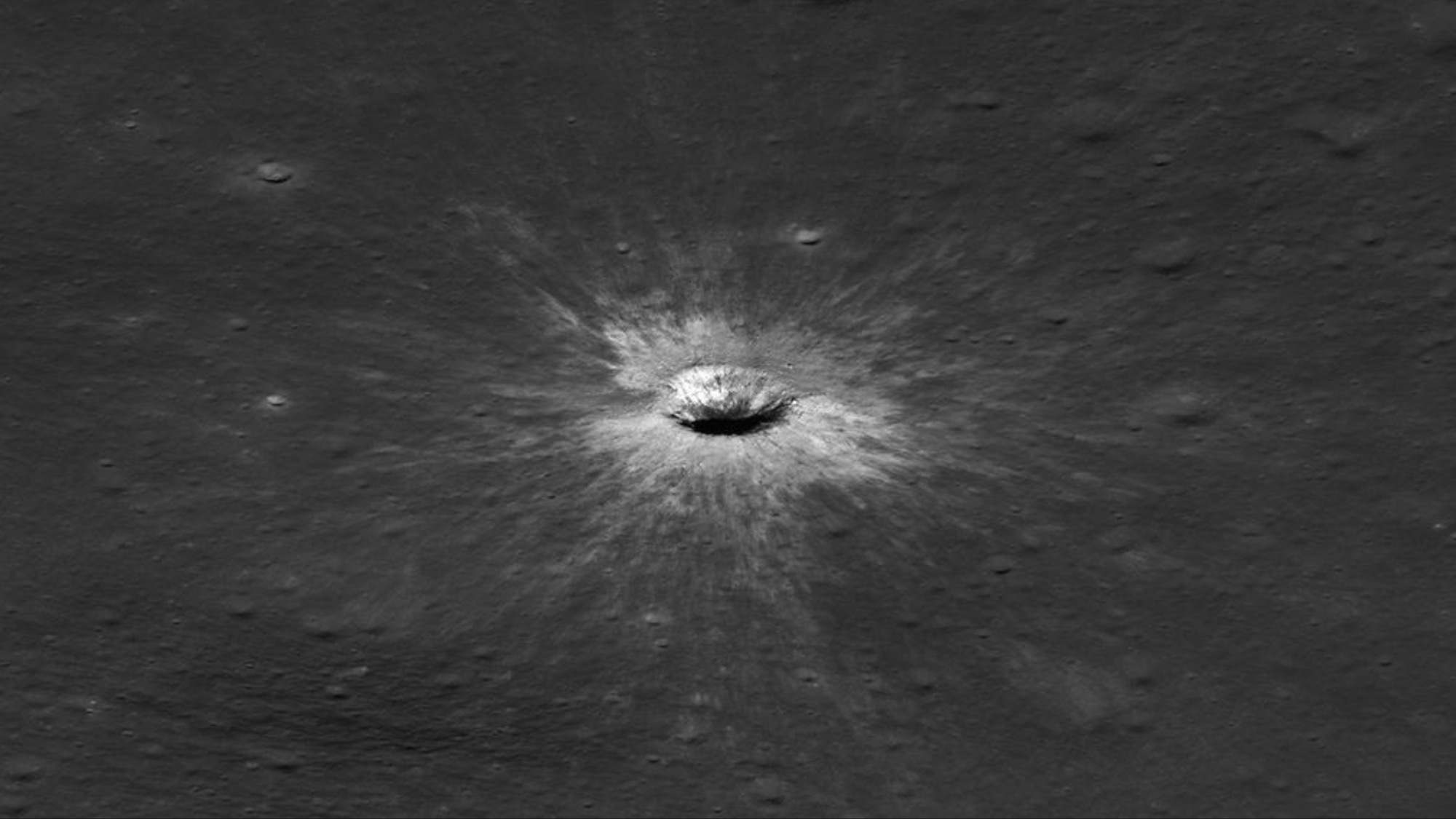
Most craters are ancient. This one is barely older than a toddler. Scientists using NASA’s Lunar Reconnaissance Orbiter have just confirmed a newly formed impact crater on the Moon’s near side that is bigger than the Roman Colosseum, and it appears to be the largest crater carved out anywhere in the solar system in recent memory. The steep-sided hole is about 728 feet across and up to 141 feet deep, the result of a powerful impact roughly two years ago that initially went undetected.
Researchers estimate an impact event on this scale happens only about once every 132 years, making it an extraordinary opportunity to study a violent process usually only inferred from ancient, weathered scars. A separate study even found a roughly four-mile-wide cold spot surrounding the new crater, consistent with a loosening of the Moon’s top layer of soil, something one co-author compared to gardening.
What makes the discovery almost stranger than the crater itself is how long it went unnoticed. The Lunar Reconnaissance Orbiter spotted the crater on the Moon’s near side in May 2024, soon after it formed from an incoming fragment of an asteroid or comet, but the impact escaped real time detection by telescopes on Earth and in space. The wide angle images sat unidentified in the crush of orbital data until August 2025, when detailed follow up pictures and confirmation finally arrived earlier this year. The crater has since been named for the late Thomas McGetchin, a former director of Houston’s Lunar and Planetary Institute, and is roughly three times larger than the previous record holder found during the LRO mission a decade ago. The object responsible is thought to have been a fragment the size of a three to six story building, a reminder that space is still throwing punches.
Buried Treasure: Platinum in the Rubble
Here is where craters stop being just scenery and start looking like real estate. A growing body of research suggests that many lunar craters are not empty bowls but scattered ore deposits, left behind by the very asteroids that carved them.
A recent modeling study estimated that craters at or above one kilometer in diameter could number around 6,500 with asteroid remnants rich in platinum group metals, and roughly 3,400 with remnants containing significant water locked in hydrated minerals. Even using a more conservative five kilometer threshold, the researchers still estimated fewer than about 400 craters carrying substantial platinum group deposits, values that are one to two orders of magnitude larger than the number of similarly ore bearing near Earth asteroids, implying that mining asteroids that have already crashed into the Moon could be more advantageous, and more profitable, than chasing the ones still orbiting the Sun.
The logic makes sense once you think about it. Certain metallic asteroids are extremely rich in platinum, palladium, rhodium, iridium, and osmium, elements that are vanishingly rare in Earth’s crust because they sank into our planet’s molten core billions of years ago. The only reason we mine them at all on Earth is because later asteroid strikes redeposited small amounts near the surface, the same mechanism behind sites like the Sudbury crater in Canada. The Moon, having taken far more hits over its history and having no geological process to bury the evidence, may be carrying a scattered fortune in impact debris across thousands of craters, sitting untouched on the surface. Getting it home remains the hard part. Even optimistic assessments admit that launching heavy loads off the Moon and landing them safely back on Earth is still well beyond current technology and economics, so think of this less as an active mining industry and more as a very promising prospecting map.
The Deep Freeze: Ice That Has Waited Billions of Years
Not every crater is about riches you can sell. Some hold something far more valuable to anyone actually trying to live on the Moon: water.
Near the lunar poles sit a special class of craters whose floors never see sunlight, ever. Because the Moon’s axis is barely tilted, crater rims near the poles cast permanent shadows into the basins below, creating what scientists call permanently shadowed regions. The most famous of these is Shackleton crater, a roughly 21 kilometer wide pit at the lunar south pole that formed somewhere between 1.1 and 3.7 billion years ago. Shackleton has sat near the south lunar pole for at least the last two billion years, and its floor never climbs above roughly 100 Kelvin, staying colder than nearly anywhere else in the solar system.
That cold matters enormously. Water bearing debris from asteroids and comets has been striking the Moon constantly for billions of years, and scientists have long suspected that some of that water could migrate into these polar cold traps and simply stay there, essentially forever, as the eons of impacting debris accumulate. At those temperatures, ice does not sublimate away into the vacuum of space the way it would almost anywhere else on the Moon’s sunlit surface. It just sits, patiently, for as long as the shadow persists.
The evidence has been tantalizing for decades but stubbornly hard to pin down. Early radar experiments improvised from spacecraft like Clementine hinted at something unusual inside Shackleton, and later missions built on that. In 2009 NASA’s LCROSS impactor deliberately smashed into the nearby crater Cabeus and kicked up a cloud of water vapor and ice particles that multiple orbiting spacecraft were able to detect and confirm. A 2012 laser altimeter survey of Shackleton itself found its floor unusually bright compared to neighboring craters, a signature the team calculated could be consistent with ice making up as much as 22 percent of a thin surface layer. Yet more recent low light imaging from the Shadowcam instrument aboard South Korea’s Danuri orbiter complicated the picture, finding no obvious thick sheets of ice and suggesting that if water is there, it may be patchy, mixed into the regolith, or hidden below the surface rather than lying in convenient, glistening deposits. The truth is probably some of both: real ice, real potential, but nothing so simple as chipping a block off a glacier. That ambiguity is exactly why everyone wants to send a drill.
China’s Postponed Trip to the Shadows
Which brings us to the mission that was supposed to settle some of these questions this year, and didn’t. China’s Chang’e-7 spacecraft was built to do exactly what orbital instruments cannot: land near the lunar south pole, and actually go looking for water ice inside permanently shadowed craters. Chang’e-7 was set to carry out explorations including searching for water ice on the Moon, and was originally scheduled to lift off within days from the Wenchang Space Launch Site on China’s Hainan island.
That launch did not happen. On August 23, 2026, China’s Manned Space Agency announced it was postponing the mission, stating simply that it did not meet the launch conditions and could not take place during the planned window this year. The agency said the decision followed a comprehensive assessment and was based on principles of prudence, reliability, and absolute mission success, without further elaborating on the underlying reasons. The mission had been intended to explore permanently shadowed craters and conduct environmental and resource surveys of the lunar south pole, continuing a program that previously returned the first ever far side lunar samples with Chang’e-6 in 2024.
It is a quiet setback for a very unquiet ambition. China has been explicit about wanting a long term, human tended presence at the lunar south pole as the anchor of its International Lunar Research Station, and Chang’e-7 was meant to be one of the scouting missions that makes that possible. The postponement does not cancel the goal, it just resets the clock, and everyone watching lunar water prospecting will be waiting for a new launch window.
A Crater That Opened a Trapdoor
Craters are not only holes punched from above. Some of them are trapdoors into what lies beneath.
For decades, planetary geologists suspected the Moon might hide something Earth has in abundance: lava tubes, long tunnels left behind when a river of molten rock cools on the outside while the still liquid interior drains away, leaving a hollow conduit. The idea was first proposed roughly fifty years ago based on Apollo era data, but for a long time it remained just an idea.
The breakthrough came through an odd feature called the Mare Tranquillitatis pit, an elliptical sinkhole about 100 meters across and over 100 meters deep, located a few hundred kilometers from the Apollo 11 landing site. Researchers realized this pit did not form the way most craters do, from something smashing into the surface, but rather from the ground itself collapsing into an underground void, evidence that it had punched straight through the roof of a lava tube. Using archived radar data collected by the Lunar Reconnaissance Orbiter back in 2010, an Italian led research team ran the signal through new analysis techniques and found something remarkable. The radar reflection was consistent with an initial bounce off the Moon’s surface followed by a second bounce from the floor of a genuine subsurface chamber, essentially a front door into the lunar underground. Three dimensional modeling of that signal suggested the cave entrance beneath the pit is at least 45 meters wide, and the tunnel itself may extend much further than that.
Since then, more than two hundred similar pits have been catalogued across the Moon, at sites including Marius Hills and Mare Ingenii, and researchers are increasingly confident that at least some of them open into genuine, intact lava tubes rather than simple rubble filled craters. The implications go well beyond geology. A lava tube would offer something the open lunar surface never can: overhead cover. Chinese researchers, in particular, have been actively studying these tubes as potential sites for a future crewed base. Lava tubes are considered almost ideal habitats because they provide natural protection from micro and even some macro meteoroid strikes, from the brutal temperature swings between lunar day and night, and from both primary and secondary radiation, all while any habitat on the Moon would otherwise need to be buried several meters below the surface for astronauts to be safe. In other words, nature may have already dug the basement. All that is left is to move in.
Crater Sports: The Regolith Run
Every steep-walled bowl scattered across the Moon is, geometrically speaking, a ski slope with no ski patrol. Crater walls like Shackleton’s pitch downward at roughly 30 degrees, smooth in places, boulder strewn in others, and dropping for kilometers into permanent shadow. At one sixth of Earth’s gravity, anything that starts sliding down one of these slopes is going to build speed slowly, glide a long way, and stay airborne on every bump far longer than it would back home. It is, in other words, the best sledding terrain in the solar system, and nobody has built the sled yet.
The fun part is that the Moon may supply its own equipment. Lunar regolith, especially in high-titanium mare basalts like those found around Mare Tranquillitatis, is loaded with ilmenite, an iron-titanium oxide that can be processed on site to extract oxygen and, eventually, metallic titanium. Titanium is about the ideal material for a lunar toboggan. It is light, strong, resistant to the brutal thermal swings between lunar day and night, and unlike most metals it does not need to survive rust or humidity, because the Moon has neither. A crater run built from titanium smelted out of the very dust it slides across would be a nice bit of poetic engineering, and a much cheaper proposition than shipping a sled up from Earth.
Practically, none of this is trivial. Vacuum means no air resistance to slow a rider down, so a run would need engineered braking zones or a long, gradually flattening exit rather than relying on friction. Fine regolith dust clings to everything through static charge and is notoriously abrasive, so any moving parts would need sealed bearings and dust skirts borrowed straight from rover engineering. And permanently shadowed craters, the ones with the most dramatic slopes, are also the coldest and darkest places in the solar system, which makes them a fantastic scientific target and a genuinely rough spot for a joyride. The gentler, sunlit craters and pit walls elsewhere on the Moon are the more realistic first runs.
Still, it is worth taking seriously as more than a novelty. Long duration lunar bases will need recreation, exercise, and morale just as much as oxygen and water, and a low-gravity crater slide, carved out of the same regolith crews are already mining, is exactly the kind of low-cost, high-payoff idea that tends to show up on future mission wish lists once the harder problems of ice and shelter are solved.
What Comes Next
Put it all together and the humble crater starts to look like the single most important feature on the Moon. Fresh craters like McGetchin are live laboratories for understanding how often the Moon gets hit and how violently, information that matters enormously as NASA and other agencies plan permanent bases nearby. Metal rich craters scattered across the highlands may hold trillions of dollars in platinum group metals, deposited for free by asteroids that did the mining work themselves. Permanently shadowed polar craters like Shackleton may be quietly hoarding billions of years of water ice, the single resource that could make a self-sustaining lunar settlement possible, if anyone can figure out how to reach it, which is precisely the job Chang’e-7 was built for before its launch was delayed. And collapsed pits like the one in Mare Tranquillitatis may be doorways into ready-made underground shelters, no construction required.
The Moon has been collecting these scars for over four billion years. It has taken us most of the last century just to start reading them properly. The next few years, with orbiters watching for new impacts in real time, sample missions probing the poles, and radar peering into hidden caves, may finally tell us whether the Moon’s craters are simply history written in stone, or the blueprint for where humanity builds its first real foothold beyond Earth.