

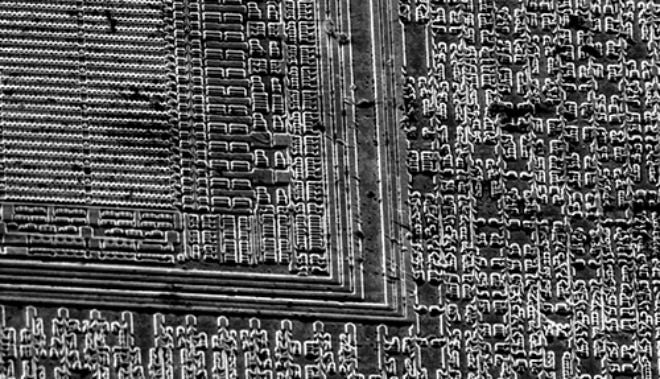
The vulnerability of silicon-based semiconductors to intense cosmic radiation remains one of the most stubborn hurdles in long-duration space exploration. Heavy ions and solar flares regularly threaten to flip bits in digital systems, risking catastrophic data corruption on missions destined for the outer solar system. While heavy shielding and redundant computing architecture offer partial protection, a radical new paradigm explores an entirely non-electronic alternative known as regolith-encoded kinetic memory. This speculative technology bypasses solid-state storage altogether by archiving critical data through the precise physical reconfiguration of local planetary materials.
At its core, this approach treats the granular surface of a moon or asteroid as an analog hard drive. Instead of storing binary ones and zeros as electrical charges or magnetic states, a specialized surface rover or lander utilizes micro-mechanical actuators to arrange microscopic grains of regolith into highly specific, geometric configurations. These physical patterns correspond to complex data sets, effectively using the local soil as a permanent, radiation-immune medium. Because the storage mechanism relies on macro-scale physical positioning rather than subatomic states, it is entirely impervious to the electromagnetic disruptions and ionizing radiation that degrade traditional electronics over time.
This method draws a clear parallel to ancient hieroglyphs, as both systems rely on changing the physical geometry of a medium to ensure the survival of information across eras. However, while ancient stone carvings were restricted by the scale of human hands and primitive tools, regolith-encoded kinetic memory operates at a microscopic level. Traditional computing methods rely on nanoscale transistors to store data, achieving immense density. In contrast, storing data by physically arranging dust grains is naturally limited by the physical size of the regolith particles themselves, which typically range from ten to one hundred micrometres on the lunar surface. Because each physical unit of data requires an individual grain or a small cluster of grains to be distinctly positioned, this method cannot compete with the ultra-dense storage of modern solid-state drives. It is designed not for high-capacity daily processing, but as a low-density, high-durability vault for critical survival data and structural blueprints.
To calculate the mathematical storage density achievable by mapping these granular surfaces, engineers look at the spatial resolution of the micro-actuators and the optical scanning systems. If a specialized planetary rover can manipulate and read individual regolith grains with a positional accuracy of ten micrometres, each data cell occupies an area of one hundred square micrometres. This translates to a theoretical maximum storage density of roughly one gigabit per square metre of planetary surface. While this is a fraction of what a standard micro-SD card can hold, a single dedicated data-printing rover clearing and arranging a hundred-metre plot of land could permanently archive ten gigabytes of uncorrupted mission logs, atmospheric records, and historical archives directly into the crust of a world.
Reading the archived data involves a high-resolution optical or laser-scanning system mounted on an orbital satellite or a passing probe. By emitting precise light pulses and measuring the scatter patterns reflected off the manipulated regolith beds, the scanner can reconstruct the exact positions of the grains. Sophisticated algorithms then translate these physical topographical maps back into digital code. If a solar storm disrupts the reading vessel, the data remains safely engraved on the planetary surface, waiting to be scanned again once the environment clears.
Protecting this open-air archive from the harsh space environment requires an immediate preservation step after the data is written. On airless bodies like the Moon, micrometeoroid bombardment and solar wind electrostatic charging constantly churn the upper layers of dust, a process known as impact gardening. To prevent the data from being erased by this cosmic weathering, the printing rover utilizes a low-energy microwave emitter to perform localized thermal sintering. Lunar regolith contains significant amounts of iron-bearing minerals, which absorb microwave radiation exceptionally well. By applying a precise burst of heat, the rover partially melts the boundaries of the arranged grains, fusing them into a rigid, rock-like ceramic tile without distorting the encoded geometric pattern. This process transforms loose dust into a permanent stone monument capable of resisting minor impacts for thousands of years.
While lunar dust is ideal for microwave sintering due to its mineral composition, other planetary environments offer unique materials that could serve a similar purpose. On Mars, where carbon dioxide and water ice are abundant at the poles, data could be thermally carved into glacial sheets using automated laser sublimation systems. The lasers would vaporize precise micro-cavities into the ice, creating binary pits that refract orbital radar or optical scans differently than the surrounding smooth ice. Alternatively, on metallic asteroids rich in nickel and iron, a rover could use focused solar concentrators to micro-weld metallic dust into magnetic patterns, creating a hybrid kinetic-magnetic storage medium out of the asteroid itself.
As humanity prepares for permanent settlement on the Moon and Mars, creating reliable, deep-time archives becomes essential for preserving scientific records and operational history. Turning the very ground we walk on into a resilient computational storage vault could redefine data survival in the cosmos. By looking past the limitations of traditional digital hardware, regolith-encoded memory offers a glimpse into a future where the line between planetary geology and information technology is permanently blurred.