

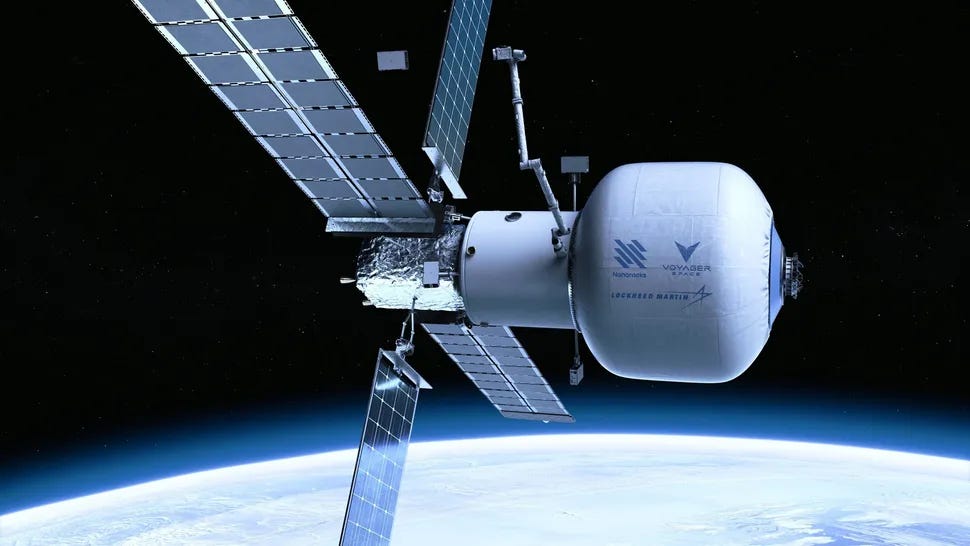
Starlab
The International Space Station has been humanity’s foothold in low Earth orbit for a quarter of a century, a gleaming symbol of international cooperation that is now approaching the end of its useful life. Around 2030 it will be deorbited, and the question of what comes next has shifted from speculation to urgent competition. NASA’s Commercial Low Earth Orbit Destinations program is the mechanism designed to answer that question. In early October 2026 the agency released its final request for proposals, inviting American companies to design, build, certify and operate the private stations that will host astronauts, researchers and commercial activity once the ISS is gone. Proposals are due in December, with awards expected in spring 2027. At least two providers will be selected in the first phase, each guaranteed a minimum of one hundred million dollars, with the full contract potentially stretching into the tens of billions over the following decade and a half. The winners will not simply inherit a government outpost. They will create the next generation of orbital real estate, places where science, manufacturing, tourism and national presence can continue without a single dominant government landlord.
At the centre of the race stands Axiom Space, a company that has already turned private astronaut missions into a working business. Its story began with a simple but ambitious idea: attach new modules to the existing International Space Station, learn the operational realities of human spaceflight in real time, then undock those modules and form an independent commercial station. The approach is incremental and pragmatic. Axiom has already flown multiple private crews to the ISS, giving its engineers and flight controllers hard-won experience that no PowerPoint presentation can replicate. The company’s first modules are progressing through manufacturing, and the plan remains to grow a free-flying Axiom Station that can eventually stand alone. In the corridors of Houston and at industry gatherings, Axiom people speak with the quiet confidence of a team that has already tasted orbital operations. They know the paperwork, the safety culture, the unexpected complications of living in space. That lived experience is their strongest card as they prepare their formal bid.
Not far behind in visibility is the Starlab project, led by Voyager Space in partnership with Airbus and other industrial players. Starlab’s narrative is one of deliberate scale and international flavour. Rather than starting small and growing, the team aims to launch a large, single-module station capable of supporting a continuous human presence from early operations. The design emphasises volume, power and the ability to host significant research and manufacturing payloads. Voyager’s leadership has been vocal about the strength of their business case, arguing that a station built for commercial customers as much as for NASA will prove more resilient in the long run. Their story is less about gradual attachment to the old station and more about arriving ready to operate at full capacity. In an industry that has seen many elegant designs fail to leave the ground, Starlab’s backers present themselves as the grown-up option, the one that combines American entrepreneurial energy with European industrial depth.
Then there is Vast, the relative newcomer that has moved with startling speed. Founded with the explicit goal of building the first commercial space station, Vast has focused on a modular approach that begins with Haven-1, a compact single-module habitat now in final integration. The company’s public messaging is refreshingly direct: they intend to fly soon, learn fast, and expand into a multi-module complex capable of continuous human presence. Where Axiom leans on operational heritage and Starlab on scale, Vast leans on velocity. Their engineers talk about rapid iteration and the advantages of starting with a simpler vehicle that can be launched relatively quickly. In an environment where schedules have a habit of slipping, Vast’s insistence on near-term flight gives their story a sense of urgency that resonates with those who fear a gap in American orbital capability after the ISS retires.
Blue Origin occupies a more ambiguous position. The company previously received NASA funding for its Orbital Reef concept, a large station envisioned in partnership with Sierra Space and others. Orbital Reef promised substantial internal volume and the capacity to host larger crews. Yet questions linger about Blue Origin’s current level of commitment. The company has been focused on recovering from challenges with its New Glenn rocket and advancing its lunar ambitions. Whether it will submit a full bid in this round remains uncertain. If it does, the story will be one of a deep-pocketed player deciding that low Earth orbit still matters alongside the Moon. If it steps back, the field narrows and the remaining contenders gain relative strength.
Beyond the leading contenders sit a handful of more speculative players who refuse to accept that the future of orbital habitation belongs only to the best-funded teams. Gravitics, a Seattle-based company, is quietly developing large metallic space structures designed to be launched in a compact form and expanded in orbit. Their pitch is industrial rather than glamorous: big, strong, pressurised volumes that could serve as the backbone of future stations or even orbital factories. While they lack the astronaut-mission heritage of Axiom or the polished marketing of Starlab, their focus on scalable structural technology has drawn attention from those who believe the next generation of stations will need far more internal volume than current designs provide.
Then there is Max Space, a smaller outfit pursuing expandable habitat modules that also promise significantly more living space per launch than traditional rigid designs. Their concept, sometimes referred to as Thunderbird, aims to launch on a single Falcon 9-class rocket and then unfold into a habitat large enough for a permanent crew of four. The company talks less about national prestige and more about practicality and cost. In an industry where every kilogram still carries a heavy price tag, the idea of getting more usable volume without needing a Starship-class launcher has a certain scrappy appeal. Whether Max Space can move from concept to credible hardware remains an open question, but their presence keeps pressure on the larger players to justify their more expensive architectures.
These underdogs are unlikely to walk away with a prime NASA award in the current round. Yet their existence matters. They represent the broader ecosystem of ideas that could later be absorbed as modules, subsystems, or even future competitors once the first commercial stations are flying. In a contest that will shape low Earth orbit for decades, the loudest voices are not the only ones worth hearing.
What unites all these efforts is a shared recognition that low Earth orbit is too valuable to abandon. The stations that emerge from this competition will not merely replace the ISS. They will redefine what it means to live and work above the atmosphere. Some will prioritise scientific research and national astronauts. Others will court pharmaceutical companies, semiconductor manufacturers and space tourists. A few may try to do all of it at once. The technical challenges remain immense: life support reliability, radiation protection, docking compatibility, affordable transportation and the sheer difficulty of keeping humans healthy and productive for months at a time. The business challenges are equally stark. Government contracts will provide an essential foundation, but long-term success will require paying customers beyond NASA.
As the December deadline approaches, the competitors are refining their proposals, sharpening their cost models and rehearsing the arguments they will make to NASA evaluators. The agency has structured the competition to select more than one provider, a deliberate hedge against the risk that any single project might falter. That decision alone changes the texture of the race. It is no longer a winner-take-all contest. It is a competition to join a small club of companies entrusted with America’s continued presence in low Earth orbit. The stories of Axiom’s operational pragmatism, Starlab’s ambitious scale, Vast’s rapid execution and Blue Origin’s lingering potential will all be weighed against one another. Somewhere among them, and perhaps among the quieter underdogs, lie the designs that will keep human eyes looking down on Earth from a few hundred kilometres up for decades to come. The ISS era is ending. The commercial era is about to begin.