

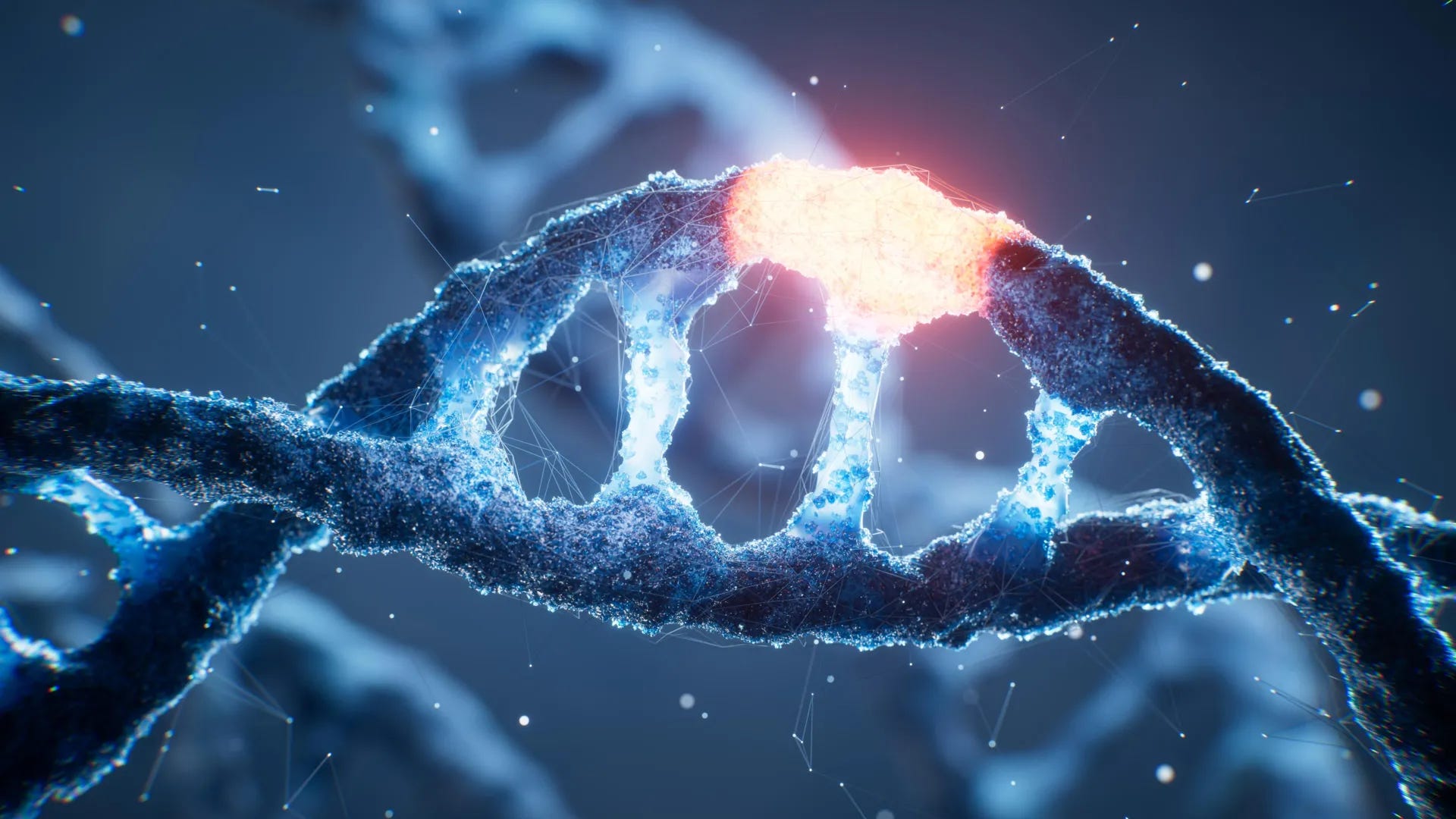
Scientists have recently shown that a bacterial enzyme can accurately read and copy a version of DNA that uses eight chemical letters instead of the usual four. All life on Earth has run on the same four-letter genetic alphabet for billions of years: A, T, G and C. These letters pair up in a precise way and form the instructions for building every living thing we know. Now researchers have demonstrated that an expanded system, sometimes called Hachimoji DNA, which adds four synthetic letters, can be transcribed by a natural cellular machine. The extra letters fit the same overall shape as the natural ones, so the enzyme treats them in much the same way.
This is still laboratory work. The experiments took place in test tubes, not inside living animals or free-living cells that could spread on their own. The synthetic letters do not exist in nature and must be manufactured. Natural organisms lack the full set of tools needed to keep an eight-letter system running indefinitely. Yet the result marks a clear step toward the long-term goal of synthetic biology: building genetic systems that go beyond what evolution has produced.
In the near future, the most realistic applications are controlled and useful. An expanded alphabet can store more information in the same length of DNA, which is attractive for data storage or for designing molecules that bind tightly to specific targets, such as disease-related proteins. Scientists could eventually create bacteria that produce novel compounds or perform tasks that ordinary cells cannot. These systems would likely be engineered with built-in dependencies so they can only survive when supplied with the special building blocks in a laboratory setting.
Looking further ahead, more ambitious scenarios become possible, though they remain distant. Researchers might one day construct a fully synthetic single-celled organism whose entire genome uses eight letters. That cell would need custom machinery for copying its DNA, reading it into RNA, and translating the new code into proteins. If successful, such an organism could explore chemical possibilities that four-letter life has never accessed. Whether it would evolve into multicellular forms faster than ordinary life did is an open and interesting question.
Evolution’s speed depends less on the size of the alphabet and more on mutation rates, population size, generation time, and the pressure of natural selection. A larger alphabet expands the space of possible sequences dramatically, which could allow more functional variety and perhaps novel solutions to biological problems. At the same time, the extra complexity might introduce new sources of error or higher metabolic costs, which could slow things down rather than speed them up. Ordinary life took roughly two billion years to go from simple cells to the first multicellular organisms. An engineered eight-letter system would start with human design rather than pure chance, so its trajectory would be different, but there is no guarantee it would race ahead.
The question of escape and survival in the open world is the one that naturally worries people. For an eight-letter cell to thrive outside the lab it would need to obtain or manufacture its unnatural building blocks continuously, maintain the expanded code across generations without collapsing into errors, and compete with the vast, highly adapted four-letter biosphere that already fills almost every niche on the planet. At present these requirements are not met. The synthetic letters are not freely available in the environment, and ordinary cells cannot maintain them. Scientists working in this area generally design biological containment measures—nutritional dependencies, inability to transfer the synthetic DNA to other organisms, and physical barriers—precisely to keep such systems from establishing themselves outside controlled conditions. A future organism that somehow overcame all these barriers and became fully autonomous would represent a profound technological achievement, but it would also raise serious questions about ecological impact and governance. Most researchers view that possibility as something that would require deliberate, large-scale effort rather than an accidental leak from today’s experiments.
The work sits at the boundary between careful engineering and deep questions about the nature of life itself. Expanding the genetic alphabet does not automatically create dangerous super-organisms, nor does it instantly deliver revolutionary new life forms. It opens a larger design space. What is done with that space will depend on the choices of scientists, regulators, and societies over the coming decades. For now the advance remains a controlled laboratory demonstration, a proof that biology’s reading machinery is more flexible than we once assumed, and a reminder that the language of life is not necessarily fixed at four letters forever.