

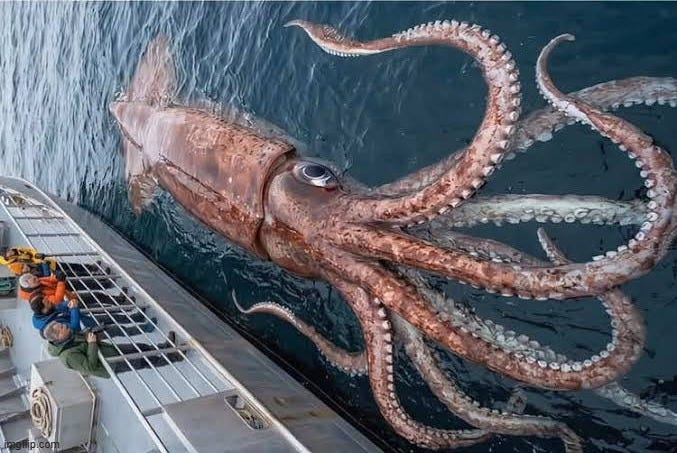
The abyss is no longer empty, and as it turns out, the deep ocean wasn’t a barren wasteland after all—we were just being terrible guests. For decades, marine biologists dropped multi-million-dollar submersibles into the midnight zone, blasting high-intensity white floodlights into a world accustomed to absolute darkness. It was the deep-sea equivalent of bursting into a pitch-black bedroom at three in the morning, waving a stadium spotlight, and wondering why everyone fled. We were essentially attaching underwater lighthouses to our remotely operated vehicles (ROVs) and blinding the most sensitive eyes on the planet, only to scratch our heads at the lack of local wildlife.
Deep-sea animals, particularly the legendary giant squid (Architeuthis dux) and the even heftier colossal squid (Mesonychoteuthis hamiltoni), possess eyes the size of dinner plates. These biological telescopes are finely tuned to detect the faintest glimmers of bioluminescence in a realm where sunlight never treads. To a creature like that, a standard halogen or LED rover light is a weapon of mass distraction. For years, the cephalopod elite saw us coming from miles away and swam for their lives, leaving scientists to film mostly empty water and mud.
The great enlightenment came when visionary researchers realized that if you want to watch the monsters of the deep, you have to stop flashing them. Leading the charge in this behavioral revolution was Dr Edith Widder, co-founder of the Ocean Research & Conservation Association (ORCA). Widder pioneered the use of far-red light illumination, a wavelength completely invisible to most deep-sea denizens, paired with a stealth camera system aptly named Eye-in-the-Sea.
“We designed a camera system that was completely unobtrusive,” Dr Widder previously noted, reflecting on the shift in methodology. “Instead of using bright white lights that scare everything away, we used red light that deep-sea animals can’t see, and we used optical lures that mimic bioluminescence. It completely changed the game.”
The results of this stealth revolution were instant and spectacular. By turning down the glare, the ocean’s most elusive titans stopped running away. In fact, they started approaching the cameras out of sheer curiosity. The shift allowed scientists to capture the historic, first-ever footage of a living giant squid in its natural habitat, aggressively attacking a bioluminescent lure rather than fleeing a blinding white beam.
More recently, this subtler approach culminated in a historic breakthrough by the Schmidt Ocean Institute. Aboard their research vessel, Falkor (too), scientists deployed the ROV SuBastian equipped with advanced, low-impact lighting arrays near the sub-Antarctic South Sandwich Islands. Lurking at a depth of 600 meters, a juvenile colossal squid—a transparent, 30-centimeter “teenager” of the species—swam calmly right up to the camera lens. It was the first time in history a living colossal squid had ever been filmed in its natural wild habitat, a feat a century in the making that would have been utterly impossible under the old, blinding regimes.
While low-light cameras are bringing us face-to-face with curious cephalopods, another group of researchers decided they didn’t even need to see the squid to know they were there. They just needed to taste the water. In a groundbreaking study out of Western Australia, scientists from Curtin University and the Western Australian Museum turned to environmental DNA, or eDNA. Every time a giant squid jets through the abyss, it leaves behind a ghostly trail of shed skin cells, mucus, and metabolic waste.
Led by researchers like Dr Maximillian Hirschfeld, the team sampled deep-sea water from the plunging depths of the Cape Range and Cloates submarine canyons off the Ningaloo Coast, reaching down over four thousand meters. By sequencing the microscopic genetic material suspended in those water samples, they hit the jackpot, detecting the undeniable molecular signature of the giant squid. It marked the first time in twenty-five years that the legendary predator had been chemically tracked in those specific waters, establishing a brand-new northernmost record for the species in the eastern Indian Ocean without ever deploying a net.
“The beauty of eDNA is that it acts as a corporate directory for the deep ocean,” explains one marine geneticist familiar with the technology. “You don’t need to stress the animal, you don’t need to blind it, and you don’t need to catch it. The creature just goes about its day, and we get to read its diary through a cup of seawater.”
Between stealthy red-light cameras inviting curious giants to peer into our lenses and eDNA revealing the invisible shadows of monsters lurking off the Australian coast, the golden age of deep-sea exploration has finally arrived. We are finally learning to appreciate the dark, and the ocean is rewarding our courtesy by letting its most magnificent monsters come out to play.