

For the last quarter of a century, astrophysicists have been comfortably haunted by a ghost. They call it dark energy, a mysterious, invisible force that supposedly makes up nearly seventy percent of our universe. According to the standard model of cosmology, this cosmic caffeine is actively pushing the universe to expand at an ever-accelerating rate, fating everything in existence to a cold, lonely dissolution known as the Big Freeze. It was a clean, dramatic story that won a Nobel Prize in 2011. There is just one tiny problem emerging from the fringes of modern astronomy: dark energy might not actually exist, and our understanding of the universe’s expansion might be completely wrong.
To understand why cosmologists are suddenly sweating into their coffee, we have to look at how we trapped ourselves in this dark energy box in the late 1990s. Astronomers were measuring distant exploding stars, called Type Ia supernovae, using them as cosmic rulers. They expected to see the universe’s expansion slowing down under the heavy boot of gravity. Instead, the data suggested the rulers were further away than they should have been. The universe was speeding up. To make the math work, scientists invented dark energy—a placeholder name for a force we could neither see nor explain. We bought into the idea because it patched the holes in our equations, not because we had ever actually caught it in the act.
The Cracks in the Cosmic Foundation
The trouble started when our measurements got too good for our own comfort. In recent years, astrophysicists have used the Dark Energy Spectroscopic Instrument, or DESI, to map millions of galaxies across cosmic time with unprecedented precision. The initial results did not deliver the triumphant confirmation everyone expected. Instead, they hinted that the strength of dark energy might be changing over time, fluctuating rather than remaining the constant, unchanging vacuum energy that Albert Einstein originally proposed.
If dark energy is changing, it means the bedrock of modern cosmology is built on shifting sand. Even worse, a growing chorus of physicists is arguing that we do not need this invisible phantom at all. They suggest that what we perceive as an accelerating expansion might actually be an illusion created by our own flawed perspective.
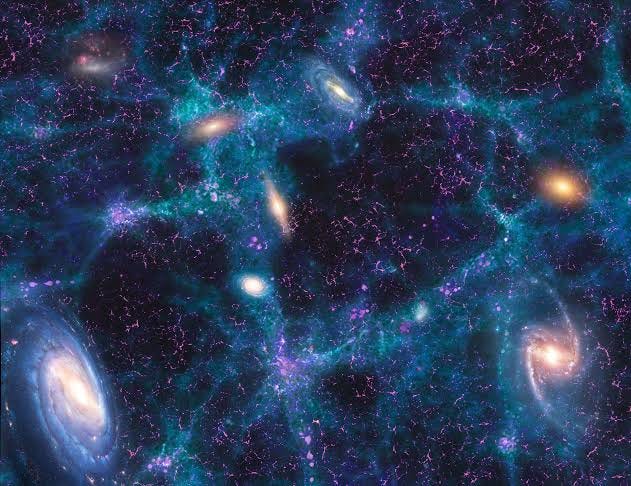
The standard model assumes the universe is smooth and uniform when viewed on a grand scale. But the real universe is lumpy, filled with massive voids and dense superclusters of galaxies. When light travels through this cosmic swiss cheese, it bends and stretches in ways that can trick us into thinking the universe is expanding faster than it really is. When you account for this lumpiness, the need for a mysterious dark force suddenly evaporates.
The Crisis of the Mismatched Constant
Adding fuel to the cosmic fire is a nagging paradox known as the Hubble Tension. Put simply, the two main ways we have of measuring how fast the universe is expanding do not agree. One method looks at the ancient light left over from the Big Bang, while the other looks at relatively nearby stars and supernovae.
For years, scientists assumed that as telescopes improved, the mismatch would disappear like a rounding error. Instead, the gap has only widened, turning a minor statistical annoyance into a full-blown existential crisis for physics. If the universe were expanding smoothly under the influence of a steady dark energy, these two numbers should align. The fact that they stubbornly refuse to match suggests that our fundamental blueprint of the cosmos is missing a massive piece of the puzzle—or that the expansion itself does not behave the way we think it does.
Rewriting the Final Chapter
If dark energy is indeed a mirage, the future of the universe looks entirely different. We would no longer be hurtling toward a bleak eternity where galaxies fly apart so fast that the night sky eventually goes totally black. Instead, gravity might eventually regain its grip, slowing the universe down or even pulling it back together into a spectacular cosmic rewind known as the Big Crunch.
Physics progresses one funeral at a time, and letting go of a theory as dominant as dark energy will take years of fierce debate. But the history of science is defined by these exact moments of unraveling. We once believed the Earth was the center of the solar system because the math worked out, and we once invented an invisible ether to explain how light traveled through space. Dark energy may well be the modern equivalent—a brilliant, mathematical ghost story we told ourselves until we were clever enough to find the truth.