

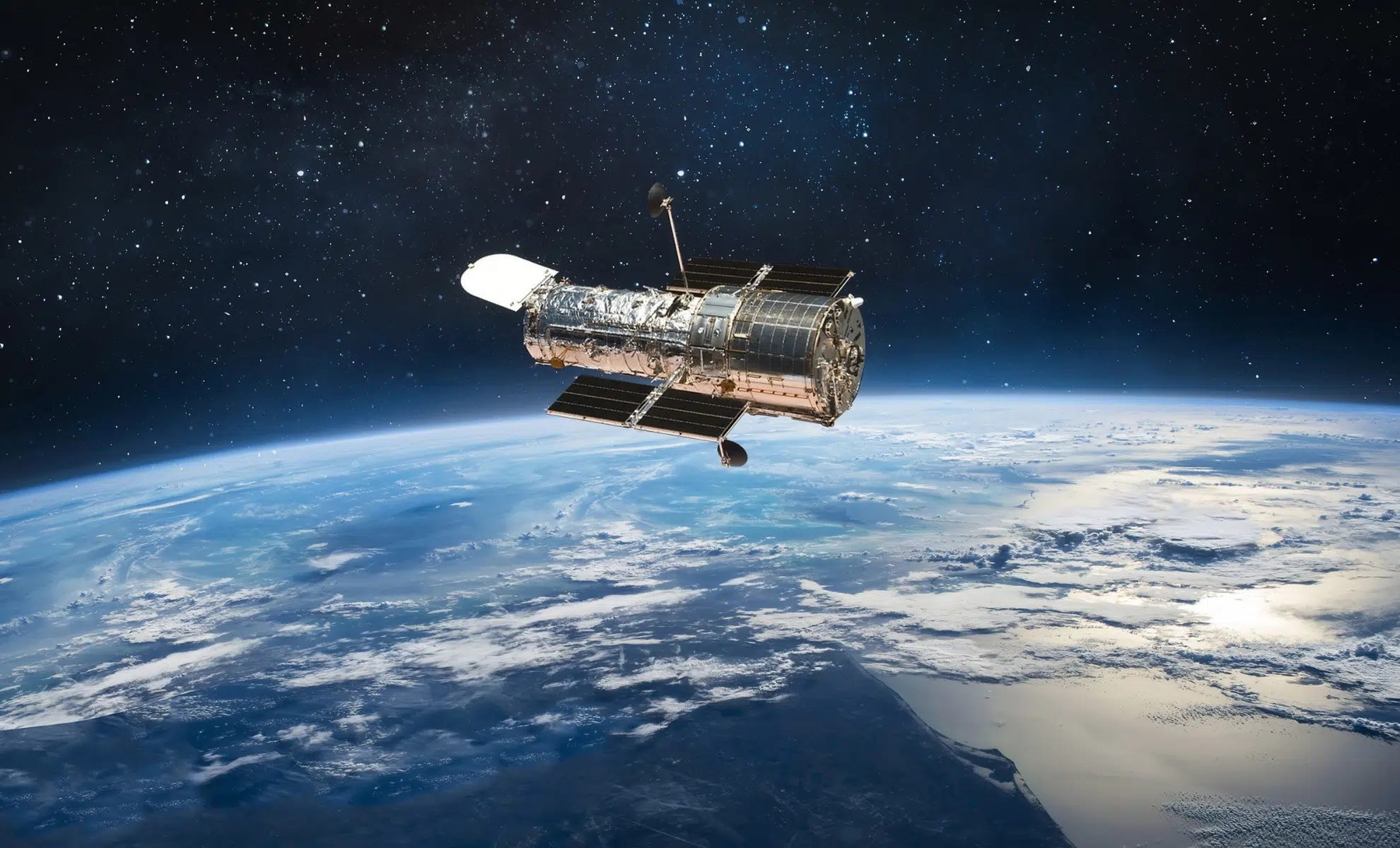
NASA has officially restarted its search for commercial space missions capable of rescuing the Hubble Space Telescope from its decaying orbit, launching a new Request for Information just over two years after shelving initial private sector proposals as too risky. The legendary space observatory, which has fundamentally reshaped human understanding of the cosmos for more than three decades, faces a certain and fiery demise in the early-to-mid 2030s without intervention. By turning once again to the private sector, NASA is testing whether the rapid maturation of commercial in-space servicing capabilities can safely extend the life of an irreplaceable scientific icon.
The central issue facing Hubble is one of basic orbital physics. Operating in low Earth orbit, the telescope is subjected to a minute but persistent atmospheric drag that steadily strips away its altitude. Because Hubble was designed without an onboard propulsion system, it relies entirely on visiting spacecraft to counteract this downward drift. The last time the telescope received an orbital nudge was in 2002 during a visit by the Space Shuttle Columbia. While a final shuttle servicing mission in 2009 successfully replaced critical components, it did not elevate the spacecraft. With the retirement of the Space Shuttle fleet in 2011, Hubble was left stranded, gradually sinking from a peak altitude of roughly 362 miles to its current position closer to 292 miles.
NASA current projections show that if left alone, Hubble has a substantial risk of an uncontrolled atmospheric reentry between 2033 and 2034. To avert a chaotic crash, any rescue attempt must be executed no later than 2032. The newly released procurement inquiry specifically asks commercial operators to pitch detailed strategies for three potential pathways: boosting the telescope to a stable altitude of at least 373 miles to secure another quarter-century of operations, conducting an in-orbit servicing mission to upgrade its aging internal hardware, or coordinating a precise, controlled disposal of the craft at the true end of its operational lifespan.
This is not the first time NASA has entertained private-sector intervention for Hubble. In late 2022, the agency partnered with commercial astronaut Jared Isaacman and SpaceX on a feasibility study to explore using a Crew Dragon capsule to rendezvous with and service the telescope. Around the same time, an open call for ideas yielded eight unique proposals from across the industry, including a highly publicized joint robotic concept by startups Astroscale and Momentus. However, after a exhaustive review concluded in early 2024, NASA management determined that the technical maturity of the proposed commercial options posed an unacceptable risk to the delicate and irreplaceable hardware of the flagship observatory.
The decision to reverse course and reopen the bidding process highlights a dramatic shift in both the capabilities of the commercial space industry and the urgency of Hubble’s timeline. In the two years since those initial rejections, the landscape of in-space manufacturing, satellite refueling, and autonomous rendezvous has transformed. Major defense and aerospace giants have successfully demonstrated highly sophisticated robotic servicing satellites in collaboration with military research wings, while lean startups have secured competitive government contracts for on-orbit maneuvers.
A recent, high-stakes attempt to save NASA’s smaller Neil Gehrels Swift Observatory served as a critical proof of concept for rapid-response space rescue. While that specific mission ultimately had to call off its docking sequence due to unexpected technical issues with the rescue craft, the underlying engineering feat—building and launching a operational rendezvous satellite inside a tight nine-month deadline—proved that the commercial sector can move with unprecedented agility.
Despite the enthusiasm surrounding the commercial sector’s rapid evolution, a successful Hubble mission faces formidable hurdles. The telescope is an exceptionally fragile target, famously sensitive to contamination and optical misalignment. Any private spacecraft attempting a docking maneuver must guarantee absolute precision, as the slightest physical miscalculation could permanently blind the instrument. Furthermore, the entire financial structure of the endeavor remains a major question mark. NASA has made it clear that while it is seeking proposals, there is currently no allocated federal budget to fund a Hubble rescue. The agency is asking respondents to assume the total burden of providing the launch vehicle, the servicing spacecraft, the mission control infrastructure, and even a human crew if a manual intervention is proposed.
The scientific stakes could not be higher. While the newer James Webb Space Telescope frequently captures global headlines, it is not a direct replacement for its predecessor. The Webb telescope peers into the universe primarily through infrared light, whereas Hubble remains humanity’s premier eye for visible and ultraviolet wavelengths. Astronomers routinely combine data from both instruments to construct multi-layered, highly detailed profiles of the cosmos. Without Hubble, the global scientific community will lose its sharpest window into the ultraviolet universe until the planned deployment of the Habitable Worlds Observatory, which is not slated to launch until the 2040s.
With the deadline for industry responses set for late November, NASA is preparing for a multi-year procurement evaluation that will dictate the final act of its most celebrated telescope. If a commercial partner can provide a viable, cost-effective blueprint that minimizes danger to the spacecraft, Hubble may yet survive to educate and inspire generations of scientists deep into the middle of the century. If the risks remain too daunting, humanity will have to prepare to say a final, fiery goodbye to its most iconic cosmic photographer.