

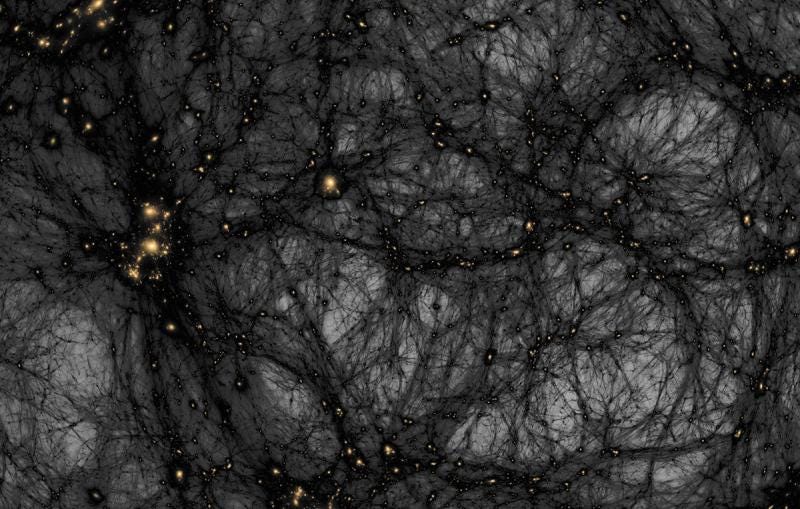
For decades, astronomers have been forced to admit a rather humbling truth: we have absolutely no idea what most of the universe is made of. We can catalogue every star in the night sky, map out billions of swirling galaxies, and track the paths of wandering comets, but all of that radiant cosmic architecture accounts for a measly five percent of reality. The rest is an invisible, silent scaffolding known as dark matter. It refuses to reflect, absorb, or emit light, making it the ultimate cosmic phantom. We only know it exists because its immense gravity prevents fast-spinning galaxies from flying apart like broken carousels. Until now, hunting for this ghost has been a masterclass in frustration, but a recent whisper from deep beneath a South Dakota mountain may have just changed everything.
In September 2026, scientists operating the LUX-ZEPLIN experiment dropped a quiet bombshell onto the physics community. Operating nearly a mile underground to shield their equipment from the relentless bombardment of surface radiation, the team announced the potential detection of a dark matter particle. The instrument at the heart of this discovery is essentially a giant, ultra-purified thermos filled with seven tonnes of liquid xenon. The goal is simple in theory but maddeningly difficult in practice: wait for a passing dark matter particle to crash directly into a xenon atom, triggering a tiny, telltale flash of light. After years of watching and waiting in the absolute quiet of the deep earth, the detectors registered a signal that cannot easily be explained away by mundane background noise.
What makes this potential discovery particularly thrilling—and a bit mischievous—is that the particle in question does not fit the standard mould physicists expected. For years, the leading candidate for dark matter was a theoretical entity called a WIMP, or Weakly Interacting Massive Particle, which was expected to be relatively light. The new data, however, points toward a much heavier class of particle. It is as if scientists went fishing for minnows and accidentally hooked a leviathan. If these results hold up to intense scrutiny, they will force theoreticians back to their chalkboards to rewrite the rulebooks on how dark matter behaves and how it helped shape the infancy of our universe.
Of course, in the high-stakes world of cosmology, caution is the gold standard. A potential detection is not yet a definitive discovery, and the data will spend the coming months being poked, prodded, and independently tested by rival research teams. Science thrives on this kind of constructive scepticism. Yet, the atmosphere in the physics community has undeniably shifted from exhausted patience to electric anticipation. We may finally be on the verge of turning on the lights in the universe’s darkest room, transforming a cosmic ghost story into a tangible piece of reality.
The Heavy Particle Candidates
If the anomalous signal from the underground xenon tank holds true, physicists will find themselves holding a smoking gun without a clear suspect. For decades, the theoretical landscape of dark matter was dominated by relatively lightweight options. Now that the data points toward a particle of unexpectedly high mass, a thrilling cosmic whodunit has begun. Theoretical physicists are dusting off overlooked models and stretching the boundaries of known physics to identify what this heavyweight phantom might actually be.
One of the most compelling suspects stepping into the spotlight is the composite dark matter particle. Instead of being a single, fundamental point of energy like an electron, this hypothetical candidate is envisioned as a tight cluster of smaller, fiercely bound particles. It mirrors the way familiar protons and neutrons are built from smaller quarks, but it operates under a completely undiscovered dark force. If dark matter can clump together to form these heavy composite structures, it would perfectly explain the massive punch delivered to the liquid xenon detector, while remaining entirely invisible to our optical telescopes.
Another intriguing avenue leads scientists to the concept of WIMPzillas. As the delightfully monstrous name implies, these are hypothetical particles of colossal mass, theorised to be billions of times heavier than a standard proton. According to cosmological models, regular particles could never grow this large in the modern universe. However, during the chaotic, violent fraction of a second just after the Big Bang, the sheer intensity of gravitational fluctuations could have forged these titans. If a WIMPzilla is indeed the culprit, it would mean we are interacting with a pristine, unchanged relic from the very dawn of time.
Finally, some researchers are looking toward the concept of asymmetric dark matter. This theory suggests a dark mirror to our own reality, implying that dark matter might have its own complex physics, distinct families of particles, and unique interactions. In this scenario, the heavy particle detected deep underground is merely the tip of a vast, hidden iceberg—the heaviest member of an entirely dark chemical lifecycle that mirrors our own periodic table.
The coming months of data validation will serve as a high-stakes elimination game for these competing ideas. Whether the mystery resolves into a monstrous WIMPzilla, a complex composite structure, or something entirely unimagined, one thing is certain: the universe is proving to be far stranger, and far heavier, than we ever dared to dream.