

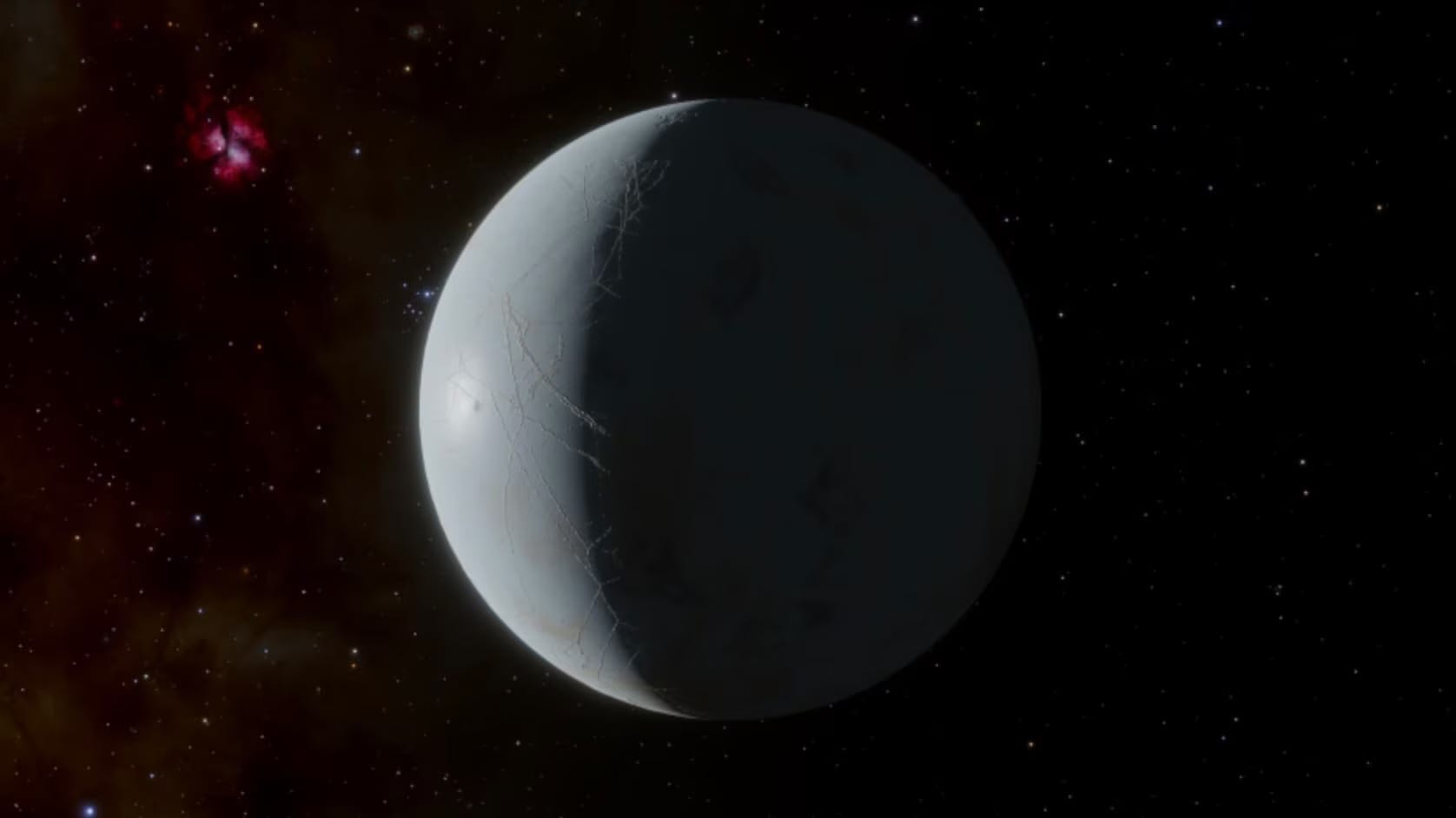
Artists Rendering of Planet X2 Beyond the Kuiper Belt
For generations, astronomers have looked toward the outer edges of our solar system with a mix of curiosity and skepticism. After the reclassification of Pluto and the ongoing search for the hypothetical Planet Nine, a new candidate has quietly captured the imagination of the scientific community. Referred to informally as Planet X2, this distant, theoretical world represents the latest frontier in deep-space exploration and gravitational modeling.
Unlike the rocky inner planets or the familiar gas giants, Planet X2 is proposed to be a cold, dense super-Earth orbiting far beyond the Kuiper Belt. Its existence was not first suggested by a direct sighting through a telescope, but rather through subtle anomalies in the trajectories of distant trans-Neptunian objects. Researchers noticed that a cluster of icy bodies seemed to be subtly tugged away from their expected paths, hinting at the gravitational presence of an unseen shepherd lurking in the dark.
If Planet X2 exists, its environment would be radically different from anything humanity has ever observed up close. Sitting hundreds of astronomical units away from the Sun, it would receive almost no solar warmth, leaving its surface locked in perpetual twilight and extreme cold. Yet, planetary scientists speculate that internal radioactive decay or tidal forces from unknown moons could generate enough heat to sustain a subsurface ocean beneath a thick crust of frozen nitrogen and methane.
The search for Planet X2 presents immense technical challenges. At such vast distances, a planet reflects very little sunlight, making it exceptionally faint against the backdrop of distant stars. Furthermore, its orbital period would span thousands of Earth years, meaning it moves across the night sky at a barely perceptible crawl. Astronomers must rely on wide-field sky surveys and advanced artificial intelligence algorithms to sift through millions of data points, looking for a single, slow-moving speck of light.
Beyond the thrill of discovery, finding Planet X2 would rewrite our understanding of how solar systems form and evolve. Current models struggle to explain how a massive planet could either form so far from the Sun or get ejected outward without being thrown entirely into interstellar space. Confirming its presence would force astrophysicists to rethink the chaotic early days of our cosmic neighborhood, proving once again that our solar system still holds profound secrets waiting in the dark.