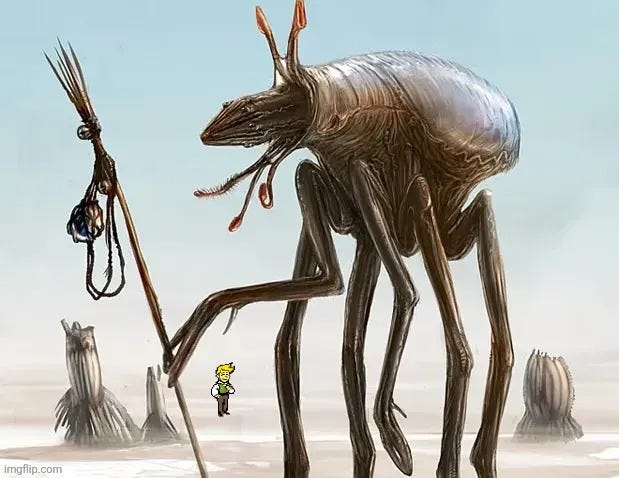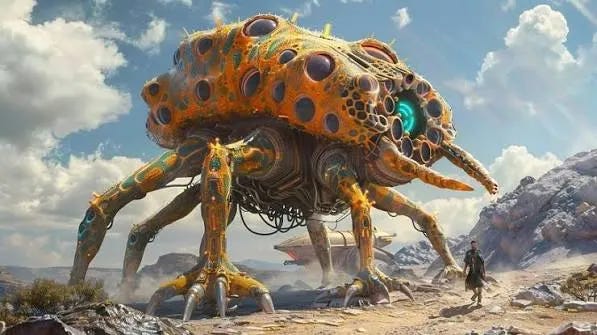
Giant aliens have long occupied a quiet but persistent corner of scientific speculation. While popular culture fills the sky with city-stomping monsters, the more careful conjectures of physicists, biomechanists and astrobiologists begin with the same unforgiving mathematics that limit animals on Earth. The square-cube law remains the starting point: mass grows with the cube of linear dimensions while the strength of supporting tissues grows only with the square. On a world with gravity near Earth’s, ordinary bone and muscle therefore impose a practical ceiling somewhere near one hundred tonnes.
Yet that ceiling is not absolute. Change the materials, the gravity, the supporting medium or remove the planet altogether, and the possible range of living size expands dramatically. What follows is a survey of those expanded possibilities, ordered roughly from the least extreme to the most, together with the practical consequences each regime would carry for intelligence, longevity, spacefaring capacity and the likely attitude of such beings toward creatures as small as ourselves.
Material Giants
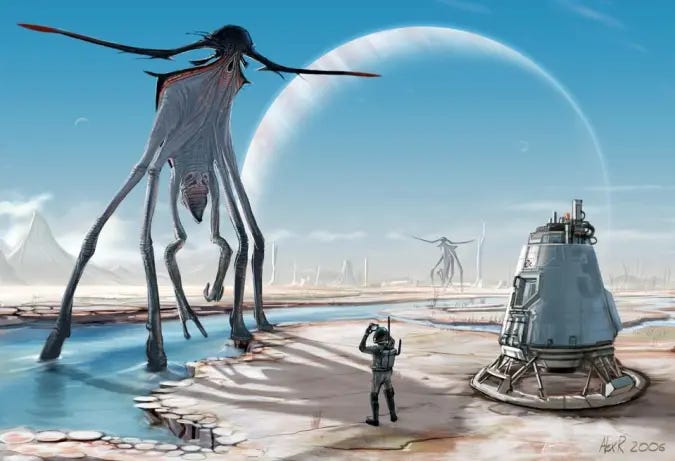
The most modest enlargement begins with organisms whose structural tissues simply outperform terrestrial bone and muscle. Titanium-grade alloys or, more radically, graphene-like carbon lattices and high-specific-strength organic composites could raise the load-bearing capacity of a skeleton or hydrostatic system by a large factor. Under Earth-like gravity such material-enhanced giants might routinely reach several hundred tonnes while still walking on land.
Their body plans need not look grotesque; longer limbs, more efficient joint geometry and modest internal air spaces would suffice. Because they are built for roughly one gravity, these beings could in principle visit a world like ours without collapsing. Their metabolisms would almost certainly be slower than those of human-sized animals, following the well-established inverse relationship between mass-specific metabolic rate and body size. Lifespans measured in centuries rather than decades become plausible, and interstellar voyages lasting decades of external time might register subjectively as long but manageable journeys.
Intelligence is harder to predict. Larger nervous systems offer more room for complexity, yet absolute size alone does not guarantee insight; Earth already shows that corvids and cephalopods achieve remarkable cognition at far smaller scales. Still, a lineage that invests heavily in neural tissue while growing to multi-tonne proportions could easily surpass human cognitive range. Their attitude toward us would likely resemble the indifference we show toward ants: we are too small, too brief and too energetically insignificant to matter except as occasional curiosities or, if we prove troublesome, as minor pests to be managed at arm’s length.
Low Gravity Giants
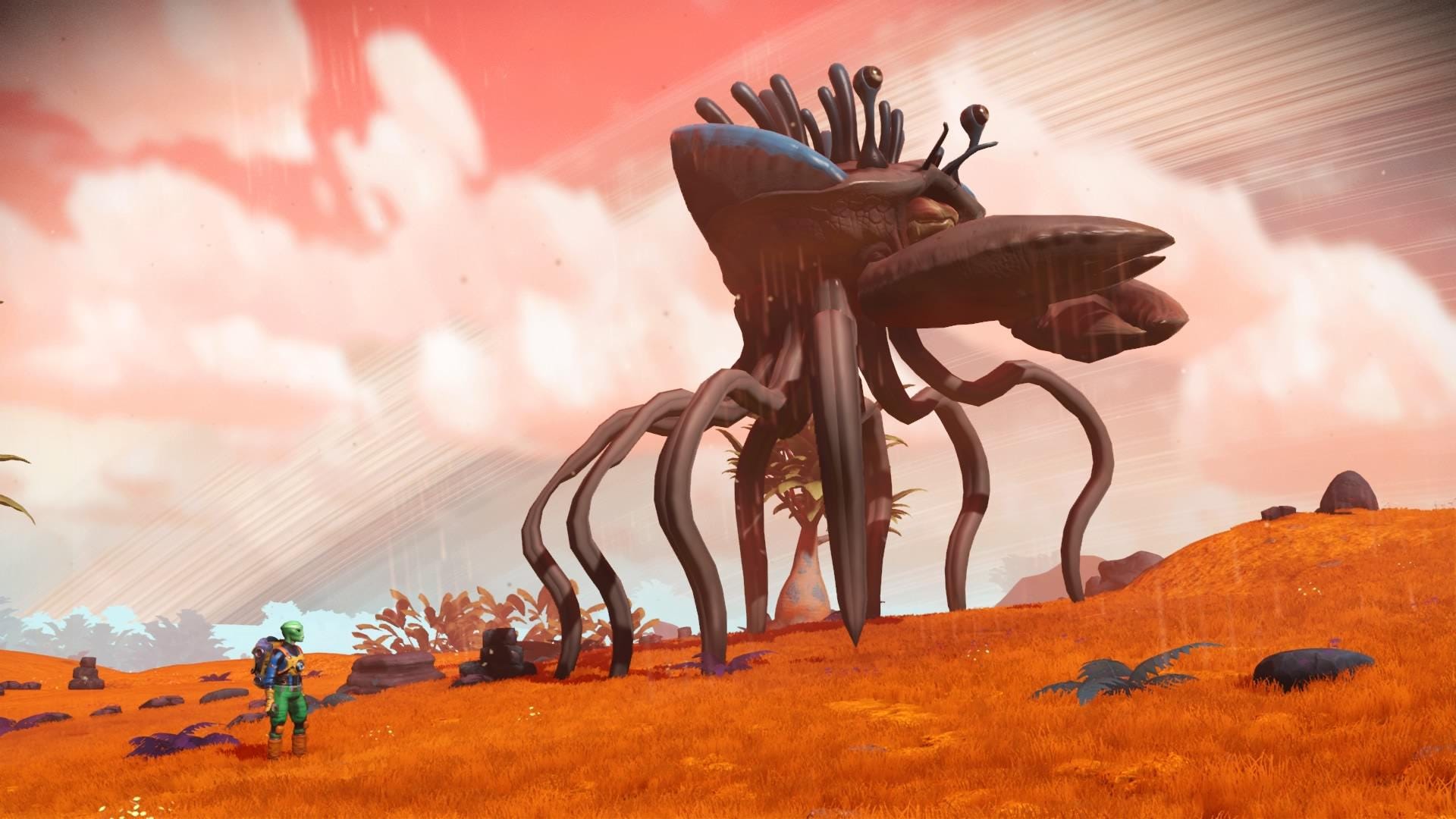
A greater leap in scale becomes available on worlds whose surface gravity is appreciably lower than Earth’s. Even with ordinary biological materials, maximum mass scales steeply upward as gravity falls. On a planet of half an Earth gravity, land animals the size of the largest sauropods would be unremarkable; at still lower values the figures climb into the high hundreds or thousands of tonnes. These low-gravity giants would find the climb out of their home gravity wells comparatively easy, a decisive advantage for any technological species attempting spaceflight.
The same low gravity, however, leaves them structurally under-designed for a one-gravity world. Standing, walking or even remaining conscious under Earth’s pull might require powered suits, exoskeletons or continuous mechanical support. Lifespans would again tend toward the long, perhaps many centuries, because the same metabolic scaling that favors longevity in large Earth animals would still operate. Intelligence could be high, yet the practical difficulty of operating outside their native gravity would limit the ease with which they could explore or colonize heavier worlds. Toward humanity their stance might combine curiosity with a certain physical aloofness; we would be the dense, high-gravity creatures who can stand unassisted where they cannot.
Buoyancy Giants
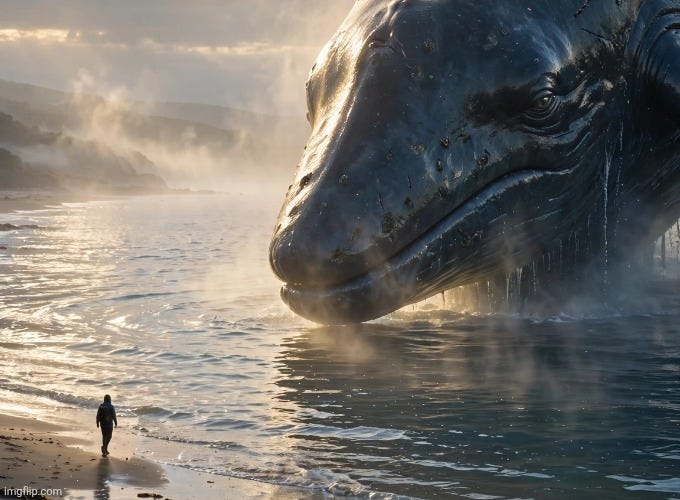
Buoyancy offers another route to great size. In a dense liquid (or a sufficiently thick atmosphere in some situations) the effective weight of an organism approaches zero, removing the structural barrier almost entirely. Earth already demonstrates the principle in the blue whale. On other worlds the same principle could produce animals of many thousands of tonnes whose only real limits become food supply, heat rejection and the time required for signals to travel from one end of the body to the other.
Such buoyant giants would find the initial ascent into space more difficult than surface-adapted forms, for a water-filled craft is heavy and the acceleration must be managed so that pressure waves inside the fluid do not injure the passengers. Yet once that engineering problem is solved, the supporting medium need not be abandoned. Artificial habitats can carry oceans with them. Cylindrical colonies of the sort proposed by Gerard O’Neill have long been imagined with internal seas held by rotation, and even simpler spinning modules could contain swimming volumes comparable to those already considered for human space hotels.
A sufficiently advanced civilization could therefore maintain fluid environments that match the density, chemistry and pressure of the home ocean, allowing buoyant organisms to live, breed and travel among the stars without ever experiencing unsupported weight. Longevity could stretch into millennia if metabolism remained slow, and intelligence might reach impressive heights simply because the available volume for nervous tissue is so large. Their view of human-scale beings would probably be remote; we would register as brief, energetic phenomena inhabiting a denser and more violent environment than their own.
Gas Giants
A thick atmosphere can provide buoyancy, but only under quite specific conditions, and the effect is almost always weaker and more limited than true liquid support. Buoyancy equals the weight of the fluid displaced. In water the density is roughly a thousand kilograms per cubic metre, so a large body can cancel nearly all of its weight with only modest volume. Atmospheric densities are far lower. Even the deepest, hottest parts of Jupiter’s atmosphere reach only a few kilograms per cubic metre—orders of magnitude less than liquid water.
To offset the weight of a multi-tonne organism the creature would therefore need an enormous volume of extremely light gas (hydrogen or helium) contained inside it, or it would have to live in a region where the surrounding atmosphere itself is already extremely dense. The first solution produces something closer to a living airship than a swimming animal; the second requires pressures and temperatures that quickly become hostile to ordinary biochemistry.
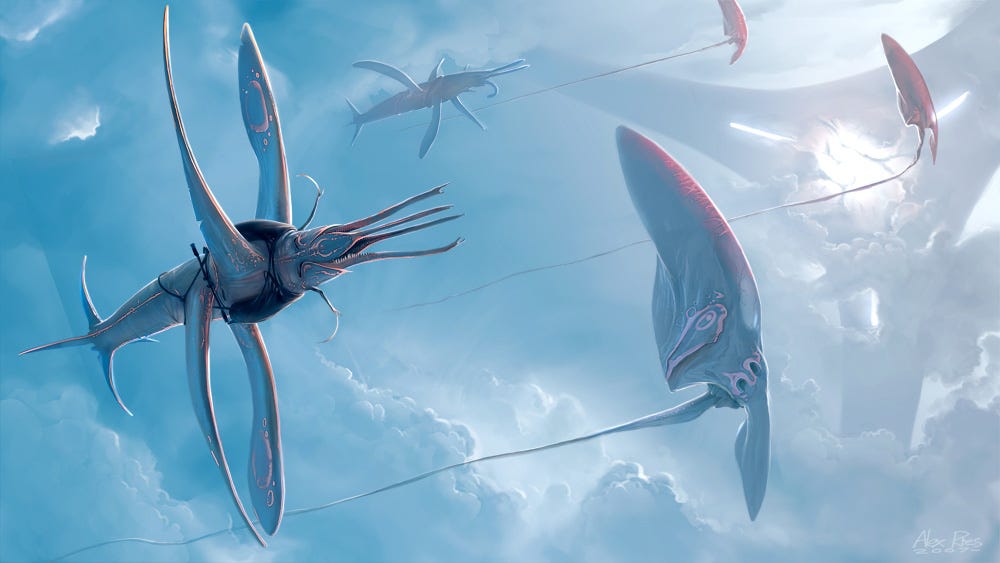
Speculative biologists have nevertheless explored the idea, most famously for the gas giants. In the 1970s Carl Sagan and others sketched “floaters”—large, balloon-like organisms that maintain neutral buoyancy in Jupiter’s atmosphere by adjusting internal hydrogen volume. Similar concepts appear in discussions of hypothetical life on exoplanets with thick hydrogen envelopes or on the upper layers of ice giants. In every case the organisms are low-density, slow-moving, and constrained by the need to keep their gas bags intact against turbulence, radiation and chemical gradients. They can be large in linear dimensions, yet their actual mass remains modest compared with a fully aquatic giant of similar length.
So a thick atmosphere is a theoretically possible supporting medium, but it is a much narrower and more precarious niche than an ocean. The least robust of the buoyancy routes. Liquid water (or an equally dense exotic solvent) remains the far more convincing path to truly massive, high-mass organisms.
Space Giants
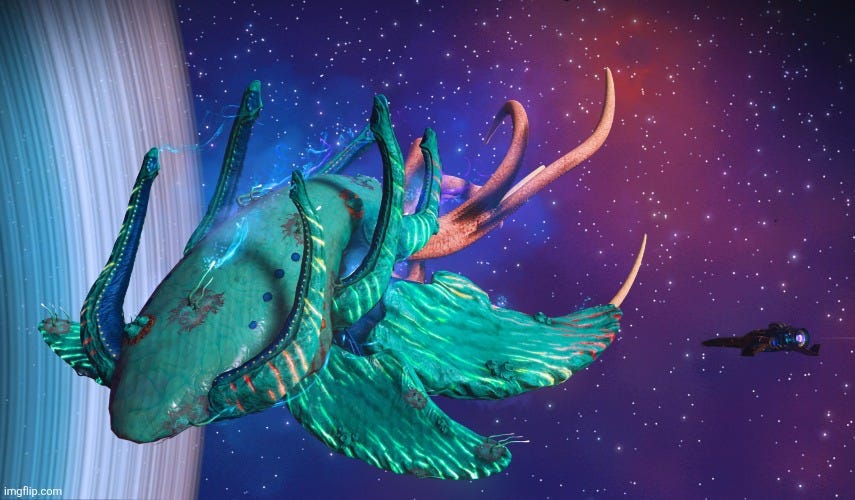
The most extreme category dispenses with planets altogether. Freeman Dyson and others have explored the possibility of organisms or organism-like systems that live permanently in free space, harvesting starlight, capturing interplanetary dust and ice, or riding the tenuous flows of the solar wind. Such space-adapted forms could in principle grow to enormous physical dimensions—thin membranes kilometers across, fractal networks, or low-density colonies whose total mass still remains modest because their density is vanishingly small. Their metabolisms would be correspondingly frugal, their generation times immense, and their subjective experience of time stretched to scales that make interstellar distances feel less forbidding.
One evolutionary route to these forms begins with buoyant planetary giants. Ocean-dwelling organisms already live in an almost weightless medium; the physiological leap into a fluid-filled habitat in true microgravity is therefore smaller for them than for any land animal. Once established in orbiting or free-flying aquatic colonies, the last structural limits disappear. Over generations, or with deliberate genetic alteration, individuals or lineages could expand far beyond the dimensions any planetary ocean could contain.
Return would likely become impossible as the new forms would be too large, too diffuse or too specialized for a gravity well. Some might continue to carry their watery habitats with them while others could gradually reduce their dependence on bulk liquid, learning to harvest volatiles and radiation more directly until they became true free-space organisms. Contact with planetary civilizations would almost certainly be technological rather than personal; a creature adapted to the vacuum and radiation of deep space, or even to a self-contained fluid world adrift among the stars, would find the surface of any planet lethal or simply irrelevant.
Intelligence, if present, would operate on timescales so long that ordinary human conversation would appear as a flickering of mayflies. Dyson himself suggested that advanced space-based life might eventually reorganize the material of entire solar systems into structures optimized for computation or energy collection, raising the possibility that the largest “organisms” in the universe are not animals at all but living architectures.
Across all these regimes the same secondary constraints reappear. Nerve conduction or its equivalent has finite speed; a creature hundreds of meters long experiences noticeable lag between extremities unless it evolves distributed intelligence or faster signaling channels. Absolute energy requirements still grow with size even when mass-specific rates fall, so food or radiant energy must be abundant or the organism must spend long periods dormant. And the correlation between size and longevity, while suggestive, is only an Earth-derived tendency; alien biochemistries could break it in either direction.
What emerges is less a menagerie of monsters than a spectrum of solutions to the same physical problems. Material-enhanced giants could walk among us, though they would find us small and short-lived. Low-gravity and buoyant forms might find space more agreeable if they can reach it yet struggle to operate on denser worlds. Free-space organisms would remain distant, their thoughts unfolding on timescales that render human history a brief interval. In every case the encounter, should it ever occur, would be shaped less by hostility than by profound differences in scale, tempo and the alien environments that first made such beings possible.