

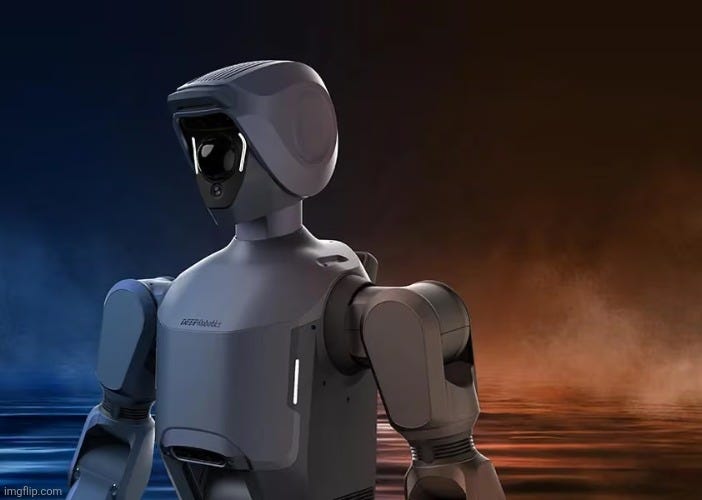
The story of automation in firefighting begins much earlier than the sleek, bipedal machines of modern imagination. For decades, the fire service looked at robots as rugged, tracked boxes designed to carry heavy water cannons into places too dangerous for human lungs. These early machines, often resembling miniature tanks or remote-controlled bulldozers, excelled at brute-force tasks. They could withstand extreme heat and roll over debris to douse chemical plants or industrial blazes. However, they lacked the agility to navigate the chaotic interior of a burning home. A tracked machine cannot climb a narrow, cluttered staircase, turn a delicate doorknob, or crawl through a collapsed hallway to look for survivors. The realization that our built environment is entirely designed for the human form eventually shifted the paradigm of robotic design toward the humanoid.
The true turning point for humanoid robots in rescue operations came in response to the Fukushima Daiichi nuclear disaster, an event that highlighted the desperate need for machines that could operate in environments built for people. This spurred the Defense Advanced Research Projects Agency, or DARPA, to launch its famous Robotics Challenge. The competition forced robotics companies to move away from tracks and wheels. Instead, they had to focus on bipedal platforms that could drive utility vehicles, use standard power tools, and climb ladders. It was during this era that Boston Dynamics stepped into the spotlight with its Atlas platform. Atlas became the gold standard for testing how a humanoid machine balances, jumps, and navigates uneven, unpredictable terrain.
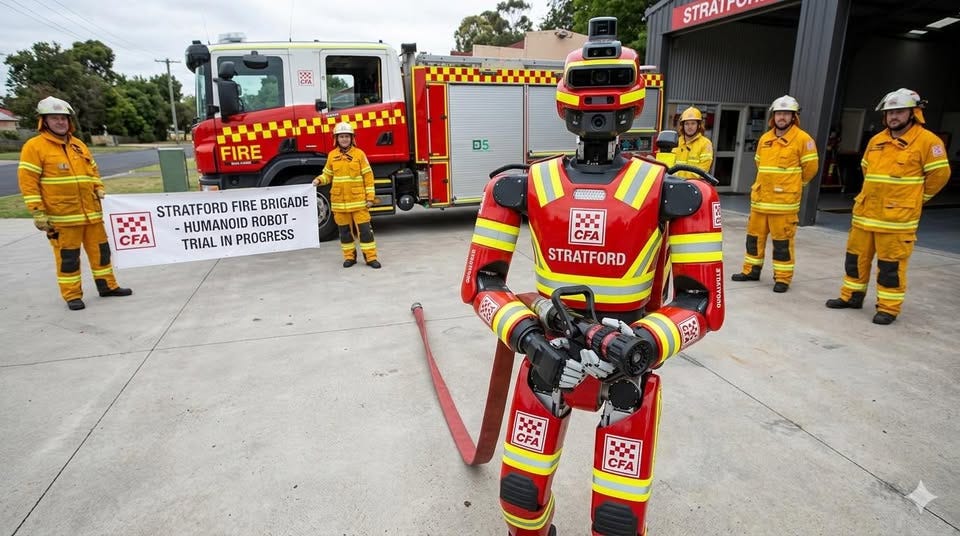
While Boston Dynamics built Atlas primarily as a research platform rather than a commercial product for fire departments, the testing phase provided invaluable data for emergency response. Engineers pushed the humanoid to its limits, proving that a bipedal machine could recover its balance after slipping on loose debris, clear obstacles with dynamic leaps, and use its hands to manipulate valves or clear blocked exits. The sight of a metallic figure doing backflips captured the public imagination, but for emergency services, the real magic was in the machine’s ability to maintain equilibrium while carrying heavy loads through simulated disaster zones.
The inherent advantages of a humanoid firefighter over traditional wheeled or tracked robots lie in this environmental compatibility. Human beings have spent centuries building cities tailored exclusively to our own biology. Countertops are a certain height, doors require a specific twisting motion to unlock, and rescue routes often rely on vertical ladders. A humanoid robot does not require retrofitted architecture. It can use the exact same equipment a human firefighter uses, from jaws of life to standard fire hoses. Furthermore, a two-legged machine possesses a unique structural agility. It can compress its frame to crawl under low-hanging collapsed ceilings, step over high obstacles that would high-center a wheeled vehicle, and transition smoothly from walking to climbing.
Looking toward the future, the integration of humanoids into fire, rescue, and emergency situations promises to redefine the nature of first response. In the coming decades, these machines will not replace human firefighters, but will instead act as the first wave into high-risk environments. Equipped with advanced thermal imaging and chemical sensors that far exceed human capabilities, humanoid responders will enter toxic smoke plumes, structurally compromised skyscrapers, and subterranean subway fires without risking human life. They will map the interior of a burning structure in real time, transmitting data back to human incident commanders outside.
As artificial intelligence continues to merge with advanced materials science, the future humanoid firefighter will become faster, lighter, and more autonomous. Future iterations will likely feature advanced fireproof skins made of synthetic materials capable of withstanding thousands of degrees of direct flame. These machines will operate with a high degree of situational awareness, allowing them to calculate the structural integrity of a room before stepping into it and to locate trapped individuals through walls using advanced radar technology. By taking on the initial, most perilous phases of search and breach operations, fire humanoids will ensure that human crews only enter a structure when the situation is stabilized, ultimately saving countless lives while preserving the safety of those who swear an oath to protect us.