

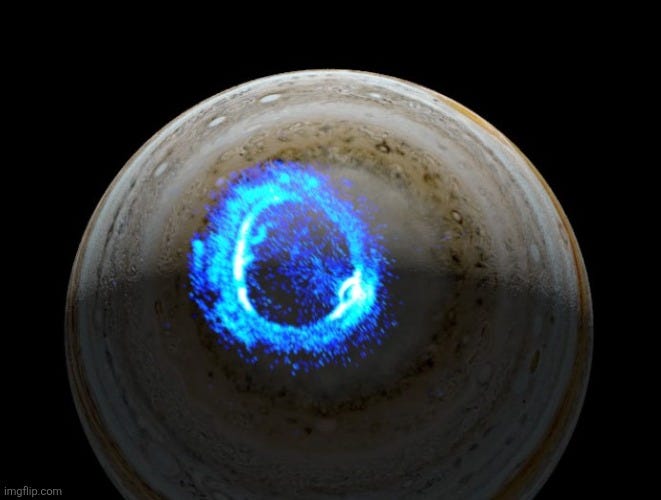
Illustration of Jupiter’s auroral oval in ultraviolet wavelengths
Astronomers have achieved a historic milestone by detecting the first unambiguous radio signals directly emanating from an exoplanet, marking a major leap forward in our ability to study distant alien worlds. The breakthrough signal was traced to Beta Pictoris B, a massive gas giant located roughly 63 light-years from Earth in the southern constellation of Pictor. While the phrase “radio signal from deep space” often sparks thoughts of extraterrestrial intelligence, scientists were quick to clarify that this transmission is entirely natural. Instead of alien technology, the broadcasts are the cosmic calling card of a planet wrapped in a hyper-powerful magnetic field and blanketed by spectacular, planet-wide auroras.
The discovery was made using South Africa’s MeerKAT radio telescope array, a sophisticated network of 64 linked dishes located in the Karoo Desert. By observing the Beta Pictoris system multiple times across 2025 and 2026, a research team led by astrophysicists from Harvard and the University of Oregon managed to isolate the planetary signal from the glare of its host star. This task required extreme precision because Beta Pictoris b orbits relatively close to its star. By meticulously mapping the radio signatures against distant background quasars, the team conclusively proved that the bursts were originating from the gas giant itself, an achievement never before definitively realized for an extrasolar planet.
What MeerKAT recorded was a combination of persistent radio emission and rapid, recurring bursts operating at frequencies between 0.85 and 3.5 gigahertz. The key to deciphering the signal lay in its high circular polarization, meaning the orientation of the radio waves rotates in a distinct circular pattern as they travel through space. Physicists recognize this unique signature as the hallmark of an electron cyclotron maser instability. This is the exact same physical process that produces auroral radio emissions in our own solar system, driving the northern lights on Earth and generating intense radio activity at the poles of Jupiter, Saturn, Uranus, and Neptune.
Because the maximum frequency of this radio emission is directly tied to the strength of the local magnetic field, this discovery provided astronomers with their very first direct measurement of an exoplanet’s magnetosphere. The results reveal a world of terrifying magnetic intensity. Beta Pictoris b possesses a magnetic field of at least 1,250 gauss at the source of the emission. To put that into perspective, Earth’s magnetic field measures a mere half a gauss at the surface, and even Jupiter, the solar system’s magnetic heavyweight, peaks at around 14 gauss. The field surrounding Beta Pictoris b is thousands of times stronger than Earth’s, perfectly matching theoretical dynamo models for a young, hyper-massive giant planet.
Several factors contribute to the planet’s intense radio output. Beta Pictoris b is a primordial gas giant roughly 10 to 12 times the mass of Jupiter, and it is incredibly young, with an estimated age of less than 23 million years. Crucially, the planet spins at a breakneck pace, completing a full rotation on its axis in just eight to nine hours. This rapid rotation churns the planet’s interior dynamo and drives massive electrical currents through its atmosphere. When high-energy charged particles from the stellar wind become trapped in the magnetosphere, they spiral down the magnetic field lines toward the poles, smashing into atmospheric gases and releasing torrents of energy as radio waves. Some scientists speculate that the aurora could be further fueled by a volcanic moon, similar to how Jupiter’s moon Io supplies charged particles to Jupiter’s auroral rings, though no such moon has yet been confirmed.
Ultimately, listening to the radio broadcast of Beta Pictoris b opens a profound new window into exoplanetary science. Measuring magnetic fields gives researchers an unprecedented look into the deep interiors and core dynamics of distant worlds. More importantly, a strong magnetic field acts as a protective shield, preventing stellar winds from stripping away a planet’s atmosphere over time. While Beta Pictoris b is a hostile gas giant incapable of supporting life, the methodology proven by the MeerKAT telescope will eventually allow astronomers to hunt for weaker magnetic signatures around smaller, rocky worlds. Finding these invisible shields will be a crucial step in identifying genuinely habitable planets across the galaxy.