

For decades, astronomers have hunted for signs that rocky worlds beyond our solar system might hold atmospheres thick enough to support liquid water and, perhaps, life. Until recently that search yielded only tantalizing hints or clear non-detections. In the summer of 2026 the picture changed.
Researchers announced the strongest evidence yet that a rocky planet in its star’s habitable zone retains an atmosphere. The discovery marks a quiet but profound turning point in the quest to understand whether Earth-like conditions exist elsewhere.
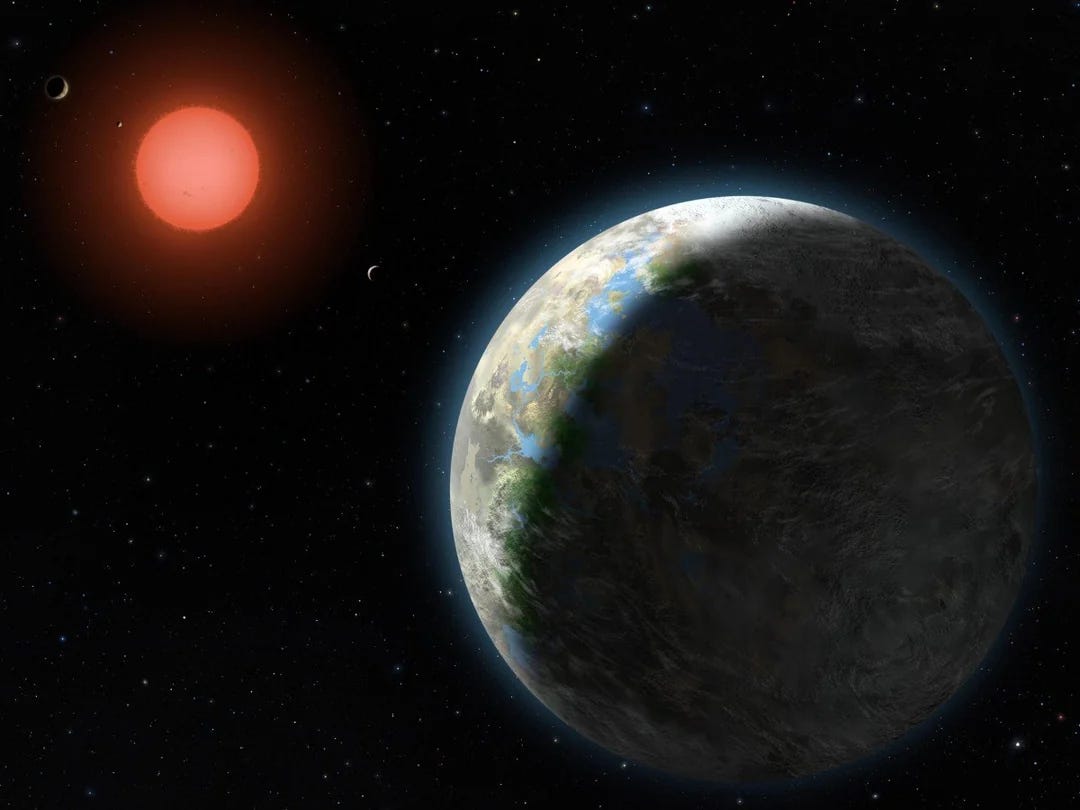
The planet is LHS 1140 b, a super-Earth roughly 1.7 times Earth’s radius and more than five times its mass, orbiting a quiet red dwarf about fifty light-years away. Using a sensitive spectrograph on the Magellan Clay Telescope in Chile, scientists detected helium streaming away from the planet’s upper atmosphere.
The signal, observed during a transit in 2024, implies that a substantial atmosphere has survived for billions of years despite the challenges of living around an M-dwarf star. Follow-up observations the next year found the escape had quieted, revealing that atmospheric loss can vary on human timescales—an unexpected and valuable detail.
Atmospheres alone are not enough. A magnetic field can shield a planet from the relentless stellar wind and intense flares that batter worlds around red dwarfs. Without such protection, even a dense atmosphere can be stripped away over geologic time. New studies of the nearest star system, Proxima Centauri, suggest that magnetic shields may be more common than once feared.
Analysis of stellar flares and spectral lines indicates that the small inner planet Proxima d likely possesses a magnetic field measured in tens of gauss—many times stronger than Earth’s. Subtle evidence also points to magnetic activity linked to the larger habitable-zone world Proxima b. These findings raise the possibility that both planets could retain atmospheres long enough for chemistry, and perhaps biology, to take hold.
The combination of atmosphere and magnetic field is powerful. An atmosphere regulates temperature, enables a water cycle, and filters harmful radiation. A magnetic field deflects charged particles that would otherwise erode that atmosphere molecule by molecule. Together they create the conditions that allowed Earth to remain habitable for billions of years. Finding both on distant rocky worlds transforms abstract statistical arguments about habitability into concrete case studies we can study in detail.
These results arrive at a pivotal moment. The James Webb Space Telescope continues its systematic survey of nearby rocky planets, testing whether other worlds show thermal signatures of atmospheres or remain bare rock. Ground-based instruments are proving surprisingly effective at catching escaping gases that space telescopes sometimes miss. Each new detection or non-detection refines models of how planets form, evolve, and survive around the most common stars in the galaxy.
The story is still unfolding. LHS 1140 b may or may not host liquid water; Proxima’s planets may or may not retain enough atmosphere for life. Yet the mere confirmation that rocky planets can keep atmospheres in the habitable zone, and that magnetic fields appear around the closest examples, removes a major theoretical obstacle. It tells us that the ingredients for temperate, protected surfaces are not unique to our solar system.
While the newest evidence comes from red-dwarf systems — the most common stars and currently the easiest to study in detail — the search is not limited to them. G-type stars like the Sun remain excellent candidates. Planets around Sun-like stars face less intense flares and stellar winds, so retaining an atmosphere and magnetic field should, in principle, be easier. The greater challenge is observational: the brighter light of G-stars makes the planetary signal harder to isolate with today’s instruments. Whether around the quiet glow of red dwarfs or the steadier light of Sun-like stars, it is likely that many other Earths are patiently waiting to be found.