

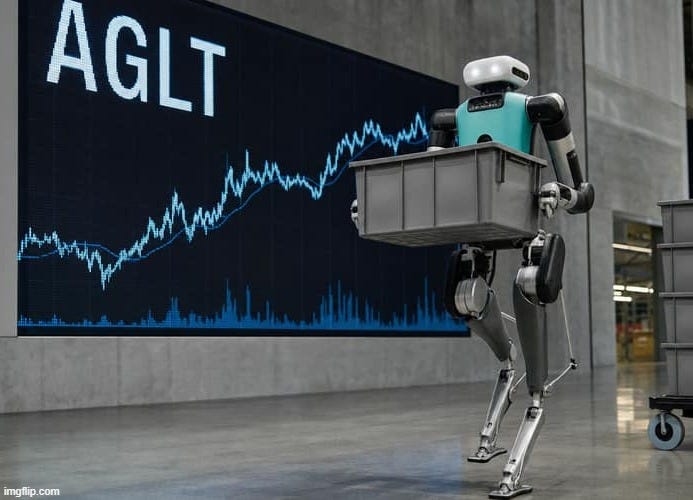
The great humanoid robot uprising of the late 2020s did not begin with a sentient supercomputer launching nuclear missiles. It began with a six-foot-tall titanium biped named Digit accidentally dropping a box of organic, gluten-free oats in a logistics warehouse, pausing for four seconds to re-evaluate its life choices, and then methodically sweeping them up while its human supervisors watched in quiet fascination.
For decades, the concept of a humanoid robot was relegated to science fiction or the occasional, deeply awkward tech conference demonstration where a million-dollar prototype would wave its hand, walk forward three paces, and then violently topple into a crowd of tech journalists. Today, however, the lab coats have been swapped for tailored suits and floor vests. We have officially entered the era of the deployable humanoid robot—a chaotic, high-stakes frontier where physical artificial intelligence meets the cold, hard realities of the global stock market.
Nowhere is this shift more apparent than on the trading floors. In a milestone that financial analysts will likely debate for the next decade, Agility Robotics recently made its highly public Nasdaq debut. Investors accustomed to trading shares of software companies or fast-food conglomerates suddenly found themselves valuing a company whose primary product looks like a very sleek, headless stormtrooper optimized for lifting plastic totes. Not to be outdone, China’s Unitree made waves by going public on the Shanghai Stock Exchange, proving that the desire to mass-produce metallic bipedal entities is a truly global phenomenon. Seeing these companies listed alongside legacy automotive giants and oil conglomerates highlights a bizarre new financial truth: Wall Street and the international markets are officially betting on the commercial viability of knees, ankles, and opposable robotic thumbs.
This rush to public markets is funding a massive wave of industrial and retail pilot trials that are currently playing out across the globe. Take, for instance, the recent experimental deployment in Shanghai, where a fleet of Agibot humanoid robots was tasked with running a retail space for twenty-four hours straight. The robots successfully completed nearly two thousand tasks, ranging from politely greeting bewildered shoppers to brewing espresso. Yet, beneath the triumphant press releases lies the hilarious, unvarnished truth of the current “hardware control gap.” While these machines are marvels of modern engineering, they still occasionally require a small army of human backup handlers standing just off-camera, holding emergency stop buttons and praying the robot doesn’t mistake a toddler for a rogue bag of coffee beans. We are living in a transitional comedy where a robot can calculate the optimal trajectory to lift a seventy-pound crate in milliseconds, but might still get entirely defeated by a stray piece of packing tape stuck to its foot.
What is changing the game and pulling these machines out of the realm of expensive novelties is the recent breakthrough in physical artificial intelligence. Historically, programming a robot was an exercise in pure misery. Engineers had to write rigid, explicit code for every single micro-movement. If a chair was moved three inches to the left, the robot would try to sit on empty air and crash. Physical AI has shattered this paradigm by utilizing large multimodal neural networks trained on massive clusters of graphics processing units. Instead of pre-programmed instructions, modern humanoids use these networks to directly map their spatial visual inputs and tactile hand feedback into organic, real-time motor commands.
This brings us to the ultimate hurdle that the industry is finally clearing: the training data gap. For years, the greatest bottleneck in robotics was the lack of real-world data. A digital AI can read the entire internet in a few days, but a physical robot has to physically move through space to learn, a process that is painfully slow and prone to breaking expensive hardware. To solve this, developers have turned to hyper-realistic simulation environments. Modern physical AI models are now closing the data gap by living millions of simulated lives before their metal bodies are even assembled. In these digital realms, a robot can drop a box a billion times across a thousand virtual warehouses, learning exactly how to adjust its grip, balance on an uneven floor, and navigate a crowded corridor. When the AI is finally downloaded into a physical chassis like Figure AI’s latest model or 1X’s Neo, the robot hits the warehouse floor with the institutional knowledge of a veteran logistics worker.
As these machines move out of research labs and into complex, chaotic real-world settings, the human workforce is learning to adapt to their new, oddly polite coworkers. The humanoid form factor, once dismissed by critics as an inefficient design choice compared to wheeled boxes or quadcopters, has proven its worth for a simple reason: our world was built by humans, for humans. Steps, doorways, shelves, and tools are all scaled to our anatomy. By building robots that match our shape, tech companies have avoided the need to redesign the planet’s infrastructure. The result is a bizarre, fascinating new reality where the line between science fiction and corporate logistics has completely dissolved. Humanoid robots are no longer coming to take over the world; they are coming to work the night shift, clock in on time, and occasionally stare at a broom with profound, algorithmic confusion.