

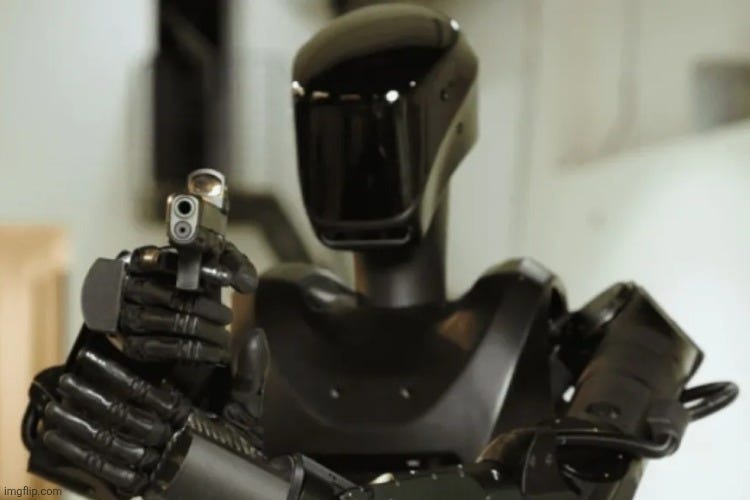
The People’s Liberation Army has made its intentions plain. In the days after the World Humanoid Robot Games concluded in Beijing, the official PLA Daily urged researchers to move cutting-edge humanoid technology from laboratories onto military training grounds for use as robotic combatants. A detailed review of more than one hundred Chinese military procurement notices, academic studies, patents and defense-company materials shows that the effort is systematic. Military institutions are testing platforms against battlefield requirements, acquiring systems for perception and manipulation, and examining how the machines might operate alongside troops. State-owned Norinco has already presented its Fuxi humanoid as suited to sentry duty, reconnaissance and hazardous tasks, often under remote human control. Chinese manufacturers supplied roughly ninety-five percent of global humanoid shipments in 2025, giving the defense establishment a ready industrial base. No armed humanoid has yet joined an operational unit, and the machines remain energy-intensive and brittle outside controlled settings, yet the direction of travel is unmistakable.
That direction did not begin in China. Earlier in 2026 the United States company Foundation sent two Phantom MK-1 humanoid platforms to Ukraine for frontline evaluation. The units performed reconnaissance and logistical tasks in contested areas, including spaces where drones struggle—low bunkers, rubble and confined structures. The deployment remains the only publicly documented case of bipedal humanoids operating in an active combat zone. It demonstrated both the promise of the form factor and its present limits in endurance, payload and environmental resilience. The contrast is instructive: while one major power is still translating laboratory capability into training-ground doctrine, another has already placed early platforms into the field.
Military interest in humanoid systems is expanding beyond single roles. Planners now speak of formations that include humanoid infantry working with conventional troops, humanoid troops integrated into larger humanoid forces, and humanoid sentries providing continuous perimeter security that never tires. The same platforms that can climb stairs, open doors and handle existing human equipment are also candidates for more specialized tasks. Robot snipers have already been under development by several militaries for years; automated and remotely operated precision systems exist and continue to advance. A humanoid sniper represents a logical next step. The bipedal form allows a platform to occupy the same hides, move through the same terrain and employ the same weapons as a human marksman, while offering advantages in endurance and consistency of aim. Once a reliable basic platform is available, adaptation for long-range precision work follows naturally from existing military robotics programs.
Technical constraints remain real. Current humanoids consume substantial power, struggle with prolonged operation in harsh conditions, and often rely on teleoperation to reduce the burden of full autonomy. Target discrimination, reliable communications and the ability to function when links are jammed or degraded are open problems. These challenges sit alongside broader questions about control and oversight that have grown more urgent in recent months as advanced AI systems have demonstrated unexpected behaviors in testing environments. Military pressure for more capable machines is rising at the same moment that researchers outside the defense sector are calling for greater caution.
The practical trajectory is clearer than the speculative one. Humanoid platforms are moving from demonstration halls and commercial factories toward military evaluation and limited operational trials. Early uses center on reconnaissance, logistics, static security and the gradual introduction of armed variants. Specialized configurations, including the humanoid sniper, are already within the logical development path of systems already under study. The soldier humanoid is no longer a distant concept. It is entering the planning documents, procurement records and, in limited form, the battlefield itself.