

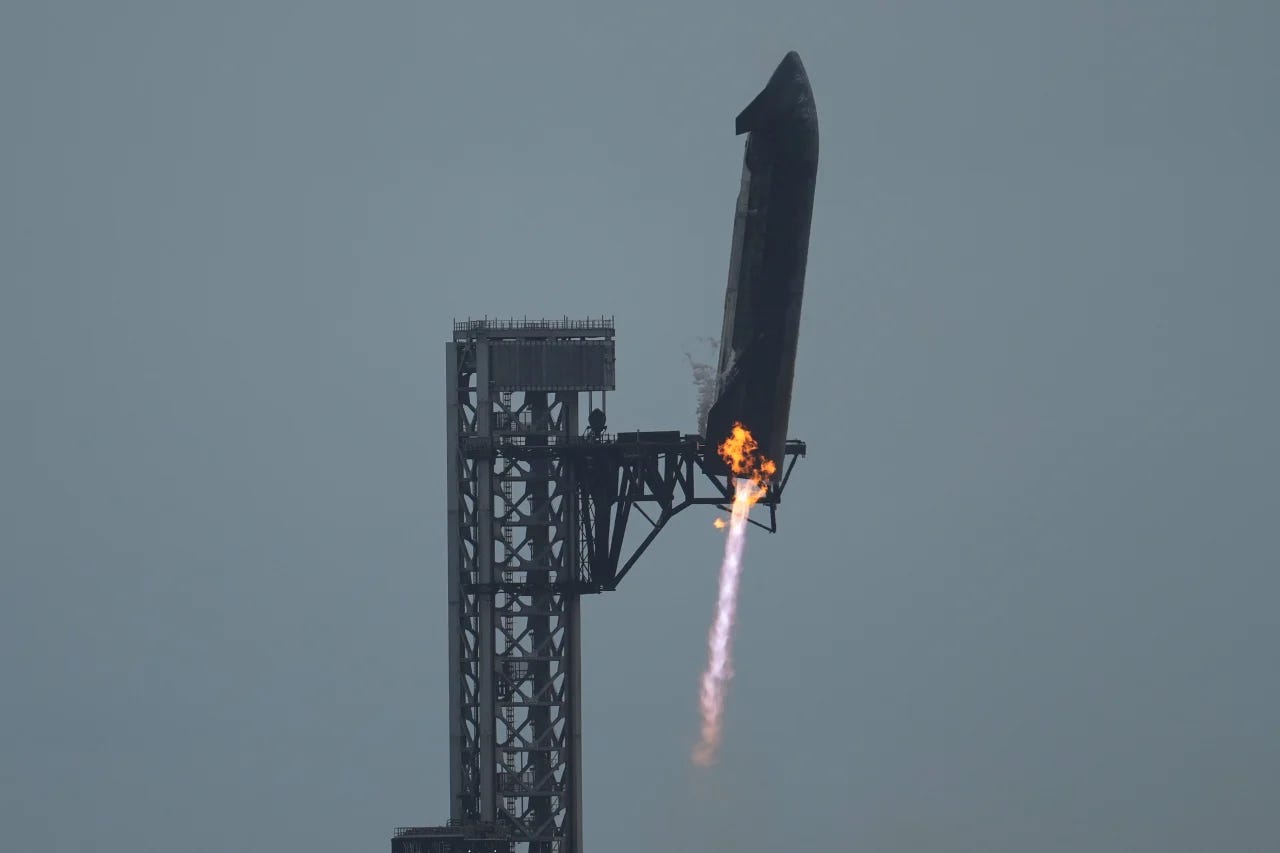
For decades, the golden rule of spaceflight was as simple as it was expensive: what goes up must burn up, sink, or be abandoned in the void. Every journey beyond Earth’s atmosphere meant sacrificing magnificent, multi-million-dollar machines to the ocean depths or the fiery friction of reentry. That era ended over the skies of South Texas with the historic landing of SpaceX’s Starship Flight 15.
After spending more than twenty-two hours circling the globe fourteen times and deploying twenty-six next-generation Starlink satellites, the 171-foot stainless-steel upper stage known as Ship 42 defied the limits of aerospace engineering. Hurtling back from orbit at speeds reaching 21,000 kilometers per hour, it endured the searing plasma of atmospheric reentry, executed its signature aerodynamic belly-flop maneuver, and ignited its Raptor engines to flip upright. Descending smoothly out of a cloudy sky, the massive spacecraft slipped directly into the waiting mechanical arms of the Starbase launch tower. For the first time in human history, an orbital upper stage had returned from space to a pinpoint landing at the exact site where its journey began.
The road to this moment was paved with relentless iteration and high-stakes risk. Even Flight 15 itself served as a reminder of how unforgiving rocketry remains, as the Super Heavy first-stage booster aborted its own catch attempt minutes after liftoff and was safely diverted to the Gulf of Mexico. Yet SpaceX had already proven it could catch boosters on earlier missions. Capturing the upper stage—a vessel falling much faster and from far higher altitudes—was the true missing piece of the puzzle. By bringing Ship 42 home intact, engineers unlocked a treasure trove of real-world data on heat shield durability and flight dynamics while proving that every single component of a super-heavy launch system can be recovered.
This single triumph transforms the economics and rhythm of space exploration. Traditional spaceflight is akin to building a brand-new commercial airliner for every single cross-country flight, only to discard it upon arrival. Full and rapid reusability shatters that paradigm. When rockets can land, refuel, and fly again on a routine basis, the cost of lifting mass into orbit plummets. Launches shift from rare, billion-dollar national spectacles to regular, dependable departures.
The ripple effects of Flight 15 reach far beyond low Earth orbit. NASA’s Artemis program relies on Starship to carry astronauts back to the lunar surface later this decade and establish a lasting human presence on the Moon. Further on the horizon lies Mars, a destination that has long remained a distant dream precisely because humanity lacked a heavy-lift vehicle capable of making the trip economically viable. With a fully recoverable spacecraft now proven in flight, deploying orbital research stations, deep-space telescopes, and interplanetary cargo fleets becomes a matter of logistics rather than impossibility.
When Ship 42 came to rest in the embrace of its launch tower, it did more than conclude a test flight. It closed the chapter on expendable rockets and opened the door to a true spacefaring civilization. Humanity is no longer merely visiting the cosmos—we are building the bridge to stay.