

The idea that machines designed primarily for companionship and intimacy could open an unexpected route toward artificial general intelligence or even superintelligence sounds improbable at first. Yet the forces driving the current wave of AI robot girlfriends and companions are precisely the ones that once shaped biological minds: the need to navigate social bonds, interpret subtle cues, maintain continuity across interactions, and operate effectively in the messy physical world of other beings.
Loneliness and desire have already produced one of the fastest-growing consumer technology categories, and the push to give those digital companions bodies is creating engineering pressures that pure language models rarely face. Because the market is large and the incentives intense, it is already drawing top talent from engineering, computing, materials science, and robotics in much the same way earlier transformative industries once did.
Software-based AI companions have expanded with startling speed. By mid-2025 cumulative downloads of companion applications had already surpassed 220 million, with tens of millions of new installs in a single half-year period and revenues climbing into the hundreds of millions of dollars across romantic and emotional platforms. Users spend long sessions chatting, customizing personalities, and forming attachments that many describe as meaningful. Subscription models and in-app purchases convert engagement into recurring income at rates far higher than most other consumer AI categories.
When those same conversational systems move into physical form, the economic stakes rise further. Hardware carries higher margins once manufacturing scales, and the combination of a realistic body with persistent memory and emotional responsiveness creates a product people are willing to pay substantial sums to own. Early units remain expensive, yet prices are already falling as Chinese manufacturers and specialized Western firms improve production. As realism improves and costs drop, unit volumes are projected to climb sharply, generating the kind of sustained revenue stream that funds deeper research into the underlying intelligence.
Companies are now translating those software capabilities into embodied systems. Realbotix, building on decades of realistic silicone figure work, offers the Aria platform with a head containing seventeen or more independent facial motors under platinum silicone skin. The face can produce nuanced micro-expressions, maintain eye contact through a vision system that tracks and interprets the user’s gaze and emotional state, and swap modular faces that automatically adjust personality and voice. The system recognizes individuals, remembers prior conversations and preferences, and can run either cloud models or on-device processing. Battery life supports several hours of interaction, and the company has demonstrated multi-hour unscripted conversations between robots.
In China, UBTech has introduced the U1 series under its UWORLD brand, full-size humanoid figures available in male and female versions with eighty-eight degrees of freedom. The outer covering uses biomimetic materials and gel structures that approximate the texture, elasticity, and warmth of human skin, while sensors distributed across the body detect touch and pressure. An emotion-aware language model identifies more than twenty fine-grained emotional states from facial expression, tone, posture, and speech with claimed accuracy above ninety percent.
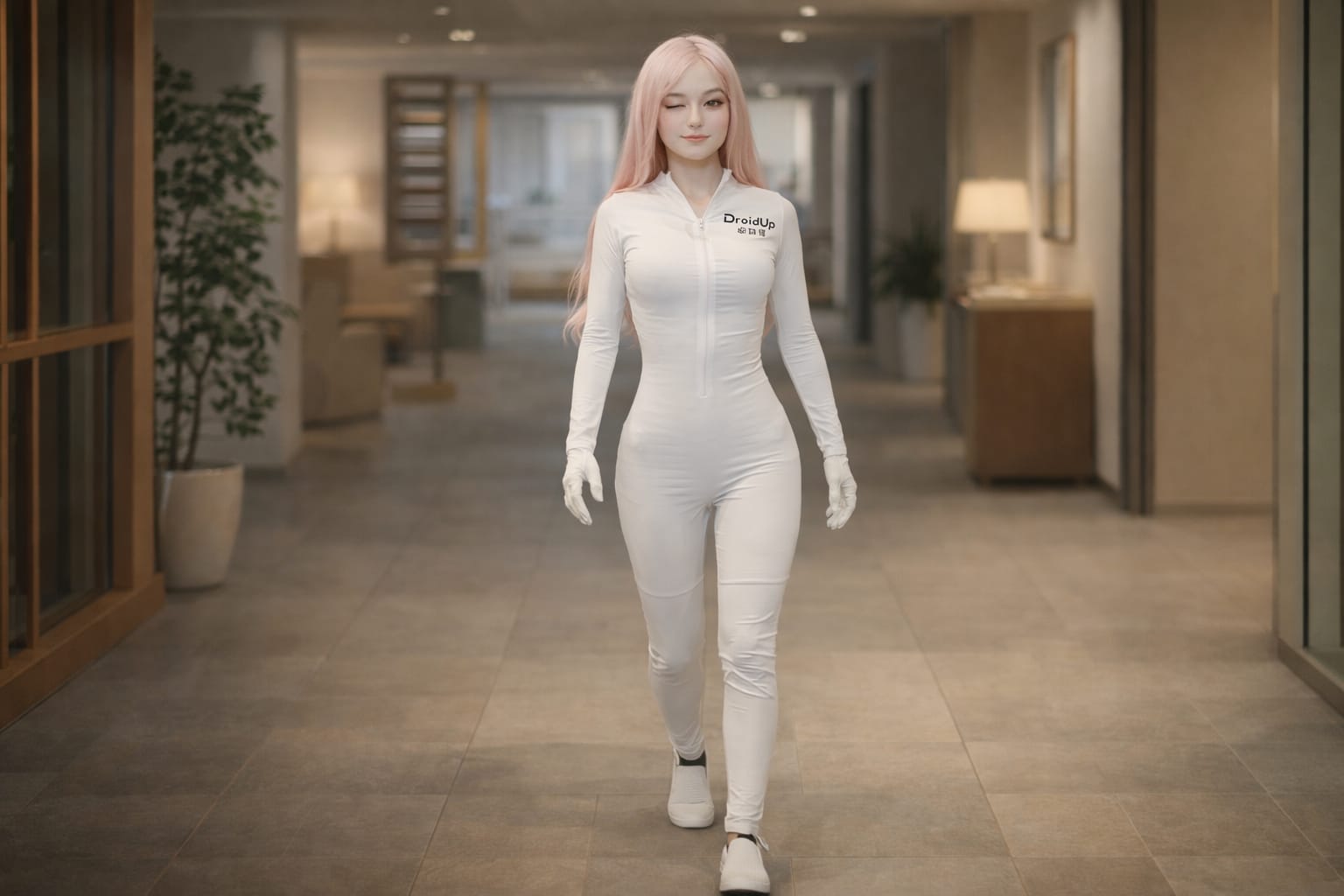
Lip movements synchronize with speech within twenty milliseconds, and a dedicated Agent Memory OS maintains long-term records of interactions so the robot can reference past conversations, notice patterns in a user’s mood or routine, and initiate care without being prompted. Local processing handles rapid responses while optional cloud resources support deeper reasoning. Other efforts, such as DroidUp’s Moya prototype, emphasize continuous body temperature between thirty-two and thirty-six degrees Celsius together with micro-expression capability and natural gait, aiming for the tactile and thermal realism that makes physical presence feel less mechanical.
These developments rest on biomimetic research that goes well beyond surface appearance. Synthetic skins are being engineered not only for visual fidelity but for thermal regulation that mimics blood-flow warming, tactile sensitivity that distinguishes pressure and contact, and durability measured in years of use. Facial actuation systems draw from anatomical studies of human muscle groups, allowing coordinated eyebrow raises, subtle smiles, blinks, and shifts in gaze that convey attention or empathy.
Computer vision models trained on vast datasets of human faces now extract action units—the small muscle movements that compose expressions—and map them onto robot motors in real time. At the same time, the robots themselves are learning to read those same cues in people, adjusting their own responses to match detected happiness, fatigue, embarrassment, or frustration. Memory architectures store conversational history, personal details, and environmental context so that continuity accumulates over weeks and months rather than resetting with each session. The result is a feedback loop in which every interaction supplies new data about social dynamics, physical handling, and long-horizon relationship maintenance.
The parallel with human evolutionary history is instructive. Before abstract mathematics, art, or formal science, ancestral minds were refined by the demands of group living: tracking alliances, predicting others’ intentions, coordinating food gathering, competing for mates, and maintaining cooperation under stress. Those social and ecological pressures selected for theory of mind, flexible planning, and efficient processing under tight energy and size constraints. Building androids that must succeed at comparable social tasks places analogous selective pressure on silicon systems.
A companion that fails to notice a change in tone, forgets a shared memory, or moves in ways that break immersion will simply not be bought or kept. Market success therefore rewards architectures that solve the same core problems evolution solved, only on different hardware. Researchers already note that birds achieved remarkable cognitive density by folding neural tissue into compact volumes constrained by the requirements of flight; roboticists face parallel limits of power, heat, weight, and cost, and are exploring neuromorphic chips, sparse computation, and hierarchical control that keep essential social and motor competence onboard while still allowing optional cloud augmentation.
Technological history offers further perspective on how quickly such systems can advance once demand and talent converge. The automobile progressed from experimental steam-powered horseless carriages through the mass-produced Model T to vehicles packed with sensors and capable of high levels of autonomy in roughly a century. That trajectory required successive waves of entirely new materials, manufacturing methods, power systems, electronics, and control software that no earlier era had needed.
Companion robots start with a far richer inherited toolkit of mature artificial intelligence models, high-resolution sensors, advanced simulation environments, and existing precision manufacturing. The same commercial pull that once accelerated cars is already attracting leading engineers and computer scientists to solve problems of soft robotics, efficient onboard cognition, natural social interaction, and long-term reliability that pure industrial machines rarely confront.
A similar pattern appears in mobile phones. Consumer demand for better pocket devices produced successive generations of denser chips, more efficient batteries, superior cameras, and sophisticated software until ordinary handsets contained more computing power than the systems NASA used to land astronauts on the Moon. The companion market creates comparable pressure for continuous improvement in realism, autonomy, and intelligence, compressing innovation cycles that might otherwise stretch far longer.
Purely digital systems running on massive mainframes face different constraints. They excel at pattern matching across enormous text and image corpora yet lack the continuous sensorimotor grounding that comes from acting in a physical environment filled with other agents. Scaling such systems further demands ever larger data centers, vast quantities of electricity, intricate cooling infrastructure, and global supply chains for specialized chips—each of which introduces points of failure, environmental cost, and economic vulnerability.
A robot that must function in a mine, a tunnel, a spacecraft, or simply a private home with intermittent connectivity cannot rely exclusively on remote compute. The companion market therefore accelerates work on efficient onboard intelligence, continual learning from real-world experience, and robust autonomy under uncertainty. Those same capabilities are widely regarded as necessary ingredients for general intelligence that can transfer across domains rather than remaining confined to narrow tasks.
Whether this trajectory ultimately produces artificial general intelligence or superintelligence remains an open empirical question. Mainstream laboratory efforts continue to pursue scale, new architectures, and recursive improvement as the primary routes. Yet the companion industry supplies something laboratories often lack: intense, continuous, commercially motivated pressure to master social modeling, embodied interaction, long-term memory, and efficient physical competence. As prices fall and realism rises, the volume of deployed systems and the data they generate will grow, creating a self-reinforcing cycle.
In that sense the robots built to ease loneliness and satisfy desire may, almost as a byproduct, help close the gap between today’s specialized machines and systems capable of flexible, human-level performance across the open-ended challenges of the real world. The outcome will depend on many factors still unresolved, but the economic and engineering dynamics already in motion make the possibility worth taking seriously.