

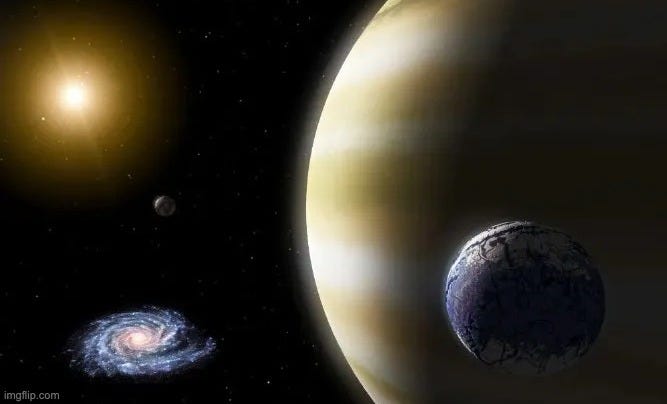
Deep within the cold, expanding voids between galaxies lie the universe’s most isolated vagabonds: rogue stars that have been violently ejected from their home systems, destined to drift through the absolute nothingness of intergalactic space. While astronomers have long studied these lonely giants, a fresh realization is dawning among astrophysicists regarding the ghostly cocoons of matter that travel with them. When a star is cast out of its parent galaxy by a rogue supermassive black hole or a chaotic stellar collision, it does not always leave entirely alone. It frequently carries a microscopic entourage of dense interstellar dust, gas, and heavy elements forged in its youthful stellar core, trapped within its moving gravitational bubble. This creates an entirely unmapped phenomenon: a transient, hyper-isolated micro-environment traveling through the cosmic deserts where nothing else exists.
This independent cosmic capsule acts as a closed-system incubator moving at millions of miles per hour across millions of light-years. As the star ages in total isolation, away from the gravitational turbulence and ionizing radiation of a crowded galaxy, its stellar winds interact with this small, trapped envelope of matter in perfectly stable ways. Without the disruptive influence of neighboring stellar gravity, the chemistry inside this bubble becomes uniquely predictable and pristine. Complex carbon molecules and basic crystal structures can assemble over billions of years without ever being torn apart by passing shockwaves from neighboring supernovas. It is a slow, silent cosmic chemistry experiment conducted in a laboratory of perfect solitude, creating molecular configurations that simply cannot survive in the chaotic interiors of dense galaxies.
Inside these isolated astrospheres, the absence of galactic background noise alters the fundamental timeline of chemical evolution. In a typical galaxy, the constant bombardment of cosmic rays, gamma-ray bursts, and X-rays from active galactic nuclei acts as a chaotic blender, breaking down fragile molecular chains just as they begin to complexify. Within the intergalactic desert, the wandering star’s own magnetosphere becomes an absolute shield, enclosing a zone of unprecedented chemical tranquility. Here, amino acids, polycyclic aromatic hydrocarbons, and intricate silicate networks can interlock into increasingly sophisticated prebiotic matrices without interruption. This hyper-stable environment allows for a continuous, unbroken chain of chemical synthesis, potentially accelerating the transition from raw elements to the building blocks of life.
However, this shielded existence presents a profound paradox for the timeline of biological evolution. While the lack of destructive galactic radiation protects delicate organic structures, it also removes the primary engine of genetic mutation. High-energy cosmic rays, while hazardous, are the traditional catalysts that drive DNA and RNA variation, forcing organisms to adapt, diversify, and evolve. Without this external pressure, any life that emerges on a world nestled inside a traveling stellar cocoon would likely evolve at a drastically slower, more deliberate pace. Generations of organisms might pass through millions of years with near-perfect genetic fidelity, experiencing almost no evolutionary pressure to change. The resulting biosphere would be remarkably stable, entirely free from the sudden mass extinctions caused by cosmic cataclysms, yet locked in a state of evolutionary stasis, producing a world of ancient, highly optimized, but structurally rigid organisms.
From the surface of a planet nestled within a wandering astrosphere, the cosmos would present a stark, haunting visual duality. Because the star’s traveling bubble traps and concentrates its own expelled stellar dust, the upper atmosphere of the planet would be perpetually choked with a faint, iridescent haze of silicate crystals and carbon particles. During the day, the sky would not be a familiar, scattering blue, but a deep, luminous amber or bruised gold, lit by a sun that never shares its sky with another object. When night falls, the transition would be absolute and terrifying. Without a single local star to puncture the dark, the sky would become a flawless, velvety abyss, broken only by the dim, ghostly smudges of distant galaxies, appearing as motionless, pale feathers frozen on a black canvas.
This total cosmic sensory deprivation raises a profound question about the emergence of intelligence under such conditions. While a lack of cosmic radiation slows genetic mutation, it does not stop it entirely. Evolution on this world would simply operate on a geological, rather than biological, timeline. Sentience could absolutely evolve, but it would require an immense, unbroken span of billions of years of perfect planetary climate stability to do so. The creatures that eventually achieved consciousness would be the products of deep time, possessing highly refined, hyper-efficient biologies that have spent eras adapting to a world that almost never changes. Their collective psychology would be forged entirely by the absolute solitude of their sky, rendering them a species with no native concept of a neighboring world or an external universe.
For such a civilization, the dawn of science would look radically different from our own. Without stars to track, they would have no early mythology of constellations, no celestial navigation to guide their global exploration, and no immediate reason to suspect that anything exists beyond their own atmosphere. Their earliest physics would focus entirely inward, mastering thermodynamics, chemistry, and geology long before ever looking up. The ultimate paradigm shift would occur only when they developed telescopes powerful enough to resolve the faint, distant smears in their night sky, revealing that the terrifying void surrounding them is actually populated by trillion-star megastructures, and that they are merely ghosts drifting through the empty spaces between the islands.
The profound beauty of these wandering star systems lies in their absolute detachment from the cosmic web. If a planet happened to form or survive within this traveling cocoon, any consciousness arising on its surface would look up at a night sky devoid of stars. They would see only a terrifying, awe-inspiring void, with the distant, faint smudges of unreachable galaxies millions of light-years away as their only companions. They would exist as the ultimate island universe, completely spared from the violent pulses of a crowded galaxy, yet forever drifting through the quiet dark on a slow, uninterrupted journey toward an unknown horizon.