

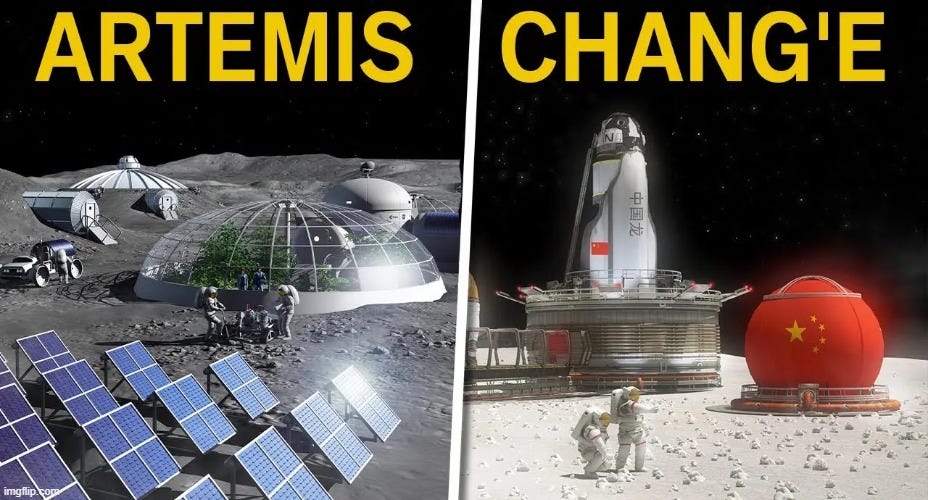
The global arena of space exploration is witnessing a spectacular revival as two modern titans lock their sights on the exact same cosmic real estate. More than five decades after the historic Apollo missions, the moon is once again the ultimate destination, but the stakes, the players, and the rules of engagement have completely evolved. This time, it is an intense, thrilling head-to-head contest between the United States and China, and the prize is no longer just about leaving a temporary footprint in the dust. Instead, both nations are sprinting to establish the first permanent, sustainable presence on the lunar surface.
This new rivalry functions as a high-stakes contrast in engineering philosophies and political structures. On one side, the United States is pushing forward with its ambitious Artemis program, aiming to land astronauts back on the moon by 2028. The American approach relies heavily on an energetic, fast-moving ecosystem of private commercial aerospace companies, alongside an international coalition of dozens of countries bound by a shared framework for peaceful exploration. It is a brilliant, highly innovative machine, though it occasionally experiences scheduling turbulence and shifting deadlines tied to domestic political and funding cycles.
Meanwhile, China is charging forward with remarkable precision and a distinct, long-term political advantage. Operating with a centralized system that guarantees consistent funding regardless of elections, the Chinese space program has hit its self-imposed milestones with clockwork regularity. Beijing has already achieved historic robotic victories, including landing the first-ever rover on the far side of the moon and executing flawless sample return missions. With an official target of putting its own taikonauts on the moon by 2030, China is actively building an entirely new spacecraft called Mengzhou and testing a colossal rocket to make that dream a reality.
The ultimate battleground for these competing programs is the lunar south pole, a heavily cratered region shrouded in perpetual shadow. This specific territory is coveted because scientists believe it contains vast deposits of water ice hidden deep inside craters. Water is the gold rush resource of the cosmos; if you can mine lunar ice, you can break it down into oxygen to breathe and hydrogen for rocket fuel. This means the south pole could serve as a cosmic petrol station, transforming the moon from a lonely destination into a vital launching pad for eventual crewed voyages to Mars.
This geopolitical tension is crystallising into a direct geographical collision course, as both nations look at overlapping candidate zones. Finding the best location on the moon depends entirely on balancing two conflicting needs: abundant sunlight for power and absolute darkness for ice harvesting. Because of this, Shackleton Crater is widely considered the crown jewel of lunar real estate. Sitting almost exactly on the lunar south pole, the unique geometry means its towering rims are exposed to near-constant sunlight for solar energy, while its four-kilometre-deep interior remains plunged in perpetual darkness and sub-zero temperatures, acting as a deep freezer for ancient water ice.
However, Shackleton is incredibly rugged and steep, featuring thirty-degree slopes that make landing a spacecraft highly dangerous. Because of these extreme hazards, scientists are actively studying secondary locations that offer flatter terrain as safer compromises. Peer-reviewed safety models often point to Nobile Rim 2 as a mathematically optimal compromise for a human landing because it offers smoother topography while still granting access to ice-rich shadows. Other prominent backups being evaluated by planners include the Connecting Ridge and the flat plains near Haworth Crater.
The friction of this overlapping ambition was on full display with the dramatic development surrounding China’s Chang’e 7 mission. Slated to launch in late August 2026, the highly publicised, ultra-ambitious robotic mission was abruptly postponed and pushed back to 2027 after failing to meet critical launch window conditions. This means the deployment of China’s highly anticipated crater-hopping probe, a revolutionary rocket-powered mini-hopper engineered to fly directly into the frozen dark of Shackleton Crater to drill for ice, has been temporarily frozen on the launch pad in Hainan.
This unexpected Chinese setback offers a fascinating shift in momentum for the American side, which is restructuring its own timeline through a hyper-cautious, safety-first strategy. Following an architecture overhaul, NASA confirmed that the upcoming Artemis 3 mission, scheduled for late 2027, will no longer attempt a lunar landing. Instead, four astronauts will fly the Orion capsule into low-Earth orbit to conduct highly complex, high-stakes docking rehearsals with prototype landers from SpaceX and Blue Origin. This massive orbital shakedown serves as a strict technical prerequisite, shifting the actual American human landing attempt to the Artemis 4 mission in 2028.
As the decade progresses, this celestial tournament will undoubtedly reshape global technology and national pride here on Earth. Whether it is an American astronaut returning to the lunar surface under the Artemis banner or a Chinese taikonaut stepping out of a lander near a dark polar crater, the race is pushing human ingenuity to its absolute limits. We are living in a magnificent new era of discovery, and the world is fortunate to watch the next chapter of human history unfold across the silver landscape of our nearest neighbor.