

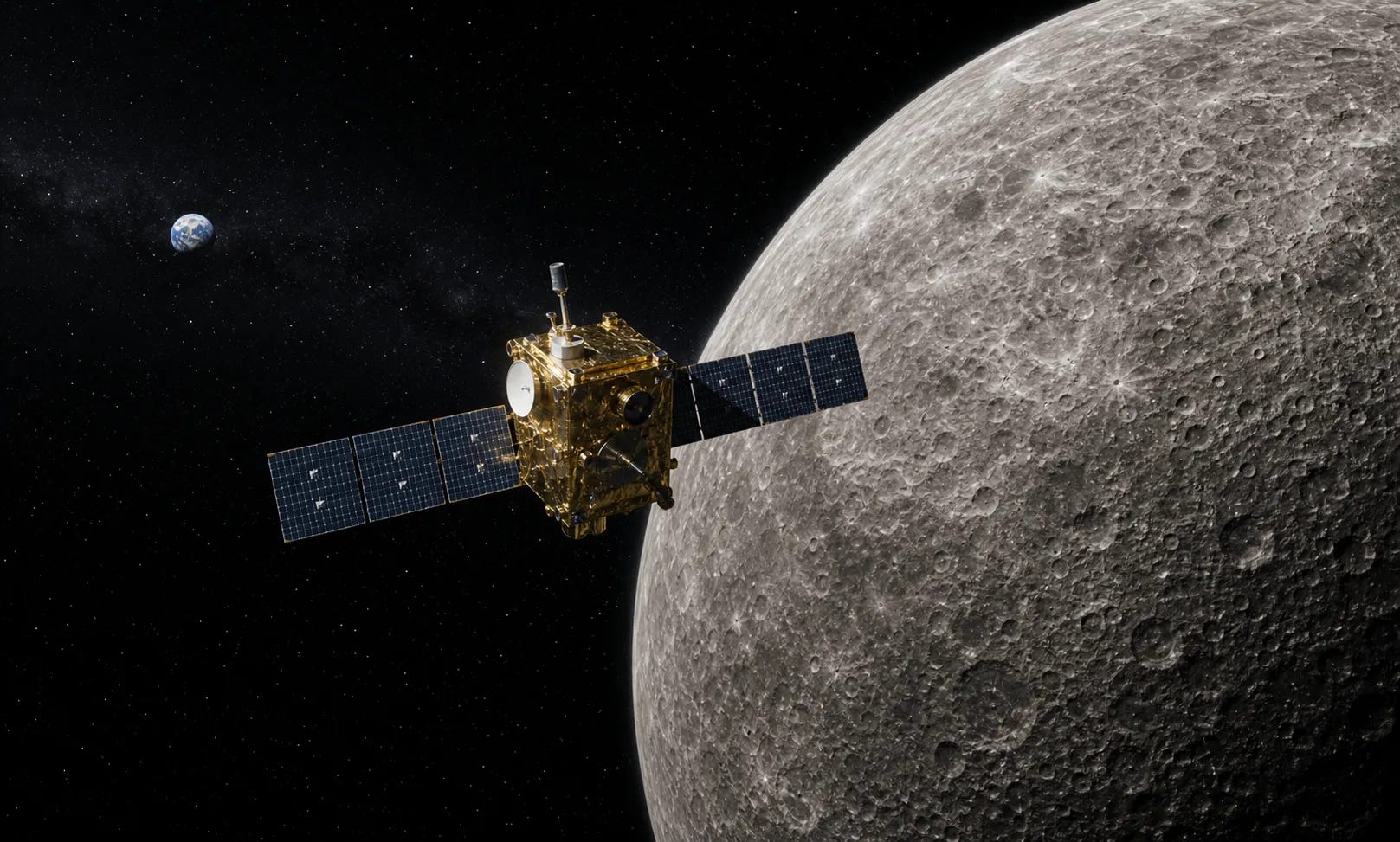
When Air Force Secretary Troy Meink confirmed this month that the United States already has weapons stationed in orbit, most of the reaction focused on what that meant for the crowded, closely watched skies of low Earth orbit, the domain where Starlink satellites fly, where the Space Force just ran its first live orbital dogfighting exercise, where a handful of major powers have spent the last decade building up genuine operational experience. Far less attention went to a quieter, older, and in some ways more troubling question that specialists in this field have been circling for years: what happens when the same competitive pressure reaches cislunar space, the vast volume between Earth and the Moon, and the two theaters turn out to run on almost entirely different rules.
Cislunar warfare is not simply orbital warfare with a longer commute. It is a genuinely distinct strategic and engineering problem, and the gap between how prepared the United States is for one versus the other has been widening for years, largely out of public view.
The Three-Second Problem
Start with something as basic as physics. A radio signal takes roughly three seconds to make the round trip between Earth and the Moon, and that number only grows for anything operating further out toward the Earth-Moon Lagrange points. Three seconds sounds trivial until you consider what it rules out. Sam Visner, who chairs the Space Information Sharing and Analysis Center, has put the practical consequence plainly: nobody drives a lunar rover with a steering wheel in real time, and nobody will defend a lunar or cislunar asset that way either. Any meaningful response to a threat at that distance, a jamming attempt, a collision course, a cyber intrusion, has to be handled autonomously, by the system itself, because no human operator on Earth can react fast enough to matter.
That single fact reshapes almost everything about what cislunar defense has to look like. In low Earth orbit, a human can still plausibly sit in the loop, watching a threat develop and authorizing a response within a reasonable window. Push the same problem out to cislunar distances, and the loop has to close on its own. The systems responsible for protecting a lunar mining operation, a cislunar communications relay, or a crewed transit vehicle will need to be trusted to identify a threat and act against it without waiting for permission, a requirement that current US doctrine, built around careful human authorization at every step, has not yet fully reckoned with.
Assets That Have to Last a Decade, Not a Product Cycle
The distances create a second problem that gets far less attention than it deserves. Low Earth orbit constellations like Starlink are built on a rapid replacement model, satellites cycle out and get replaced every few years, which means security flaws, outdated hardware, and emerging threats can be patched simply by launching the next generation. Cislunar infrastructure cannot work that way. A lunar surface habitat, a cislunar relay station, or an orbital facility supporting a mining operation will need to remain functional for ten to fifteen years at a minimum, simply because getting a replacement out to cislunar distance is neither cheap nor fast. That turns every cislunar asset into a long-lived, slowly aging target, one that has to be secured against threats and vulnerabilities that do not yet exist at the moment it launches, with no realistic prospect of a quick hardware refresh if something goes wrong partway through its service life.
A Region With No One Clearly in Charge
Underneath both of these technical problems sits a governance gap that specialists have been warning about for longer than most of the public conversation around this topic realizes. Serious, focused discussion of cislunar security is not a reaction to this month’s weapons disclosure. The Johns Hopkins University Applied Physics Laboratory has been working the problem for years, publishing a detailed technical framework built on lessons from a series of Cislunar Security conferences that were already being held back in 2020 and 2021, well before Artemis II ever carried astronauts back through this same region. What that body of work keeps returning to is not a specific weapon or adversary, but a structural absence: there is currently no coherent, actionable plan for who monitors cislunar space, who has authority to act if something goes wrong there, and how norm violations would even be identified, let alone answered. One recent assessment described the country as entering a new phase of strategic competition in a region it has no real plan to administer or defend, a blunt way of putting a problem that has been building quietly for half a decade.
Space-ISAC has been running the closest thing available to a rehearsal for this gap. In one recent exercise, analysts worked through a hypothetical cybersecurity incident set less than a decade from now, involving a lunar mining facility and an orbiting laboratory, deliberately pulling in the kind of questions nobody has fully answered yet: which government has jurisdiction when a multinational crew and multiple companies are involved, how insurers and investors would even begin to assess the damage, and how quickly reliable information could reach the public in a crisis playing out three light-seconds away. These are not hypothetical curiosities. They are the exact questions any real cislunar incident would raise immediately, and right now the honest answer to most of them is that nobody fully knows.
Why the Stakes Keep Rising
None of this would matter much if cislunar space were still the empty transit corridor it was for most of the last fifty years, but that description no longer fits. Artemis II carried a crew back through this exact region for the first time since Apollo. The Space Force has stood up a dedicated Cislunar Coordination Office specifically because the volume of activity moving through the area has grown enough to need one. China continues advancing its own lunar program in parallel, including cooperative plans for a joint lunar research station with Russia, and has made no secret of its ambitions at the lunar south pole, the same region increasingly understood to hold the water ice that could make sustained lunar operations genuinely viable. A region only draws serious military attention once it becomes worth having, and cislunar space, quietly and largely out of public view, has spent the last several years crossing exactly that threshold.
The Domain Doctrine Has Not Caught Up To
The broader shift toward a more openly acknowledged offensive posture in orbit, the kind confirmed by this month’s disclosure, is happening on a battlefield the United States has spent over a decade learning to operate in. Cislunar space is a different battlefield entirely, one governed by communication delays that rule out real-time human control, hardware that has to survive a decade or more without a refresh, and a policy framework that multiple serious institutions have been quietly flagging as inadequate since before most of today’s headlines existed. The weapons announcement made news because it confirmed something about orbit that officials had avoided saying outright. The more consequential question, still mostly unasked outside a small community of specialists, is what happens the first time a serious incident occurs somewhere between here and the Moon, in a region nobody has yet finished deciding how to govern.
China is already training satellites to act autonomously:
https://thedebrief.org/a-new-cold-war-is-unfolding-in-orbit-as-china-advances-satellite-surveillance/