

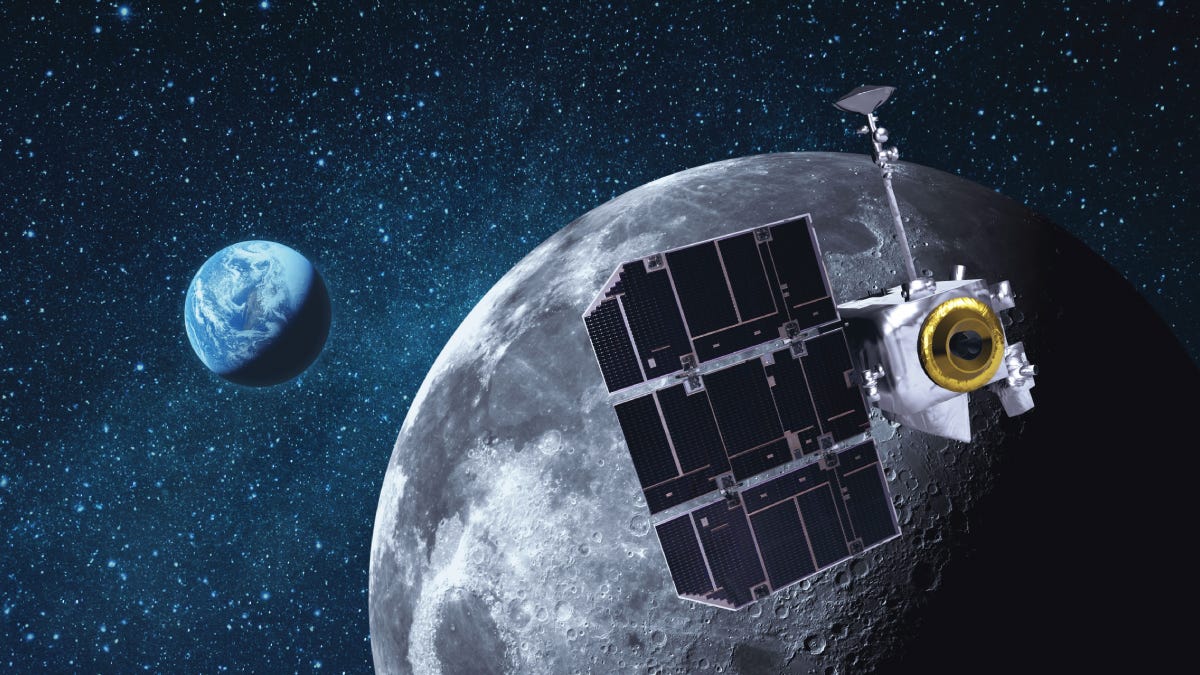
Cislunar space—the vast volume stretching from Earth orbit out to the Moon and its surrounding Lagrange points—is no longer an empty transit corridor. As Artemis missions, commercial landers and international programs increase activity, three interconnected needs are coming into focus: the ability to track and protect assets (security), reliable positioning and timing (navigation), and the extraction of local materials to reduce dependence on Earth (resources).

Security and Domain Awareness

Earth-orbit sensors provide limited visibility beyond geosynchronous altitude. Objects in cislunar trajectories can approach or depart in ways that are hard to detect with existing networks, creating potential blind spots. Space domain awareness in this region is therefore a growing priority for civil and military planners.

The U.S. Space Force has established coordination efforts focused on cislunar operations, recognizing that sustained presence—whether scientific, commercial or logistical—will require continuous monitoring. New sensor concepts, including dedicated surveillance spacecraft and mobile inspectors, are in development to improve custody of objects far from Earth. Conjunction assessment tools are also being extended beyond traditional Earth orbits.

Security concerns are not solely military. Protecting communications relays, navigation satellites, habitats and resource facilities from both accidental collision and intentional interference will become more important as the number of assets rises. International norms and transparency mechanisms are still evolving.

Navigation and Timing

There is no GPS on the Moon. Spacecraft and surface vehicles currently rely on a mix of Earth-based tracking, inertial systems and optical techniques. For sustained operations this is insufficient.

NASA and partners are developing lunar positioning, navigation and timing (PNT) services. Approaches include extending the reach of existing Global Navigation Satellite Systems (GNSS) signals to lunar distances, deploying dedicated lunar relay and navigation satellites, and creating interoperable networks under frameworks such as LunaNet. Early demonstrations have already shown that GNSS signals can be received and used for navigation near the Moon.

Accuracy goals for early infrastructure are in the tens of meters, with tighter performance expected as systems mature. Surface beacons, orbital relays and precise timing will support autonomous rovers, precision landings and coordinated activities at multiple sites. Secure, resilient PNT is also recognized as dual-use infrastructure with both civil and national-security value.

Resources and In-Situ Utilization

The long-term viability of cislunar activity depends on using what is already there. The most immediate target is water ice concentrated in permanently shadowed regions near the lunar poles. Extracted water can be split into oxygen and hydrogen for propellant, life support and radiation shielding.

Other resources under study include oxygen from regolith, metals for construction, and potentially helium-3. In-situ resource utilization (ISRU) demonstrations are planned in the coming years, with the aim of moving from laboratory experiments to pilot-scale production of propellant and consumables. Success would dramatically reduce the mass that must be launched from Earth and enable more frequent and flexible missions.

Resource sites themselves become strategic. Access to ice-rich areas, power generation (including nuclear systems for the long lunar night), and the infrastructure to process and store products will shape where bases and industrial activities develop.

An Integrated Picture

Security, navigation and resources reinforce one another. Tracking assets requires good navigation data. Protecting resource facilities requires domain awareness. Efficient use of local materials reduces the logistical burden that security and navigation systems must support. Together they form the foundation of a sustained cislunar presence.

Progress is uneven but real. Demonstrations of lunar navigation, improved tracking concepts and early ISRU technology are advancing. The scale and pace of investment over the next decade will determine whether cislunar space remains a series of isolated missions or becomes a connected operational domain with its own infrastructure and economy.