

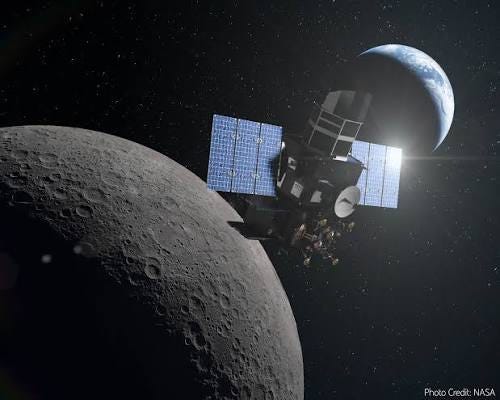
In this cosmic layout, Low Earth Orbit is the busy inner-city business district sitting just a few hundred kilometres above our heads. This is where companies like AST SpaceMobile operate, launching massive “cell towers in space” to connect standard smartphones directly to the internet. Cislunar space, by contrast, is the vast deep-space territory that extends all the way to the Moon. It is a massive gravitational playground between Earth and the lunar surface, and it is quickly becoming the premier frontier for NewSpace investment.
The term cislunar platforms often causes confusion, but the distinction is simple when using the city analogy. Spacecraft are the cars and delivery trucks—highly mobile vehicles designed to transport people or cargo from point A to point B. Rocket Lab, for instance, builds these deep-space transit vehicles, having already proven its navigation capabilities by flying NASA’s CAPSTONE spacecraft into specialized lunar orbits. Platforms, on the other hand, are the city infrastructure. They are the fixed highway networks, communication grids, and fuel stations that spacecraft rely on to do their jobs. While a spacecraft moves through space, a platform stays in a permanent or predictable orbit to provide a continuous service.
For a long time, the planned centerpiece of this deep-space architecture was NASA’s Gateway, a massive government-funded orbital space station. However, under the leadership of administrator Jared Isaacman, NASA officially cancelled the Gateway program to pivot its funding toward a permanent base on the lunar surface. Rather than killing deep-space ambitions, this shift acted as a massive catalyst for private enterprise. Without a single, government-owned hub dictating traffic, the cislunar domain has matured into a distributed, commercialized economy built on a network of independent platforms.
The true gold rush in NewSpace is happening within this infrastructure layer. Investors are pouring billions of dollars into cislunar platforms because they solve the ultimate bottleneck of space travel: Earth’s intense gravity. Hauling heavy rocket fuel and hardware up from Earth is incredibly expensive. To bypass this, companies are building automated fuel depots positioned at gravitationally stable locations known as Lagrange points. These platforms will store volatile propellants, eventually sourcing water ice directly from the Moon to refuel passing spacecraft. By turning cislunar space into a refueling highway, space transit becomes a profitable, repeatable business.
Beyond fuel depots, billionaires like Amazon founder Jeff Bezos are making capital-intensive bets on long-term cislunar platforms through Blue Origin. Bezos envisions a future where heavy, polluting industrial manufacturing is moved entirely off Earth. To support this, private consortia are designing commercial space habitats to act as orbiting business parks, research labs, and automated factories. Concurrently, international frameworks are deploying cislunar communications networks—the lunar equivalent of GPS and high-bandwidth internet—using optical laser relays to bridge the massive data gap between the lunar farside and terrestrial ground stations.
Ultimately, the cancellation of a centralized government station did not slow down deep-space expansion; it opened the floodgates for a market-driven network of private habitats, data networks, and cargo platforms. By understanding that platforms are the foundational infrastructure making deep-space travel viable, it becomes clear that the current cosmic gold rush is not about isolated, flags-and-footprints expeditions. It is about building a permanent, interconnected, and highly profitable industrial ecosystem across the cislunar frontier.