

The boundaries of human industry are expanding beyond the traditional confines of Earth, stretching into the orbital space between our planet and the Moon. This emerging sector, known as cislunar mining, represents a profound shift in how humanity views resources and sustainability in space. Rather than relying entirely on terrestrial supply chains, which suffer from the steep energy costs of escaping Earth’s gravity, future space exploration will rely on material extracted and processed directly in transit. And unlike many space-industry visions, this one already has startups, prototypes and launch dates attached.
The Moon as a Mine
At the core of cislunar mining is the Moon itself. Lunar mining focuses primarily on volatile compounds trapped in the permanently shadowed regions of the lunar poles. Water ice is the most critical resource found in these areas. When processed, water can be split into hydrogen and oxygen to create rocket propellant, or used directly for life support and radiation shielding. By establishing mining operations on the lunar surface, space agencies and private enterprises can create a network of orbital fueling stations, turning the Moon into a stepping stone for deeper solar system exploration.
The commercial field is taking shape from several directions. Seattle-based Interlune, founded by former Blue Origin technologists, is chasing a different prize: helium-3, an isotope with potential uses in quantum computing and medical imaging. Its founders include former Blue Origin leaders and an Apollo 17 astronaut. The company plans a resource development mission in 2027 to measure helium-3 concentrations at a future mining site, followed by a pilot plant in 2029. The scale of the challenge is sobering: helium-3 is present in tiny concentrations, and a single kilogram could require processing up to a million tons of soil.
Other lunar players are building the infrastructure that mining will depend on rather than digging themselves. Astrobotic and Intuitive Machines provide landers and delivery services, while Japan’s ispace has flown two HAKUTO-R landers and announced commercial regolith sales to NASA. In a sector with no established customers, even a sale of lunar dirt counts as a milestone.
Capturing Near-Earth Objects
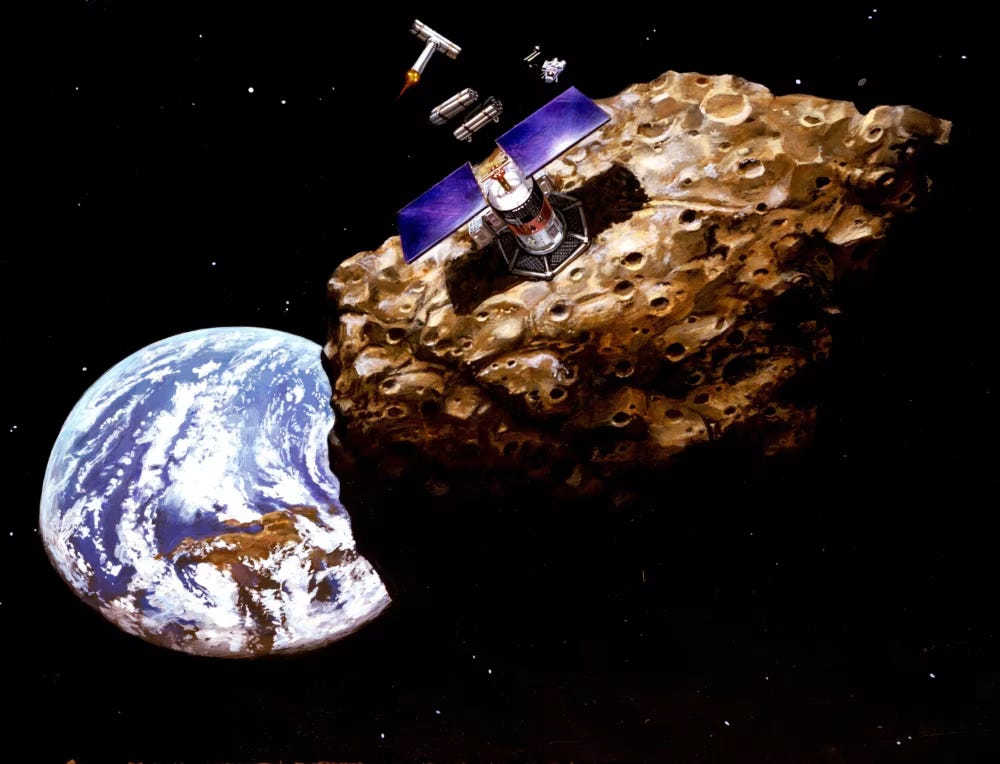
Beyond the lunar surface, cislunar mining encompasses the capture and processing of near-Earth objects. This aspect of the industry involves identifying asteroidal bodies rich in metals or water and bringing their materials into the Earth-Moon system. Once secured in cislunar space, these resources can be processed without the logistical challenges of deep-space transit. A single carbonaceous or metallic asteroid could provide enough raw material, from platinum-group metals to structural iron, to support massive orbital manufacturing projects for generations.
This is the segment with the most dramatic history. The first wave of asteroid mining companies, including Planetary Resources and Deep Space Industries, faded away years ago, and today’s startups say they have learned from those failures. Two stand out, and they are betting on different prizes.
AstroForge is pursuing metal. It specializes in extracting platinum-group metals and favors low-cost, replicable spacecraft. Its path has been bumpy: its Odin probe was aimed at 2022 OB5, a near-Earth asteroid about 100 meters across and thought to be metallic, but the mission was declared over in March after running into problems. The company, unbowed by the failure, has kept building.
Karman+ is after water. The Denver-based company has Dutch roots through co-founder and CEO Teun van den Dries, and in February 2025 it raised $20 million in seed funding. Where AstroForge targets metallic asteroids, Karman+ is looking for asteroids that might harbor hydrated minerals, with its first mission, High Frontier, planned as soon as 2027. The strategy has a clever twist: Karman+ intends to be the first customer for the water it produces.
Salvaging Orbital Debris
The third pillar of this orbital economy addresses a man-made resource found closer to home. Orbital debris salvage presents an opportunity to turn a growing hazard into an asset. Abandoned rocket stages and defunct satellites represent highly refined alloys and valuable electronics. Recycling these materials reduces the need to launch heavy structural elements from Earth.
One company is already building around this idea. Colorado-based CisLunar Industries, founded in 2017, is developing what it calls the Modular Space Foundry. The system robotically cuts aluminum off derelict satellites, then processes the metal using electromagnetic levitation furnace technology originally proven on the International Space Station. The output is not just raw material. The foundry produces rods of metal “fuel” for a Neumann Thruster on a debris removal spacecraft, which can then deorbit its target and move on to the next one. CEO Gary Calnan has joked that converting debris to fuel rods is like using your compost pile to fuel your car.
The concept has attracted institutional backing. In 2023, CisLunar and partners Astroscale U.S. and Colorado State University won a $1.7 million Space Force SBIR contract through SpaceWERX. The company’s longer-term vision goes beyond cleanup: it aims to create the first space-based metal refining and production capability in cislunar space, feeding an in-space manufacturing industry that needs a steady supply of refined metal.
A Closed Loop Takes Shape
Together, these three components form a closed-loop economic system in the space surrounding Earth. Lunar miners supply water and propellant, asteroid prospectors supply metals and volatiles, and foundries turn orbital junk into construction material. None of these businesses is yet profitable, and several have already stumbled. But the pieces are no longer hypothetical, and the shift from an economy based entirely on Earth-launched supplies to one fueled by indigenous space resources may mark the true beginning of a spacefaring civilization.