

The next time you look up at the moon and indulge in a moment of existential wonder, try to look past the poetry and see the ultimate fixer-upper. For decades, humanity treated Earth’s natural satellite like a remote vacation destination—a place to snap a few historic photos, collect some expensive rocks, and leave behind some very high-tech trash. But the transition from cosmic tourism to a permanent presence is officially underway, and it relies entirely on a massive, invisible, and deeply unglamorous concept known as cislunar infrastructure.
Cislunar space is the vast, gravity-sculpted playground between Earth’s upper atmosphere and just beyond the Moon. Right now, it is mostly an empty void, but over the next few decades, it is slated to become the solar system’s busiest construction zone. Think of it as the ultimate highway system, except the highway is three-dimensional, moving at thousands of miles per hour, and completely lacks a single gas station or rest stop. Building infrastructure here is the equivalent of trying to establish a bustling metropolis in the middle of Antarctica, if Antarctica were also trying to actively suffocate you and boil your blood simultaneously.
To make the moon more than just a historical monument, we have to solve the cosmic logistics nightmare. You cannot build a lunar economy if every single bottle of water, wrench, and Wi-Fi router has to be hauled up from Earth at the cost of thousands of dollars per pound. This is why the first wave of cislunar architecture focuses heavily on orbital gas stations and automated tugboats. Space tugs will lounge around in stable gravitational pockets called Lagrange points, waiting to catch heavy cargo ships and gently guide them to their final destinations. Meanwhile, orbital propellant depots will act as the truck stops of the cosmos, allowing deep-space rockets to top off their tanks before hurling themselves toward Mars.
Of course, no modern frontier can function without a decent cell signal. Communication in cislunar space is currently a game of shouting across a canyon and hoping Earth hears you. A crucial pillar of this new infrastructure is a dedicated lunar satellite network, effectively bringing 5G to the craters. This will allow lunar rovers to stream their discoveries in high definition, let automated miners coordinate their digging routes, and presumably allow future astronauts to complain about their freeze-dried dinners on social media in real time.
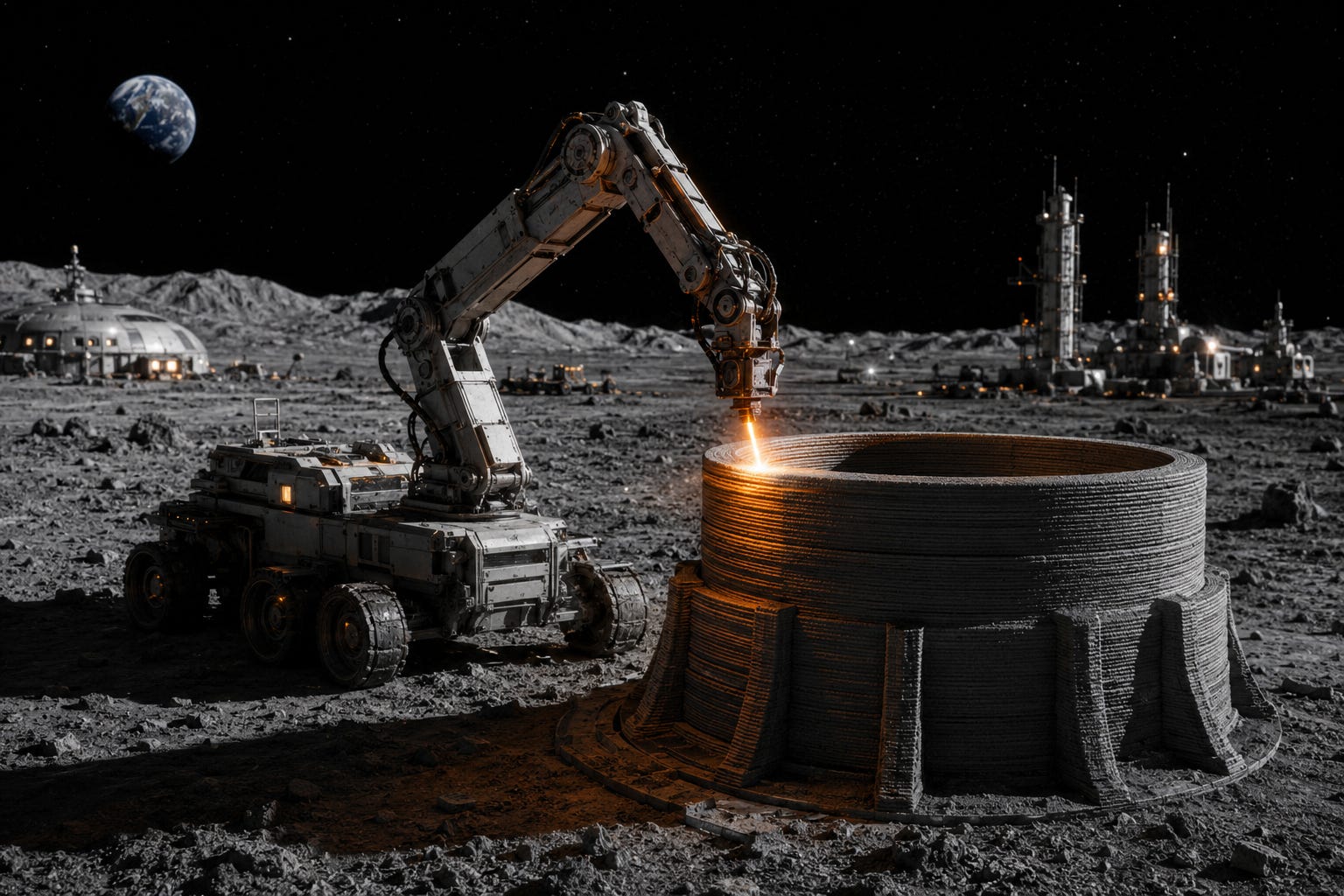
The true magic happens when we stop shipping supplies from Earth and start manufacturing them on-site. The moon is covered in a fine, abrasive powder called regolith, which is traditionally a nuisance because it ruins space suits and jams machinery. However, futuristic lunar factories will soon use automated mirrors to bake this dust into solid bricks, effectively using the moon to build its own landing pads and habitats. Furthermore, deep inside the permanently shadowed craters of the lunar poles lies billions of tons of water ice. This ice is not for drinking; it is raw rocket fuel waiting to be harvested. By splitting water into hydrogen and oxygen, the moon transforms from a barren rock into the premier refueling depot of the twenty-first century.
Building this infrastructure is not just a triumph of engineering; it is an act of profound human audacity. We are constructing an entire economic ecosystem in a vacuum, proving that our species is finally outgrowing its cradle. It is tedious, incredibly difficult, and wildly expensive work. But once those celestial highways are open, those fuel depots are stocked, and the lunar Wi-Fi is up and running, the moon will no longer be the finish line. It will simply be the place where we stop to stretch our legs before heading out into the rest of the universe.